Sierra snowpack arrives with storms — but first survey shows Northern California lags
California’s just-in-time Christmas gift — a pair of early-season storms that blanketed the Sierra Nevada — delivered a welcome boost to the state’s snowpack, though water managers Tuesday at Phillips Station found the first survey totals below where the snowpack stood a year ago.
The Department of Water Resources’ Dec. 30 measurements show the snowpack improved but remained uneven across the state. The Southern Sierra neared average for this time of year, while the Northern Sierra — source of much of California’s water supply — remained well below normal.
Statewide, snow-water equivalent was averaging 6.5 inches, putting California at 24% of the April 1 average and 71% of normal. That’s up from just 5% and 44%, respectively, from Dec. 1, but behind last year’s stronger early-season showing of 39% of the April 1 target and 115% of the daily norm.
“As a state, 24 percent ... is still only about a quarter of what we’re looking for,” said Angelique Fabbani-Leon, who directed Tuesday’s survey. “We’re going to be really looking forward to additional storm systems, especially during that January through March period. It’s still early in the season, and there’s time to catch up”.
At Phillips Station near Sierra-at-Tahoe in El Dorado County, water managers in snowshoes trudged through fresh powder for the first manual measurement of the water year, which started Oct. 1. But just two weeks ago, much of the site — like much of the Sierra — was “just complete bare dirt,” as one DWR spokesperson put it during the event that will repeat monthly through the winter and early spring.
“Just a week and a half ago, this ground was bare ground,” Fabbiani-Leon said. “And the statewide snowpack was at 12% of average after an initially dry start to December. The series of storms over the past week increased our snowpack significantly.
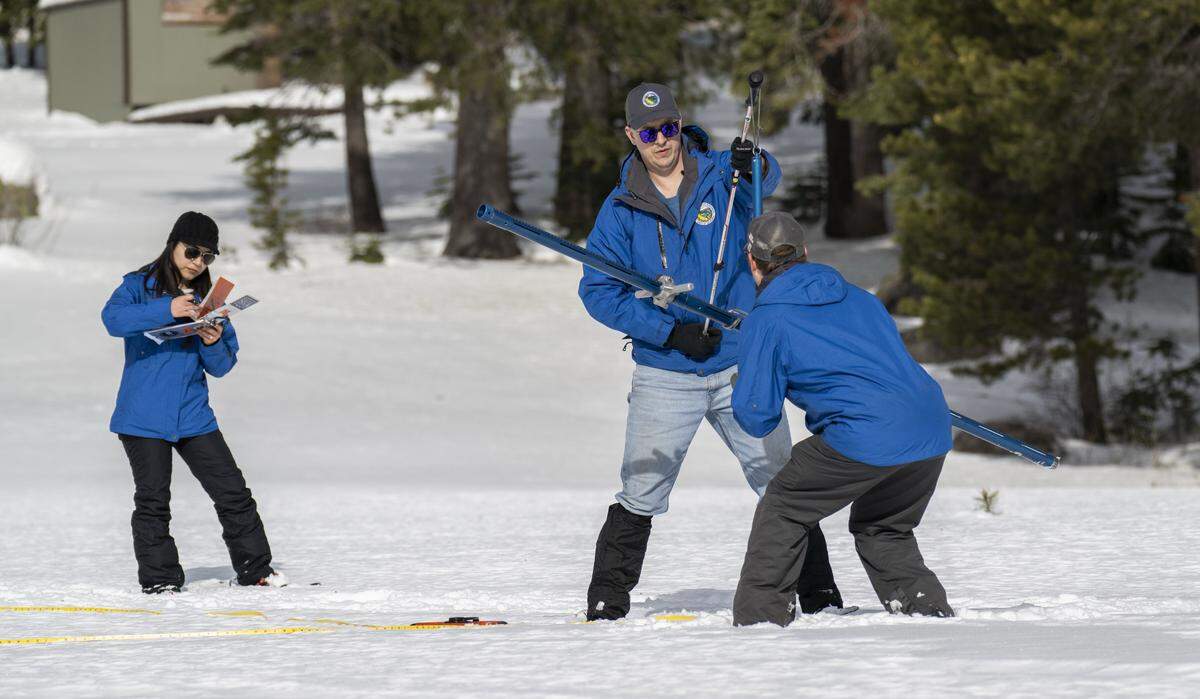
“Although this didn’t catch us up completely, it has put California in a much better place in terms of our water supply,” she said.
Statewide as of Tuesday, snowpack across the state registered at 24% of the April 1 average and 71% of the daily normal, according DWR gauges. That’s down significantly from Dec. 30, 2024, when readings showed 39% of the April 1 average and 115% of the normal for the date.
Sierra snowpack by the numbers
In the Northern Sierra, conditions have improved since the start of the month but remain well below normal. As of Tuesday, the region that covers the upper Sierra and Cascade and Trinity ranges measured just 4.4 inches of snow water equivalent — putting it at 17% of the April 1 average and 51% of the daily normal.
In the Central Sierra, including the Tahoe and Yosemite regions, snow totals are nearly double where they were Dec. 1. Snow water equivalent was recorded at 7.1 inches on Tuesday, translating to 25% of the April 1 average and 72% of the daily normal. On Dec. 1, those figures were just 4% and 33%, respectively.
Still, it’s a slower start than last year, when the region posted 36% of April 1 average and 103% of normal on the same date.
At Phillips Station, specifically, snow depth was at 24 inches and snow-water content was 5 inches, Fabiani-Leone said, 50% of average for Dec. 30 and 21% of the April 1 target.
“This past week definitely helped us,” Fabbiani-Leone said.
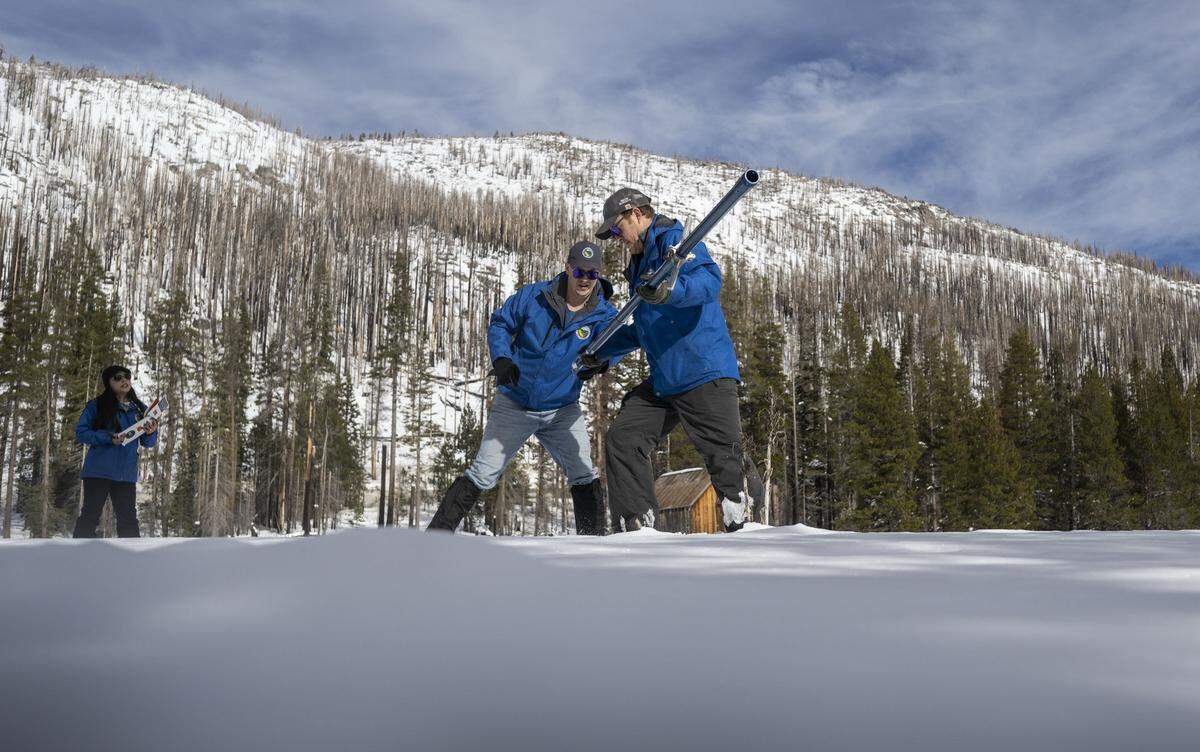
The Southern Sierra continues to lead the state in early-season accumulation. With 7.9 inches of snow water equivalent, the region now sits at 31% of the April 1 average and 94% of the daily normal. That’s nearly triple where it started the month, at just 11% of April 1 average — but already a near-normal 96% of daily normal — on Dec. 1.
“It’s still pretty early for the water year and our winter season,” Fabbiani-Leone said. “The conditions in the coming months — especially January all the way through the end of March — are really going to be telling and determine how our snowpack is ultimately going to be for our water supply in the spring and summer.”
Reservoirs remain healthy
California’s reservoirs remain in stronger shape. Most of the north state’s major reservoirs are running well above average for this time of year, with Shasta Lake, the primary federal supply, impounding 72% of capacity — 123% of its historical average — as of Tuesday.
Lake Oroville, the state’s main storage bank, is at 68% capacity and 127% of average. Folsom Lake sits at 56% capacity and 136% of average, with water managers releasing flows to make room for recent runoff. Trinity Lake is at 79% capacity and 132% of average. And San Luis Reservoir, a key piece of the State Water Project in the San Joaquin Valley, is at 68% capacity and 110% of its historical average.
Despite that, the snowpack’s modest start may complicate the forecast for California’s water supply, which is built on the expectation that hefty, cooler winter precipitation will add up as mountain snow to feed about one-third the state’s water users, mainly in the south state.
“Ideally, we would like to get our snowpack to reach our April 1 average,” for the state’s water supply, Fabbani-Leon said.
“We’re close to being there, (but) not quite. We’re really going to be looking into the storm systems that we receive in the coming months to get us to our April one average.”
In a Dec. 11 assessment, the National Oceanic and Atmospheric Administration found that “snow drought” conditions were most severe across California’s Sierra Nevada.
Climate change has intensified the state’s weather extremes — bringing warmer, wetter storms and drier dry spells, often with little warning — and this year’s early-season snow readings add fresh uncertainty to what has become a volatile supply picture.
“Rain across the West increased soil moisture and reservoir levels. However, the continued above-normal temperatures forecast across the West may worsen snow drought conditions,” it predicted, while adding that snowpack can “change dramatically with a single storm this early in the season.”
Storms hitting California have been warmer
Ahead of winter, scientists had predicted above-normal temperatures for California this winter, from December through February. While a single season is difficult to attribute directly to climate change, warming temperatures are part of a long-term trend affecting the state, experts say.
“Temperature is a huge factor in terms of our snowpack,” Fabbani-Leon said from Phillips Station. “We did have some incoming storm system and precipitation, but it does need to be cold enough to retain it as snowpack. So it is a huge factor, and we’ll be looking for more storm systems that come in cooler to help add more to our water supply”.
What was “unusual” about Tuesday’s snowpack was how delayed the accumulation took place, water officials said, including State Climatologist Michael Anderson, because the season’s unusually warm temperatures and high freezing levels caused much of the precipitation to fall as rain instead of snow until a recent cold front finally lowered freezing levels enough for snow to begin accumulating.
Daniel Swain, a climate scientist at University of California Agriculture and Natural Resources, previously explained to The Sacramento Bee that small temperature increases have big snow impacts, shifting precipitation from snow to rain.
Even if we get the same amount of water overall from rain rather than snow, Swain said, California’s water infrastructure depends on snowpack acting as natural storage, holding the equivalent of multiple storms in the mountains and releasing it gradually in spring and summer, especially during dry periods.
“So instead, we get this big pulse of water all at once, and it’s much harder to store it for later use during the dry season,” Swain said.
“The same amount of water coming as rain rather than snow means that the soil dries out earlier in the summer, so you have a longer fire season (and) you have less water to replenish water supply,” he said.
More storms will be needed
The early-season reading comes on the heels of one of the most hydrologically productive three-year stretches California has seen in a generation. In 2023, the statewide snowpack ended at 237% of normal after record-breaking atmospheric rivers soaked the Sierra. The following year, in 2024, snowpack finished just under average — 96% of the April 1 norm — still enough to keep reservoirs full and water deliveries steady thanks to carryover storage.
But those results can still be uneven over the next four months.
In 2023, for example, the statewide snowpack was just 28% of average on Jan. 2. But back-to-back atmospheric river storms in January and March helped push the snowpack to 111% of average by April 1, capping off one of the wettest seasons in recent memory.
But water managers remain cautious, pointing to recent winters that have swung dramatically from wet to dry. In 2022, a promising start to the season fizzled into drought as storms dried up by mid-January — the snowpack dropped from 150% of average in early January to just 37% by April 1. The year before that, 2021, had also ended in severe drought conditions.
DWR officials stressed that what truly matters is where the snowpack stands on April 1 — the point when California typically locks in its peak water supply from snow. Even a strong December can be misleading, while a single March storm can turn a dry winter around.
“The critical thing to remember about our snowpack is that conditions can change throughout the season,” Fabbani-Leon said. “Our reliance on atmospheric rivers and winter storms — based on their timing, duration and location — can make the difference between a wet and dry year for California.”
The state is expecting a series of storms starting on New Year’s Eve, Fabbani-Leon added.
Despite the modest start to the snow season, drought is not currently a factor across most of California.
According to the U.S. Drought Monitor, updated Dec. 25 by researchers at the University of Nebraska-Lincoln, no part of the state is experiencing official drought conditions. Still, roughly 12% of California is categorized as “abnormally dry” — the least severe level on the scale. Those areas include a slice of the state’s extreme northeast corner, which missed the brunt of recent atmospheric river storms, and areas around San Diego.
This story was originally published December 30, 2025 at 11:59 AM.