New details emerge in deadly Sierra avalanche, but key questions may never be answered
On Feb. 17, the morning that fifteen skiers and snowboarders set out from Frog Lake huts in a bid to exit the backcountry before travel became impassable, snow was falling with an intensity that impressed even veterans of Donner Pass’s furious snowstorms.
Through the morning, snow accumulated at a rate of roughly four inches each hour. Snow piles grew even faster where strong winds had swept the powder over ridgelines and deposited it on north-facing slopes.
Among those slopes was Perry’s Peak, an 8,260-foot summit that rises up from Frog Lake and the cozy, well-appointed huts where the group had spent the previous two nights.
That morning, the skiers crossed the ridgeline east of Perry’s Peak, taking the long way around a narrow notch lined with steep cliffs that the group’s four professional mountain guides saw as too dangerous given the avalanche risks, according to an account two men on the trip would later give The New York Times.
Those two men were inexperienced backcountry travelers who had booked the guided adventure to more safely explore skiing’s wilder side, according to The Times. They were joined on the trip by a third as yet unidentified male client.
At Frog Lake, they shared lodging and ski runs with a group of eight women, longtime friends and veteran backcountry skiers with children whose comfortable lives – many appear to have split time between Tahoe homes and the Bay Area – were enlivened by a love of the mountains and quest for outdoor thrills.
All of them had paid more than $1,000 to Blackbird Mountain Guides for their two-night, three-day ski trip. To lead the 11 clients, the company – which had grown quickly, alongside the sport of backcountry skiing, since its founding in 2020 – sent four guides.
The guides were transplants from Florida, Vermont and Ontario, Canada, who’d moved to the Tahoe area to pursue mountain lives. They had varying levels of experience but, according to Blackbird, all had certification through the American Mountain Guiding Association.
On Tuesday, those guides led the group out of the huts with urgency. But the going was slow, the two men recounted. Breaking a trail through deep, fresh snow – and by Tuesday morning, as much as 3 feet had fallen – is brutal work. Groups usually switch out the lead skier often to avoid exhausting one person.
After descending the ridgeline, the group turned southwest. They traveled up a drainage, seeking ground they knew wasn’t steep enough for the snow to give way beneath their feet.
But their path took them too close to one side of the valley – too close under Perry’s Peak. Up there, where the snow had piled up overnight and through the morning, the slope angle was more than enough for an avalanche to be triggered in that type of storm.
The avalanche ran out for 400 feet.
Only six people survived it. That even that many emerged alive is the result of the survivors’ determination in the harrowing moments after the avalanche. Two people who weren’t buried in the snow rushed to uncover their companions before they asphyxiated, rescuing four people before they ceased digging and turned to keeping two injured skiers, and themselves, alive amid the blizzard.
Had the two unburied skiers — one a guide, and one a client, who told The Times he’d struggled with a ski binding — not fallen behind the group, the death toll could have been even worse.
In the immediate aftermath, questions swirled around why the group was skiing in such conditions at all. As more information about the trip emerged, the questions have narrowed: Why did the guides pick their route out of Frog Lake huts, when safer but longer routes existed? And having chosen that route, why did they ski so close to Perry Peak?
“A group of thirteen people were put under an avalanche slope during high avalanche danger and during a storm and there’s a lot of questions on how that came to be,” Dave Miller, the owner and director of International Alpine Guides, also based in the Tahoe area, told The Bee.
Buried evidence
Investigators say they may never know what triggered the slide.
It’s possible, given what forecasters know about the snowpack that day, that the movement of the group caused a collapse in the snowpack that shot uphill from where they traveled, bringing the snow down upon them.
“The trigger, slab thickness, depth, width, and other details of the avalanche remain unknown and may never be known, as the storm buried the evidence under additional snow,” the Sierra Avalanche Center wrote.
Backcountry skiers do travel and ski amid storm conditions. They try to do so while avoiding terrain where avalanches are possible. And though the guides took the riskier route out, topographic mapping indicates it was possible to thread the danger zones. But somehow they failed to.
Avalanche safety protocol calls for skiers to spread themselves out when crossing terrain where an avalanche might slide, whether underfoot or down from above. The two survivors told The Times that at other moments the guides had spread the group out that way. When the avalanche caught them, though, sheriff’s officials said the group was bunched together – meaning they either didn’t realize they were in avalanche terrain at that moment, or had neglected that protocol.
The Nevada County Sheriff’s Office is conducting an investigation into possible criminal negligence. Cal-OSHA has opened a workplace safety investigation. Both the company, Blackbird Mountain Guides, and the families of the six clients who were killed have hired a public relations firm.
Blackbird has not responded to requests for comment, including to its PR firm. The company’s last public statement was on Feb. 21, grieving the deaths of both guides and clients. “Those who lost their lives were deeply loved family members, friends, partners, and valued members of the broader mountain community,” it said.
The Sierra Avalanche Center has issued a partial accident report, but has not yet published a detailed accounting of the choices the group made. Such reports are used by avalanche safety researchers and instructors to try and avert future tragedies.
The law enforcement investigation, the involvement of a guiding company and the high public interest have all complicated that process, Sierra Avalanche Center education director Wendy Antibus told The Bee. It remains unclear how much more information the center will be able to acquire.
The oncoming blizzard was well forecast, as was the avalanche danger it would bring.
The huts where the group stayed offer internet connectivity, according to marketing materials and one of the survivors’ accounts. On Monday, one of the guides uploaded to Strava, the website where skiers, cyclists and runners upload GPS maps of their routes, showing they had skied low-angle terrain near the huts.
At Blackbird, “guides in the field are in communication with senior guides at our base, to discuss conditions and routing,” the company’s founder, Zeb Blais, said in a Feb. 18 statement.
Still, there’s no official word on whether the guides leading the trip had read, or been made aware of, of a stark warning published by the Sierra Avalanche Center at 5 a.m. that morning.
“Avalanches could be triggered from very low on the slope in some areas,” the center wrote. “Avalanches from above could travel down through treed terrain, often thought of as ‘safe’ during storms. Travel in, near, or below avalanche terrain is not recommended.”
On both Monday, when planning the day’s ski runs, and Tuesday, when planning their exit, the guides met in a room separately from the clients, the two survivors told The Times. On Tuesday, they emerged from that meeting saying the group needed to head out quickly.
Straying to one side?
In the backcountry skiing community, both in Tahoe and nationwide, the tragedy – and the intense media scrutiny – has drawn a mix of reactions. Many have urged restraint from judgment.
“We all want to know, well, this happened for this reason, and that’s what we do with every kind of disaster,” Sara Boilen, a psychologist and snow safety researcher, told The Bee. “But the reality is, things also just compile and go really, really wrong. And this seems like something that went really, really wrong. Despite their best intentions.”
The valley where the avalanche caught Blackbird’s group was formed by gentler slopes to the west across from Perry’s Peak. Miller, the ski guide, noted the ultimate fatal mistake may have come down to angling slightly too far toward the eastern side.
“That’s my biggest question,” Miller said. “Not so much that they went that way, it’s why did you stray under that side of it? Why did they not give it a wider berth?”
That answer, observers have noted, may never become totally clear because the guides skiing in the lead are dead.
When traversing over ridges and up drainages, cautious backcountry skiers check the angle of slopes around them using a tool called an inclinometer.
Backcountry skiers of an older school often keep one attached to their ski pole. Increasingly, people use digital mapping apps on their smartphones that allow the user to overlay slope angles as colored shading on the map – the darker the coloring, the steeper the slope and higher the avalanche risk.
Investigations into previous avalanches have raised questions about the growing use of those maps, which may miss small nuances in slope angle or terrain that increase avalanche risk beyond what the shading might imply. Those risks are elevated if the maps aren’t paired with a close look at the terrain one is actually traveling through – something that could happen during the blinding snow of an intense blizzard.
During such storms, Miller said he keeps his phone in his hand because he’s checking his location on topographic maps continuously.
Although they don’t know what triggered the avalanche, Sierra Avalanche Center investigators did publish a key measurement – the slide’s alpha angle, or runout angle. That measurement calculates the angle from where the avalanche started to where the runout ends.
Skilled backcountry skiers calculate alpha angles to ensure they’re staying far enough away from a steep slope that an avalanche can’t reach them. Most snow safety literature suggests keeping to a 20-degree alpha angle will protect one from avalanches even on storm days, Bruce Tremper, the author of what many in backcountry skiing consider a foundational book in the field, “Staying Alive in Avalanche Terrain,” told The Bee.
Around 95% of avalanche accidents in the U.S. involve people within a runout angle higher than 20 degrees.
But, he added, when it comes to avalanches it’s “really hard to talk in absolutes.” What’s safe changes from one mountain range to another, and from day to day. Amid a major storm like this one, it may change from hour to hour.
“Unusual weather makes very unusual avalanches,” Tremper said.
Where does an avalanche stop?
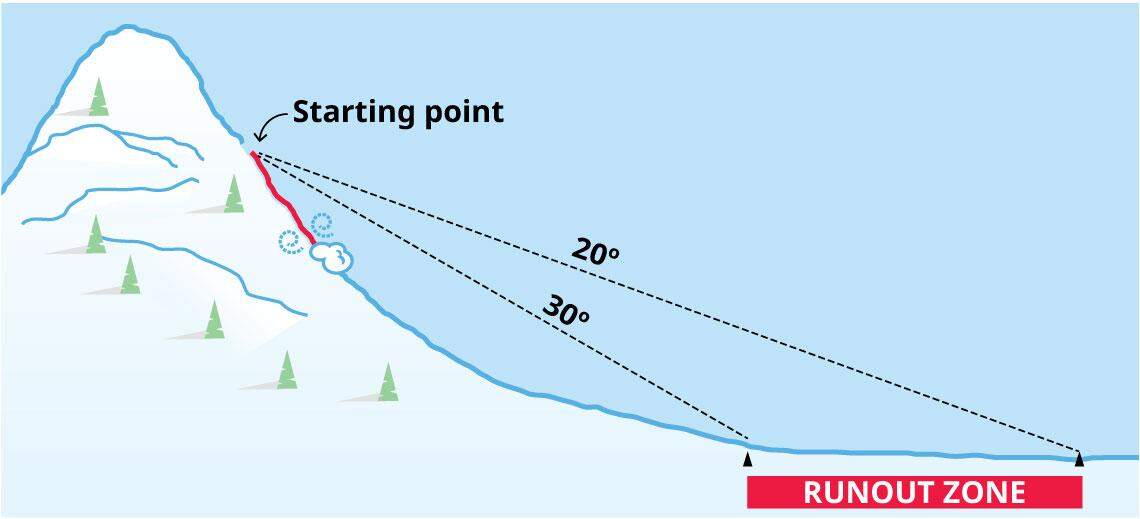
Source: Bee research. Graphic: The Sacramento Bee
Investigators put the area where the bodies were buried at a 22-degree alpha angle from where the avalanche began – not far off from the safe zone described. But when they calculated the alpha angle using their maps, as opposed to measuring the terrain they could see in front of them in the clear days after the storm, they put it at 25 degrees – a less safe runout angle to travel.
The skiers may have been caught closer to the avalanche zone.
The bodies were found packed under 8 feet of snow in a small depression ringed with trees and boulders, the Sierra Avalanche Center reported. They were buried together within a roughly 20-square-foot area. The avalanche likely carried them there, but how far is unknown.
In their account to The Times, one of the survivors who saw the avalanche rushing toward him said he saw colors in the snow that he believes were the skis and clothing of skiers being washed along.
Experts offered different possibilities for why the skiers traveled too close to the steep slopes of Perry’s Peak. The guides picking the route could have known where they were but believed they were outside the reach of an avalanche. Or, amid the blinding snow, the exhausting work of breaking trail and the mental labor of keeping fifteen people on track in dangerous conditions, the guides and clients lost track of where they were, if only slightly.
“It’s a mistake in these avalanche accidents to point fingers until we get all the information in,” Tremper told The Bee this week. “I don’t think it is all in because we don’t really know the decision-making process.”
This story was originally published March 9, 2026 at 10:36 AM.