
Punjabi artwork finds American, agricultural ties at Sutter County Museum
AI-generated summary reviewed by our newsroom.
- “Beyond the Five Rivers” exhibits Sarabjit Singh’s art at Sutter County Museum.
- Singh’s exhibit traces Punjabi immigration, agricultural ties to Sutter and Yuba counties.
- The show — through May 9 — highlights Punjabi integration challenges.
Through art and abstraction, a new exhibition reveals the rich history of a culture deeply entrenched in the farmland and people of Sutter County.
“Beyond the Five Rivers: Punjabi Pioneers Through the Art of Sarabjit Singh” is showing at the Sutter County Museum through May 9, with support from the Punjabi American Heritage Society. A free reception with the artist takes place from 5-7 p.m. Friday, April 17 at the museum.
Bay Area artist Sarabjit Singh put together the show with her artwork on Punjabi and Punjabi American history and culture, stretching through early immigration from the Indian region to the U.S. into the agricultural legacy that remains in California farm communities, such as those in Sutter and Yuba counties.
“Punjab,” which translates to the “land of five waters or rivers,” has a rich agricultural history from which many brought talent and knowledge when immigrating to the Central Valley. Understanding the history of Sutter County requires knowing the influence of the Punjabi diaspora, most of whom are Sikh, in the growth of the agricultural area.
“We were really excited that (Singh) wanted to bring this exhibit here because it’s just a perfect fit for our community and a good opportunity for people to learn more about the history,” said Molly Bloom, Sutter County Museum director. “And it’s a topic that’s very much of interest to a lot of people, we’re regularly asked to do more programs on different cultures in the community.”
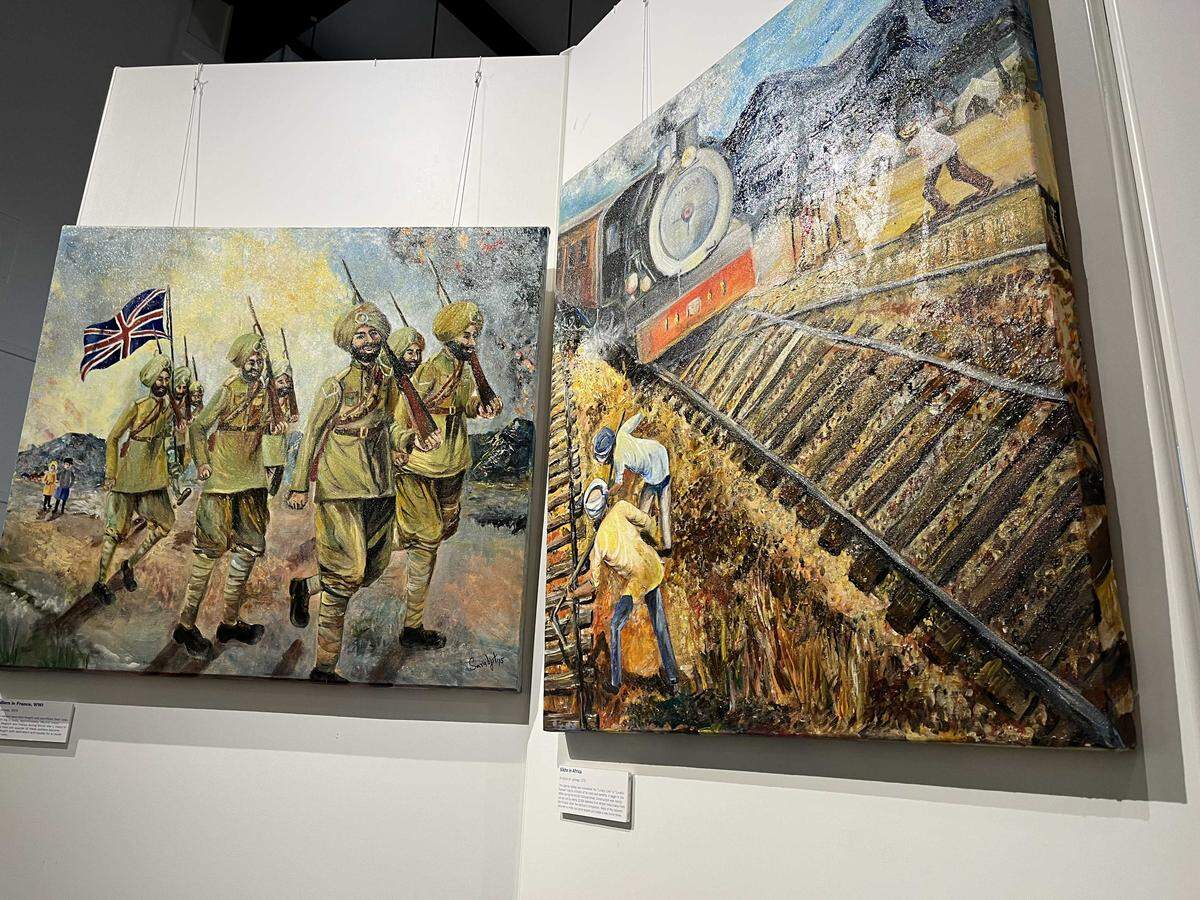
The artwork spans the challenges of integration into the U.S., the 1947 partition separating what are now India and Pakistan, and depicts soldiers who fought in World War I and laborers brought to Africa to work on railroads who later settled there, among other stories and themes.
“I think some of these stories might not be as familiar to people when it comes to the history,” Bloom said.
The collective exhibit echoes themes of resilience, diligence and opportunity that resonate through the history of the Indian region and those who spread its cultures throughout the world.
Punjabi influence in Yuba-Sutter
Walking through the doors of the Sutter County Museum, visitors encounter a painting, hoisted on an easel and still in progress, representing the lineage of the Punjabi Mexican families, many of which hail from the Yuba-Sutter area.
That work is not far from a rug woven by the artist’s great-grandmother as a wedding gift to the artist’s parents. The rug is displayed near a painting of the newly-wed couple.
From its perch on a bench, next to which attendees can sit and pose, a large paper-mache-and-cloth doll oversees the exhibit.
With colors that pop throughout, Singh employed a range of mediums when assembling the Sutter County exclusive.
“This is a historical museum, and mine is also historical-based art, so I think it was a perfect fit for that reason,” Singh said.
Punjabi immigrants faced challenges when integrating into California farm communities in the early 1900s, accentuated by laws that restricted immigration from Asia, closed paths to citizenship and barred noncitizens from landownership.
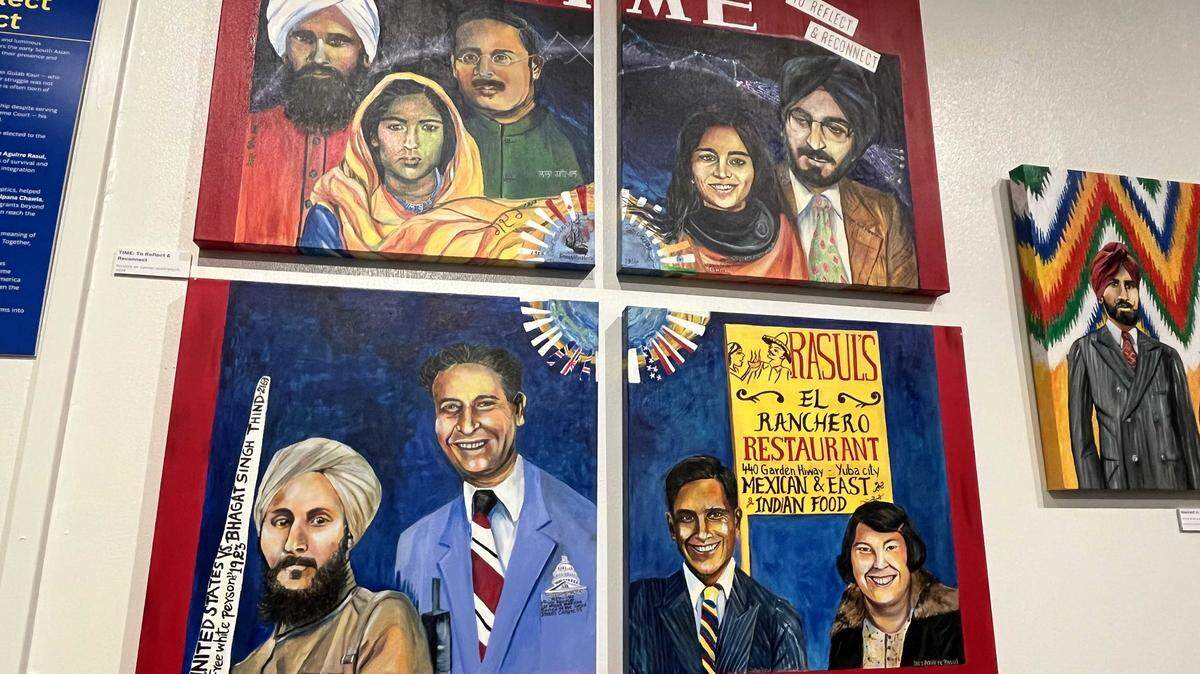
Marriages between Punjabi men and Mexican women at the time blended the cultures, and cuisines, resulting in a rare culinary combination. El Ranchero in Yuba City, which is no longer around, served a mix, and sometimes fusion, of Indian and Mexican dishes. Its owners are depicted in a four-panel piece showing Punjabi pioneers as cover models for Time Magazine.
That homage exemplifies the local connections to the temporary exhibit, and an unheralded piece of California history that retains roots in the region.
“Some of the people’s descendants are still living there,” Singh said.
Peace through art
Singh, a first-generation immigrant settled in the Bay Area for more than 30 years, has been an artist her whole life. But the purpose of her art shifted after the events of 9/11, as the fabric of American identity was tested, and some groups, such as Sikhs, particularly those wearing traditional turbans of the faith, faced cultural discrimination and misunderstanding.
“These were the things that show that people still don’t know much about us, and it was time for some people around us, the media and everybody, to know the stories of the people who are living in this country,” Singh said.
She studied Punjabi history to then share it through her art, capturing moments in time that illustrate history foreign to many who live in the California communities it influenced. Those moments, and the lessons they share, show through the pieces displayed inside the Sutter County Museum.
“We’re not isolated from each other, we’re all connected, in one way or another,” she said.