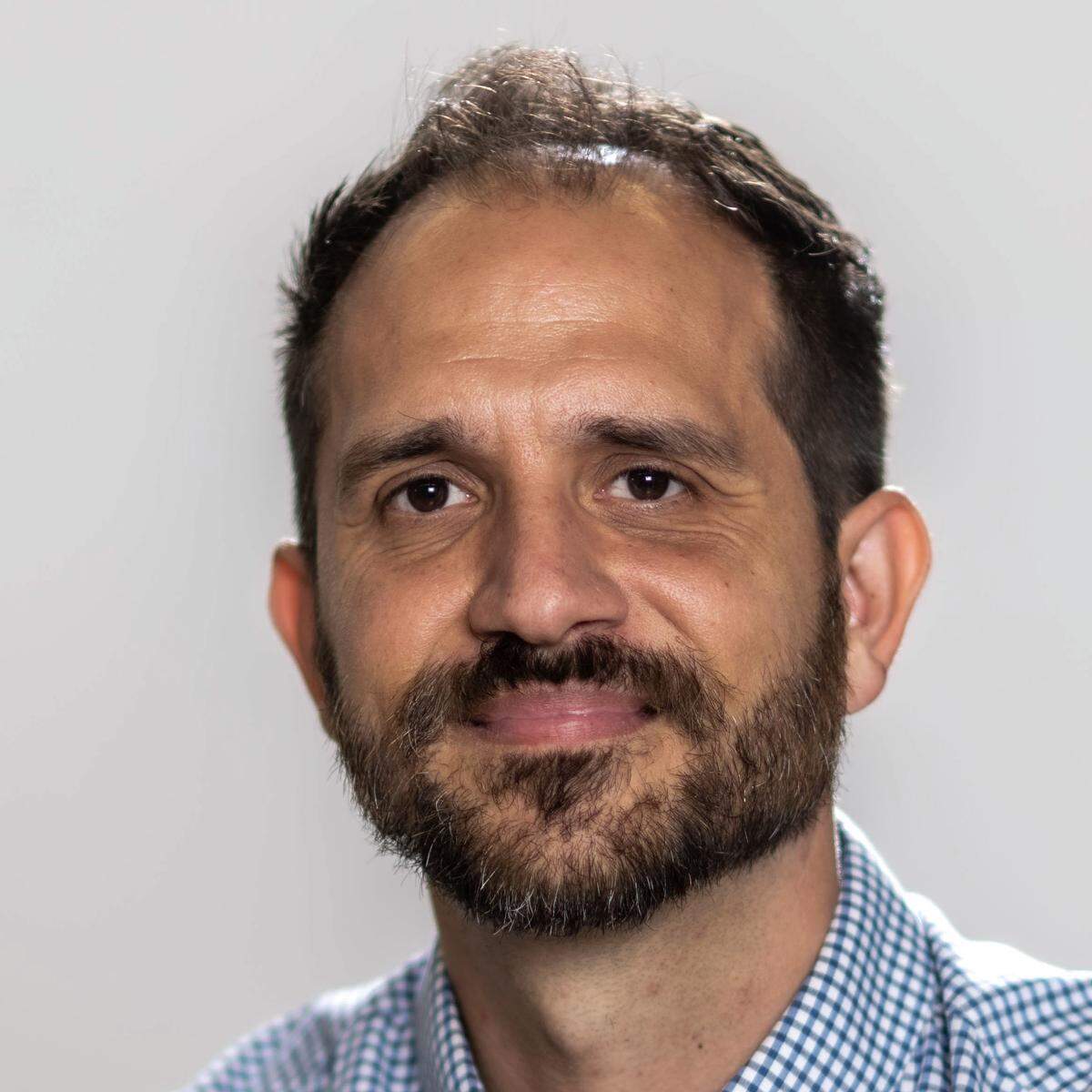
Meet Sacramento’s new city historian, a longtime leader of state railroad museum
Ty Smith’s ability to make the improbable happen goes back to his days as a community college student.
Smith, 49, starts Monday as Sacramento’s new city historian following a nine-year run as director of the California State Railroad Museum in Old Sacramento. Previous city historian Marcia Eymann retired in April 2025.
Years ago as a student at Cuesta College near San Luis Obispo, Ty Smith helped his school host the California Indian Conference in 1999.
“We were sort of younger and maybe naive and we volunteered Cuesta to host it kind of without the knowledge of our professors,” he said. “It was audacious because we were the first community college to host the California Indian Conference.”
Now Sacramento could be in position to benefit from Smith’s audacity. Known in part for his success at the railroad museum, Smith might prove instrumental in a long-term project to combine the Center for Sacramento History and the Sacramento History Museum.
Ty Smith’s background
Dennis Judd remembered the night he met Ty Smith.
Judd is a retired Cuesta College professor and taught Smith in an introductory U.S. history course about 30 years ago in Smith’s native Paso Robles. “He kind of gave me a hard time as we walked out that evening in saying that I was not dealing with Native America to the degree he had hoped,” Judd said.
For Smith, the issue is personal. He is an enrolled member of the Choctaw Nation of Oklahoma, with his father’s parents coming from Caddo, a small town in that state. “I learned history first sitting at the foot of my grandmother, who wasn’t a historian but exuded it through her lived experience,” Smith said.
Judd and another now-retired Cuesta professor, William Fairbanks, invited Smith to attend a California Indian Conference. This inspired Smith and other students to lobby to bring the conference to Cuesta.
“I would say to Ty, ‘You got me into a lot of trouble,’” said Fairbanks, who is now 89. “And then he would respond, ‘Yeah, but I got you out of it, too.’”
After Cuesta, Smith went to Cal Poly, San Luis Obispo for a bachelor’s degree in history, Sacramento State for a master’s degree in public history and UC Santa Barbara where he earned a doctorate in public history.
“Ty brought a sense of maturity,” said Dan Krieger, one of his professors at Cal Poly. “I think he was working almost full-time at the time he was my student and I knew it was a struggle for him. But he was doing the best he could. And in conversations with him, I could tell a love of history that you don’t always see in students.”
At Sacramento State, Smith overlapped with John Fraser, who would later supervise Smith’s direction of the railroad museum. The museum is part of the Old Sacramento State Historic Park. Fraser serves as superintendent for the Capital District of California State Parks, with district offices located near the museum.
“Largely the museum before Ty was there emphasized very heavily the technology, the machinery and the equipment of the railroad,” Fraser said. “Ty really transformed it into a place that focused on the people behind the railroad.”
The museum had 217,771 visitors last year. Its attendance peaked in 2019 at nearly 250,000 visitors, a figure it hasn’t been able to match since the COVID-19 pandemic. This isn’t unique to Sacramento, with Smith noting that an American Alliance of Museums survey found that 55% of museums report decreased traffic.
But the number of annual school visitors to the railroad museum is now more than 50% higher than it was pre-pandemic. Smith said this was the result of deliberate strategy by the museum. He also said there were other ways people were engaging with the railroad museum’s programming.
“There are a number of people who just go on the excursion train and that to me indicates that there is more of a museum without walls,” Smith said.
How Smith could showcase Sacramento’s history
Smith’s work with the railroad museum caught the eye of Megan Van Voorhis, the city’s director of convention and cultural services.
A news release about Smith’s hiring noted that Sacramento’s historian serves both as steward of the city’s “historical collections and a civic leader helping shape how the city preserves, shares and connects its history to education, culture, tourism and community identity.”
How history is presented to the public could be changing in Sacramento in the years to come, putting Smith and his unique experience in a position to help.
The Sacramento History Museum has more than 1.2 million Facebook followers. But its physical space, just down the street from the railroad museum, is small. The Sacramento History Alliance operates the museum for the city.
“I think what we both recognize is that we really need a larger platform than what we have at the current site,” Van Voorhis said.
In the River District, the Center for Sacramento History offers a fascinating array of historic papers, such as the collection of civil rights attorney Nathaniel Colley. There are artifacts that include the shovel of landlady Dorothea Puente, infamous for poisoning tenants of her boarding house and having them buried in her yard on F Street.
But the center, as currently designed, is a research and preservation facility. It sits in nondescript office space near Richards Boulevard, is open by appointment and has capacity to accommodate only a small amount of visitors at a time. “The Center for Sacramento History definitely has significant challenges that we’re aware of,” Van Voorhis said.
There is the possibility of the Center for Sacramento History and the Sacramento History Museum joining forces. Van Voorhis said that when the city renewed its agreement with the Sacramento History Alliance in October, it discussed the possibility of putting the center and the museum in the same space.
“I think we’re excited about figuring out what that partnership could really yield in the future by way of a potential new building and a new site for co-location,” Van Voorhis said.
Van Voorhis said the project was still in its early stages and that it might take a decade to be completed. She said Smith could play a key role in the effort.
“I think his background uniquely suits him,” Van Voorhis said. “He’s been an educator. He’s been a museum director. He’s lived on a lot of different sides of this. And all of those things are really important as we try to gain momentum to see if we can get something done.”
People who knew Smith early on, like his Cal Poly professor Dan Krieger, are optimistic for him as he settles into his new role as Sacramento city historian.
“I know it’s a difficult role, but Ty knows how to facilitate things,” Krieger said. “So he’ll be a great builder.”