Sacramento County supervisors restore some sheriff, DA funding in new $9B budget
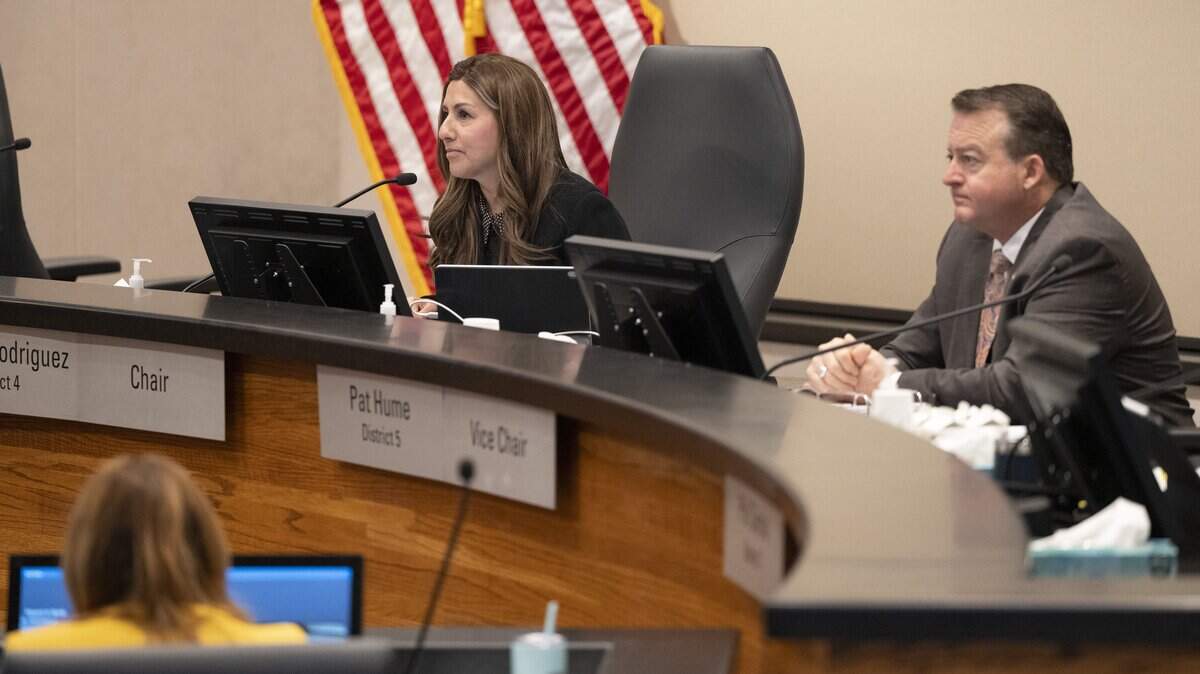
The Sacramento County Board of Supervisors approved a proposed $9 billion budget Wednesday that cuts $57 million from general fund departments, prompting warnings from the sheriff, district attorney and public defender that the reductions could undermine public safety.
Sacramento County’s recommended budget for the 2026-27 fiscal year fiscal year includes a $57 million reduction in spending for general fund departments, amounting to the elimination of 194.5 full-time positions. The cuts came as officials sought to manage a projected $101 million shortfall — the product of a long-term structural deficit and significant costs associated with HR 1, according to Amanda Thomas, the county’s chief fiscal officer.
HR 1, the federal budget and tax package passed by Congress and signed by President Donald Trump last year and better known as the One Big Beautiful Bill Act, shifts millions of dollars in costs to counties.
Under the proposed spending plan, 38 positions would be cut from the Sheriff’s Office, 15 from the District Attorney’s Office, and 11 from the Public Defender’s Office. While several of these positions are vacant to avoid layoffs, representatives said the reductions would nevertheless devastate public safety efforts. The county employs 12,897 workers in total, according to county officials.
“You expect me to do my job, but my hands are tied behind my back to do it,” Sacramento County Sheriff, Jim Cooper, said at the hearing. “I can’t operate this way.”
The Board of Supervisors voted 4-1 to approve the budget Wednesday. The final budget will be considered for adoption in September.
Fiscal pressures and the balancing act
The recommended budget for the 2026-27 fiscal year, released days before Wednesday’s workshop, included a 2.8% decrease compared to the last budget.
During an initial budget workshop in January, county officials directed all general fund departments to implement a 2.5% reduction in spending to manage an expected $101 million shortfall.
Thomas attributed the shortfall to the county’s reliance on a shrinking pool of one-time funding — consisting of unspent funding from the prior fiscal year — creating a long-term structural deficit. While tackling this deficit has been an ongoing, multi-year effort, changes on the state and federal levels this year have only amplified fiscal pressures, she said.
“As we look at our overall projected operating deficit, about half of that is attributable to HR 1 impacts,” Thomas said during the hearing.
Around $50 million in costs are expected to be imposed on Sacramento County under HR 1, according to Thomas. County Executive Officer David Villanueva further warned that the bill’s impacts will be “far worse in future fiscal years.”
Additional county cost obligations, including the Mays Consent Decree — requiring the county improve mental and medical healthcare for inmates — have also mounted spending. The decree drove a $100 million increase in net county costs, a significant proportion of which was borne by the Sheriff’s Office, Thomas confirmed.
To balance the budget, county officials outlined the $57 million reduction in discretionary spending, leaving just over $1 billion in discretionary revenues — referred to as net county costs — for the upcoming fiscal year. But representatives of the seven general fund departments affected by the cuts argued that the across-the-board reductions would disproportionately affect certain departments.
The county’s approved recommended budget totals $8.9 billion, including $4 billion in general fund spending, $3.2 billion in enterprise and special revenue funds, and $1.7 billion in restricted funds.
Cuts to public safety
Following a tense back-and-forth with the District Attorney’s Office, county officials restored $4.4 million in funding to the department, reducing proposed funding cuts from $8.5 million to $4.1 million for the upcoming fiscal year. The amount would eliminate 15 positions — 14 of which are currently filled.
“Right now, we’re already running on fumes,” DA Thien Ho said at the hearing. “We don’t have much depth to cut from.”
Ho urged the Board of Supervisors to restore his department’s budget, citing a “crushing” caseload and existing strain from unfulfilled personnel growth requests from the previous year. Ho added that eliminating vacant positions would remove entry-level jobs in the office’s misdemeanor bureau, creating a “cascading effect” of experienced staff shortages as prosecutors move around to absorb the workload.
“I may have to make some decisions about either not prosecuting certain crimes, whether they're drug offenses, whether they're thefts, or delaying them.” Ho added. “Across the board cuts may balance a budget, but at what cost to public safety?”
Sheriff Jim Cooper and Undersheriff Mike Ziegler echoed Ho’s concerns, urging supervisors to reconsider the proposed $13.7 million reduction to the Sheriff’s Office, which would eliminate 38 positions. They argued the cuts would inhibit the department’s ability to provide public safety services, particularly to residents in the county’s unincorporated areas.
According to Ziegler, 43% of the Sheriff’s Office budget is dedicated to complying with the Mays Consent Decree — a mandated expense that cannot be cut to meet spending targets. Another 32% supports field services, including responding to 911 calls. As a result, most cuts would fall on specialized units that do not fall under core operations, such as patrol and investigations.
Under the proposed spending plan, the department would eliminate the Problem Oriented Policing Team, or POP Team, Homeless Outreach Team, or HOT, Marine Enforcement Detail, or MED, Gang Suppression Unit, or GSU, and Identity Theft Bureau.
Cooper and Ziegler said the loss of the POP and HOT teams would increase demands on patrol deputies and lengthen response times. The Sheriff’s Office received 270,515 emergency 911 calls for service last year and averaged a response time of 14 minutes, 21 seconds — “well below the national average” and nearly four minutes longer than the Sacramento Police Department’s average response time in 2025, Ziegler said.
“If you have an incorporated city in your jurisdiction, they get a better level of service,” Cooper said. “If they call 911 their officers show up at half the amount of time waiting. That is not fair. That's not okay.”
The cuts would leave four deputies per square mile, down from the current 4.9 deputies per square mile, making “an already difficult geographic challenge even worse,” Cooper added.
Public skepticism and support
As Ho, Cooper and Ziegler urged supervisors to reject the cuts inside the board chambers, a coalition of Sacramento County residents gathered outside and advocated for the reductions, arguing they “don’t go far enough.”
Members of Decarcerate Sacramento and the Anti-Death Penalty Coalition handed out pamphlets arguing that county spending on the Sheriff’s Office, Probation Department and other carceral services has left housing, behavioral health services and prevention-focused programs underfunded.
“Instead of pursuing across-the-board cuts, the board should reduce the Sheriff’s and DA’s budget to enable increased funding for critical community programs and services,” the group’s agenda read.
Still, members of the public spoke in favor of funding what they described as the “trifecta of public safety” — the DA’s Office, Sheriff’s Office and Public Defender’s Office.
“The foundation of county government is public safety; everything else is built upon that foundation,” Greg Stuber, president of the Sacramento County Probation Association, said at the hearing. “When forced to make cuts, it should not start with your foundation.”
The Public Defender’s Office faces $3.3 million in cuts, including the elimination of 13 positions and the department’s post-conviction representation unit, juvenile pretrial support, and felony and misdemeanor mental health diversion programs.
“A functioning system of enforcement, prosecution, outreach is a basic building block of economic development and a foundational to the health and safety of our communities,” Michael Beller, an Arden-Arcade resident and representative of the Hardin House Alliance and Property Business Improvement District, said at the hearing.
Supervisors Rosario Rodriguez, Rich Desmond and Pat Hume voiced support for restoring public safety funding at the hearing.
“Public safety is the number one priority for me,” Rodriguez said, echoing Hume’s and Desmond’s commitments to restore funding for the HOT and POP teams.
After the hearing, the Board of Supervisors revised the recommended budget and restored approximately $9.9 million in funding. The restorations included $7.9 million for the Sheriff’s Office — specifically for HOT, Marine Patrol, gang suppression and identity theft units — as well as $1.37 million for the DA’s Office community prosecution positions and $649,076 for the Public Defender’s misdemeanor mental health diversion program.
The POP team would still be eliminated under the amended budget.
Rodriguez — the board chair who represents the county’s north and east tiers including Folsom, Citrus Heights and Elverta — remained the lone vote against approving the recommended budget.
The new fiscal year begins July 1, and the approved budget is expected to begin implementation in August. Members of the public will have another opportunity to comment on the budget before its final adoption in September.