
$10,000 for community service? How College Corps is helping Californians pay for school
Three years ago, Drew Dailey felt stuck. Working as a full-time carpenter, he had only completed a few community college credits. No one in his family had ever received a college degree.
But Dailey, 28, started to consider a future filled with more meaningful work, where higher education was possible. His hurdle was the high cost of entrance.
He started googling and networking with colleagues, asking around how he could find funds to attend school. Eventually, he came across California’s College Corps program.
In return for 450 hours of community service, he learned he could receive $10,000, academic credit and job experience. Dailey thought it was too good to be true, but he applied anyway.
He was accepted into Sacramento State’s cohort last year. The now-sophomore said it was the “big difference” that made attending college a reality for him last year.
Entering its third year, the state’s College Corps initiative offers students who participate in community service a debt-free route to college. As college becomes increasingly expensive for many Californians, the program aims to reduce higher education costs for thousands of student fellows enrolled each year.
How the first-in-the-nation program works
An early version of College Corps, called Civic Action Fellowships, initially launched in the fall of 2020. The pilot program included nearly 250 students at eight California colleges. California Volunteers received nearly $4 million in state and federal funds to establish the first program of its kind in the U.S.
It was “wildly successful,” according to California’s Chief Service Officer Josh Fryday, leading the state to allocate $300 million to establish a wide-scale version of the program from 2022 to 2026.
The program’s goals were straightforward — help low income students graduate with less debt while emboldening a new generation of students to solve community issues.
“We have a dual crisis in our society. We have a student debt crisis and we also have a crisis in our democracy where people feel very disconnected and feel divided.” College Corps planned to tackle both, Fryday said.
The program is a scholarship and internship rolled into one. College students from dozens of public and private campuses across the state work around 15 hours a week on service projects in their communities.
Students generally focus on one of three areas of need within a community: K-12 education, climate action or food insecurity. Past fellows have completed tree plantings and habitat restoration projects, served at on-campus food pantries, and completed one-on-one tutoring sessions to make up pandemic learning losses at local public schools.
Fellows receive up to $10,000 a year for participating. They get paid $7,000 during the school year through bi-weekly or monthly stipend checks. If students finish 450 hours of community service during the school year, they earn an additional $3,000 educational award.
Last year, Dailey put in hundreds of hours at the Health Education Council in Sacramento. He coordinated health events and food distributions.
The work was personally fulfilling for him. He said growing up food in his house was scarce. He was never aware that there were resources where his family could go to get free groceries.
While volunteering one day, he recalled two siblings under 10 who arrived at a food give-a-away without shirts or shoes and looked like their “souls were shattered.” They spoke no English, but Dailey said their faces beamed when he was able to put food into their hands.
“I just had that full circle moment of when I was a young kid needing help and being able to help these kids now,” he said.
In the two years since the program launched, more than 6,000 fellows have completed two million hours of service, according to a recent news release.
College funding for Dreamers
Undergraduate students who want to apply for the service program must qualify for either the Federal Pell Grant Program, Cal Grant Award or the Middle Class Scholarship to meet the financial need criteria.
Undocumented students who meet the criteria include AB 540 eligible Dream Act Students and Cal Grant B recipients. College Corps leaders said Dreamers were always included because it was the right thing to do.
“If we’re going to send a message that everyone has something to contribute, we need to create the opportunity for everyone to contribute,” Fryday said.
Last year, the program enrolled nearly 600 California Dream Act students and more than 2,000 first generation college students, College Corps said.
Many Dreamers do not qualify for federal scholarships and financial aid, including the Free Application for Federal Student Aid, making it increasingly difficult for these students to afford rising college costs. For the 2023-24 school year at Sac State, tuition, housing and food costs were estimated at nearly $24,000, according to the National Center for Education Statistics.
As a child, Wendi Lizola, watched her Spanish-speaking parents deal with a myriad of health issues. They struggled to communicate at doctor’s appointments and Lizola was often called on to translate. She was shocked by the lack of Latino representation in hospitals and started to envision a career in healthcare.
But as an undocumented first-year student at Sac State, she struggled to pay rent and tuition, let alone purchase school supplies, food and gas. The university’s nursing program seemed out of reach as she watched her finances plummet.
It wasn’t until Lizola, 21, heard about College Corps at her school’s Dreamer resource center that she saw a pathway to stay enrolled and housed on campus.
As a senior participating in her third year in the service program, she said College Corps had completely changed her career trajectory. She said the service program gave her the extra money to go after the career she really desired, one where she could help Spanish-speaking populations receive better healthcare in the U.S.
“I feel like it gave me a little more hope and confidence for us Dreamers that there’s help for us,” Lizola said.
For her service project, she chose to tutor middle-schoolers in mathematics. Last year, she switched to one-on-one online tutoring so she could focus more on her nursing program.
The future of College Corps
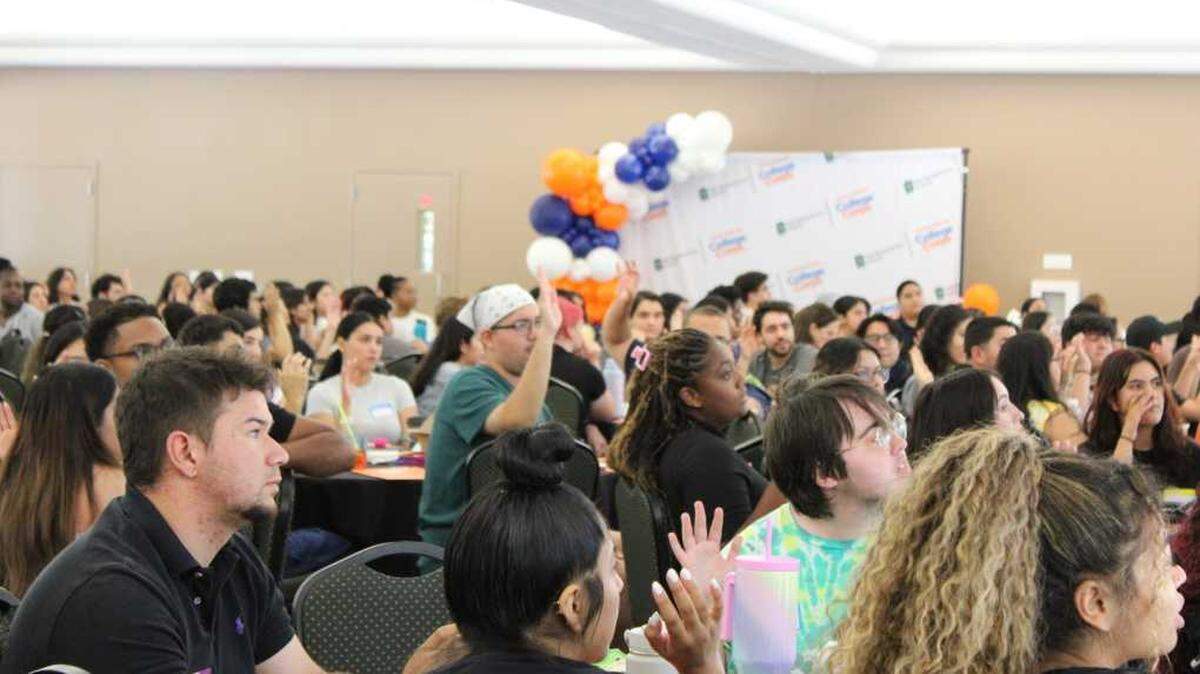
This fall marks the third year College Corps is welcoming a new cohort of students. On Saturday, 170 fellows attended a kick-off event at Sac State welcoming new and returning students to another year of service.
Out of nearly 10,000 applicants, around 3,000 students were selected to participate at 17 community colleges, 16 California State Universities, seven UCs and four private colleges across the state.
Program leaders said the program has become increasingly competitive as more students decide to return for a second or third year.
The initiative has also sparked copycat programs in other states. New York announced in July the creation of the Empire State Service Corps where 500 students at state colleges and universities will get paid for 300 hours of community service.
California’s College Corps program is funded through 2026. Beyond that, its future is murky. Fryday said he’s hopeful the Legislature will eventually set aside more funding.
He is already envisioning an expanded version of the program in California, where all college students have the opportunity to be paid for community service, not just a few thousand a year.
“The question for us moving forward is how do we continue to meet the demand for this very successful program,” Fryday said.