
Urban farming program at Sacramento high school given room to grow after fears of closing
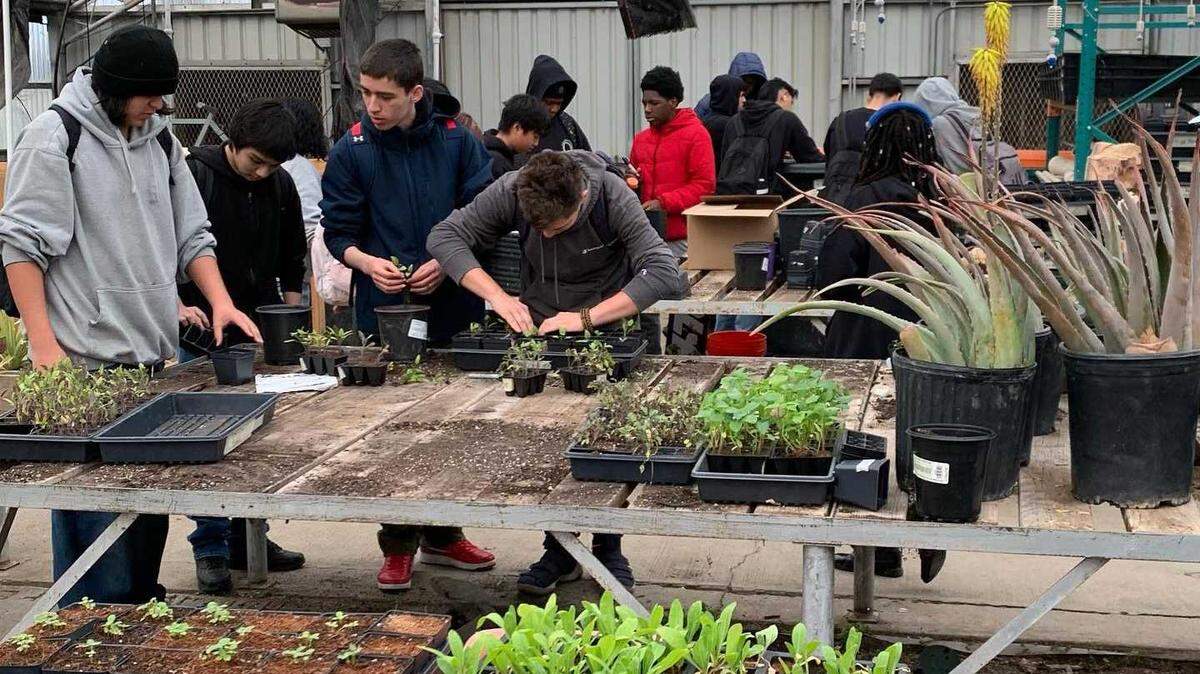
A Sacramento high school’s ambitious agricultural program is secure following fears of its demise once school ends in June.
Teachers at Luther Burbank High School’s Urban Agriculture Academy and Burbank principal Jim Peterson agreed on Wednesday to keep the three-year program intact. Peterson had considered changing the program to an elective class on concerns over students’ lagging enrollment.
“We started having conversations on Monday talking about whether the program should be a pathway or an elective. We came to agreement today to leave the program as it currently is,” Peterson said Wednesday. “We’re going to continue on next year on a three-year pathway.”
The unique program teaches students about sustainable agriculture, health and nutrition, and food justice while they learn about basic gardening, growing food in an urban setting and the economics of agriculture at its BUG, the Burbank Urban Garden, on the Florin Road campus. The academy is one of a number of pathways at Burbank; others include Building Trades, and Law and Social Justice.
But enrollment and retention in the agriculture pathway have lagged in recent years as more students are enticed by the school’s more popular pathways such as Media Arts and Technology.
Enrollment stood at 160 students or 58% of capacity, according to district officials, leading the school to consider the change.
That sounded the alarm bell for teacher and academy adviser Todd McPherson, as well as students, parents and program supporters who feared the program was going away for good at the end of the school year.
McPherson in a Jan. 30 Facebook post said he was shocked at the news of a possible end to the ambitious program and had rallied supporters to attend Sacramento City Unified School District’s board meeting Thursday to keep the program alive.
“The news was as shocking to me, the teacher/program coordinator/farmer, and my students as I’m sure it likely is to you all,” McPherson said in a Jan. 30 Facebook post. “It came without warning, without any offer of support or opportunities given (to) address the enrollment and cost concerns used as reasons to justify the academy shutdown.”
A day after his initial announcement on Jan. 30, McPherson went to Facebook to say school site administrators were able to secure a single year of funding for three agriculture elective classes on the campus.
“While this is good(ish) news, and a decent start, we feel this does not adequately resource a garden/farm and program of our scope, size, and ambition,” McPherson wrote. However, he added, it was “certainly no replacement for what is being cut” at Luther Burbank High, named for the noted Northern California horticulturist and botanist.
Peterson on Wednesday insisted the program was never in danger of ending, but said he was concerned about the sluggish enrollment figures and the students’ willingness to commit to three years in the agriculture program.
“At no point was I trying to cut the program. The challenge has been that kids have gravitated to the other pathways,” Peterson said. “The challenges that we’re taking on are: How do you attract students into a three-year pathway and make them willing to commit to a three-year pathway in ag; and, how do you hold onto them?”
Burbank and program leaders will have incentive with the California Department of Food and Agriculture’s Office of Farm to Fork in January awarding more than $610,000 in grant funding for the district’s Farm to Cafeteria project, the bulk of which runs through June 2026.
The grant to the district’s Nutrition Services Department is on the consent agenda for Thursday’s SCUSD board meeting. The project stocks salad bars in district schools’ cafeterias with local produce including from Burbank Urban Garden and provides hands-on nutrition education programs across SCUSD.
The CDFA grant also funds the Burbank farm’s expansion and is paying for nutrition education and cooking lessons to teach academy students how to feed people with the crops they have raised. The grant expands that hands-on instruction to juniors and seniors taking career technical education courses at the Parkway neighborhood campus.
District grantees say the project builds on the SCUSD’s earlier Farm to School grants by teaming with its one-acre, student-run farm called the Food Literacy Center. The farm features a cooking classroom and industrial kitchen on the campus of Leataata Floyd Elementary School in Upper Land Park serving 14 schools, many of whose students live in food deserts.
The academy program has ridden a recent wave of momentum, McPherson said: A new academy van, dubbed the BUGmobile, purchased with funding from the city of Sacramento; an additional acre of farm space negotiated by school’s principal Peterson was recently enclosed with district-supplied fencing, McPherson said in the January Facebook post.
Peterson said the teachers are developing ideas to keep students in the program and attract others.
“We’re going to continue forward for next year and we’re going to look at metrics on what to do to get those numbers up,” he said. “The teachers convinced me that they can make the program successful as a career pathway. That they can keep these kids in (the program) and retain them.”
.JPG)