Did San Juan Unified School District violate the Brown Act? Legal expert weighs in
AI-generated summary reviewed by our newsroom.
- San Juan Unified held closed meetings to censure a board member, possibly violating law.
- Brown Act excludes elected officials from disciplinary discussions in private.
- Legal experts stress need for public transparency in disciplining elected members.
San Juan Unified School District may have violated the Brown Act when investigating and reprimanding an elected board member.
The district board formally reprimanded Trustee Nick Bloise earlier this month for engaging in “inappropriate and excessive” personal disclosures during school site visits, according to a document obtained by The Sacramento Bee. Discussions of the investigation and a vote on the corrective actions issued to Bloise took place in meetings closed to the public.
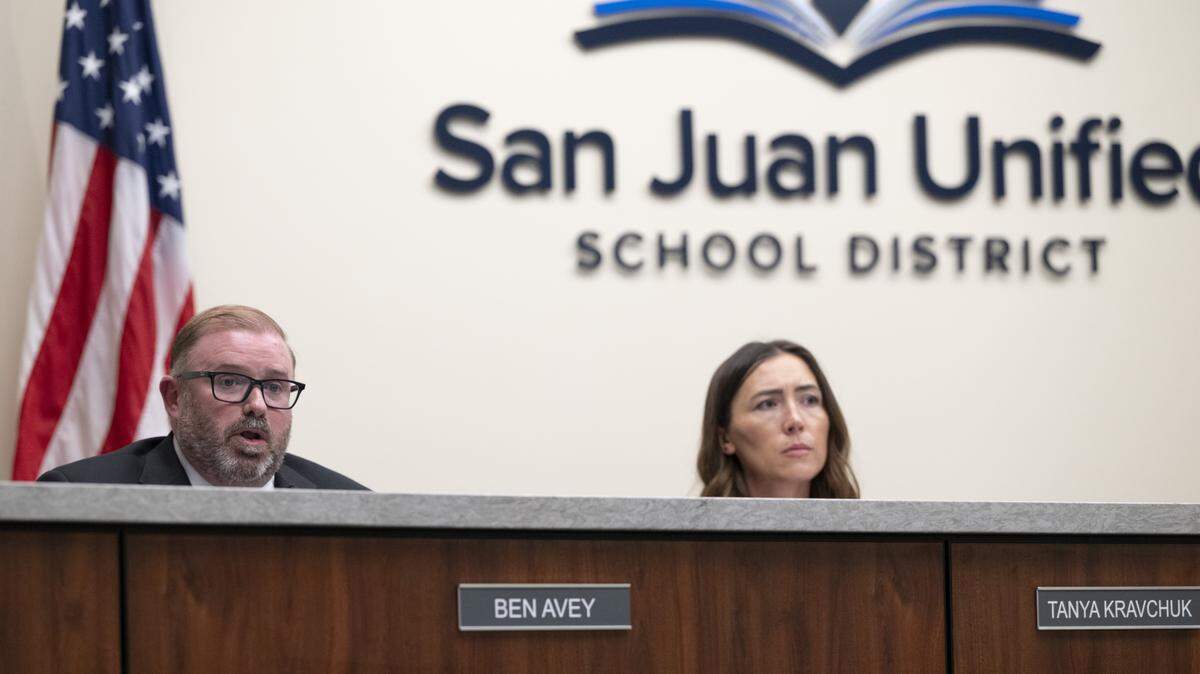
The matter was only discussed in open session briefly at a Sept. 9 board meeting when Board President Ben Avey gave a two-minute statement summarizing the board’s recent actions following the completion of an independent investigation into Bloise’s conduct. The report from closed session did not include any specifics about the allegations against Bloise nor did it include the fact that Bloise is barred from visiting San Juan Unified campuses for a period of 90 days, with further restrictions in place for a full year.
The Brown Act is a California law that requires legislative bodies (such as city councils and school boards) to adhere to a set of rules to ensure the public’s right to attend and participate in their meetings. It was enacted in 1953 in response to growing concerns about government officials’ practice of holding secret meetings to conduct business outside of the view of the public.
The law does make exceptions — one such exception, under a subsection of Government Code 54957, says that discussions surrounding the employment, evaluation, discipline or dismissal of high ranking staff under direct supervision of an elected body (such as a school district superintendent) can be held in closed session.
The school district cited this subsection on its agenda when holding these closed session discussions of the investigation into Bloise. But just a few paragraphs down, the law explicitly excludes elected officials from this exception.
“For the purposes of this subdivision, the term “employee” (...) shall not include any elected official, member of a legislative body or other independent contractors,” the code reads.
Bloise was elected to his position as the Area 4 Trustee by local voters in November 2024.
Did San Juan Unified violate the Brown Act?
Legislative bodies should not use the closed meeting exception to close their deliberations about elected officials or their own members, attorney Aaron Field said. Field is a senior staff attorney at the First Amendment Coalition who focuses on strategic litigation to hold California public agencies accountable under free speech and open government laws.
“It sounds like a mistake was made here and that’s not to say this was intentional, but it is to say that it sounds like a closed meeting was held under the closed meeting provision, when this was actually about a personnel matter regarding an elected official and not a public employee,” Field said.
The school district’s legal team resists the suggestion that they violated the Brown Act, saying that Avey’s readout satisfied the requirement that the investigation be discussed in open session.
Avey’s statement did not include any details about the allegations or complaints against Bloise, nor did it include all of the components of his reprimand. When this was pointed out to San Juan Unified counsel Fhanysha Gaddis, she erroneously told The Bee that Avey said in his public statement that the allegation had to do with “inappropriate communications with staff that related to interpersonal relationships, romantic relationships and the like.”
District spokesperson Raj Rai called back shortly after to correct Gaddis’ statement, saying that she was not reading Avey’s public statement, but reading off of the letter given to Bloise by the board which was not made available to the public. The Bee had requested this document multiple times in the previous two days, but it was only turned over following the conversation with Gaddis and Rai. The Bee was the first to publish the contents of this letter.
The district is citing attorney-client privilege as the main reason the investigation was discussed behind closed doors. Rai cited a California Supreme Court decision in the case of Roberts v. City of Palmdale which held that a local agency retains the attorney–client privilege for written legal opinions from its attorney and that the Brown Act does not override that privilege.
“The investigation you reference was conducted under the direction of the District’s legal counsel and is therefore protected by the attorney–client privilege,” Rai said in a statement. “This privilege exists to ensure that clients can seek and receive candid legal advice without fear of compelled public disclosure.”
In her response, she also cited Gov Code section 54957(b)(3) which she wrote “explicitly authorizes governing boards to meet in closed session to consider complaints or charges brought against a public employee,” but did not acknowledge that the following paragraph of the law excludes a public official from being considered an “employee” in this context.
Gaddis also said that there was nothing in the law requiring the board to deliberate or vote on this matter in public. Rai expanded on this in a later statement to the Bee.
“There is no legal requirement under the Brown Act for the Board to take a public vote on the acceptance of an investigative report or on confidential personnel-related corrective actions when those actions do not themselves constitute a formal Board action requiring approval in open session,” she wrote. “Any decisions that must be taken in public session will be, but confidential legal advice and personnel-related deliberations remain protected.”
Field disagrees.
“A legislative body’s ‘report out’ to the public after a closed session does not satisfy and is a far cry from the Brown Act’s general requirement of openness,” Field said. He cited the California Attorney General’s Office, which wrote that the law has been interpreted to mean that all deliberative processes by legislative bodies should be open and available for public scrutiny.
Field said that the public was supposed to see the deliberations and votes of the body — “a post hoc statement of what already happened is not the same as the situation where the public has access to the discussion.”
Gaddis said that the reason the majority of the investigation was discussed in closed session was because “the matter related to other employees as well.”
She cited another subsection of the law, which allows a legislative body to exclude the examination of a witness in the matter being investigated. San Juan Unified spokesperson Raj Rai previously told The Bee that the district had hired an external law firm to investigate the allegations against Bloise.
Field said that regardless, this subsection of the law allowing the examination of witnesses in closed session does not allow them to close public meetings or portions of meetings, to the public entirely.
In other internal investigations into public officials, a law firm will conduct research and interviews of staff involved and then present their findings to the board omitting private staff names. In November 2024, Yuba County hired a law firm to investigate Supervisor Seth Fuhrer following a series of complaints from county workers. The findings from the law firm were presented in open session after which the board voted 3-2 to censure him.
Why transparency matters
The US Supreme Court wrote in 1986 that “people in an open society do not demand infallibility from their institutions, but it is difficult for them to accept what they are prohibited from observing.”
Elected board members have very limited ways to governing one another — they can institute board policies, codes of ethics or censure a member in limited situations following substantiated allegations of misconduct. The importance of discussing investigations into elected officials during public session is two-fold: to ensure accountability from both the sanctioned member and the rest of the board.
“The more authority an official wields on behalf of the public, the more important it is for the public to know about allegations of misconduct against the official, to ensure the official is not engaging in mis- or malfeasance, and to hold that official accountable,” Field said.
Field said that an elected official’s constituents also want to be able to judge whether or not the person representing them is being fairly assessed by the other members of the body.
“When members of the public go to the ballot box to cast their vote for a person, that vote will be realized in actual representation in government,” he said. “If their representative is going to be limited in their exercise of authority or even disciplined, it is particularly important for the public to understand why and to assure itself it has not been made arbitrarily or incorrectly so we can ensure that our will as voters is being realized to the fullest extent possible.”
This story was originally published September 16, 2025 at 5:47 PM.