Ex-Sac City official alleges board favored teachers’ contract over fiscal solvency
Sacramento City Unified School District’s former top financial officer alleges that the board of trustees knowingly made financial decisions that worsened the financial crisis, according to documents obtained by The Sacramento Bee.
Former Chief Business Officer Janea Marking claimed in an email that the board, under pressure from the teachers union, approved a labor contract despite being advised that it was unaffordable.
“They were warned, several times, of the realities of their decision-making,” the email reads.
The district is facing a nine-figure shortfall that could put it into state receivership — an increasingly real possibility that could have devastating educational consequences for tens of thousands of Sacramento students, including those who haven’t yet been born.
The severity of this outcome is not lost on the district’s board of trustees, who have said that they are “fighting fiercely” to prevent state takeover. In the last seven months, they have chastised district staff from behind the dais for not providing timely, relevant budget information and not acting urgently enough.
But Marking alleges, according to documents obtained by The Bee, that the board and former Superintendent Lisa Allen were well aware of the district’s financial picture when the contract was approved and that trustees have been dishonest about it in the months since.
“Yes, of course the board had all of the information needed for an informed decision; they KNEW the current crisis was the consequence of their decision making; I also shared every number with the Supt (first) and Cabinet (second) before sharing with the board,” she wrote. “Lisa (Allen) never told the community that she was concerned about the affordability of these decisions either.”
Former CBO says trustees were aware of crisis
Marking’s March 10 email to the Sacramento County Office of Education officials, and the documents attached to it, show that the board was aware of the impending crisis as early as June, months before a fiscal solvency plan was drafted. She alleged that board members chose instead to prioritize providing Sacramento City Teachers Association with an “unaffordable” new contract over maintaining fiscal solvency.
Marking wrote that trustees conspired to “flood the zone,” referencing a political strategy attributed to President Donald Trump’s former political strategist Steve Bannon to deceive, distract and disorient the public with a deluge of information to avert accountability.
“The board’s response to the financial concerns, when faced with developing a solvency plan, was to develop the strategy of ‘flood the zone’ (so named by one of the trustees), which was to sow as much chaos as possible in light of the information they had (and re-direct any accountability from leadership),” she wrote.
“Yes, they set out to manufacture more chaos on top of the very real crisis situation the district was already in so they could hide behind it.”
The Bee reached out to the seven members of the board — Board President Tara Jeane, Taylor Kayatta, April Ybarra, Jasjit Singh, Jose Navarro, Chinua Rhodes and Michael Benjamin.
Jeane, on behalf of the executive committee of the board, sent a statement saying they were “hurt and betrayed that someone we trusted and engaged with in the confidential closed session space would write this email.”
“This is an improper public airing of a skewed perspective from a former employee about confidential closed session discussions, and we are looking into whether any laws have been violated,” the statement reads. “We cannot and will not comment on those confidential conversations, even if we disagree with how they were portrayed.”
They said that the board’s priority remains implementing a fiscal solvency plan that reflects the community’s priorities.
“A systemic lack of budget clarity has been a factor in the board’s ability to effectively govern,” the statement reads. “The continual updates that our Fiscal Solvency Plan has required is indicative of the fact that the board has been asked to make decisions without a full financial picture. State receivership is not an option. Our community deserves to maintain local control over the decisions that impact our schools, students, and staff.”
Marking declined to comment for this story.
A fateful labor negotiation
In May 2025 the district entered contract renewal negotiations with Sacramento City Teachers Association.
In her email to SCOE financial officer Nick Schweizer, Marking said she implored trustees to consider the economic effect that raises for teachers could have on the district.
According to a presentation script from a June closed session meeting with trustees she attached to the March 10 email, Marking shared three multiyear projections based on potential bargaining outcomes with the teachers union, labeling them “conservative yet overwhelming,” “in-between” and “ALL IN.”
“As your CBO I am very concerned about the ending number on all of these models,” Marking wrote in her script.
Marking wrote in her email to SCOE that the board barely discussed the “conservative yet overwhelming” option before agreeing to it, despite her and then-lead negotiator Cancy McArn’s urging to start negotiating lower than that option.
“The ‘conservative yet overwhelming’ was intended to show them just how much a small raise of 2% and 2% for everyone would cost and they were encouraged to start below that, but they did not follow staff recommendation,” she wrote.
In response to a request for comment, McArn — who now also serves as interim superintendent — sent the following statement: “My focus remains on implementing our fiscal recovery plan, repairing the systemic problems that led us here, and caring for our entire system in these unprecedented times.”
The new contract also included compensation for eight additional days added to the academic calendar in fall 2024 to make up for lost days from the 2022 teachers strike, even though the academic calendar has gone back to the pre-2024 number of instructional days. This netted teachers an additional 4.5% boost on top of the 4% over two years.
Ultimately the option the board unanimously approved showed a projected $2 million deficit in the current school year and $122 million by the end of 2027-28.
Some trustees have acknowledged that they knew approving the contract would put them in a tight financial position, but that they directed staff to make cuts to administrative positions that were never implemented.
“We approved a series of budget bargaining agreements in this year and in the previous year that we knew were going to make our budget be tight, but we had a plan to fund it,” trustee Taylor Kayatta said at a March 19 board meeting. “We identified eliminating positions that were COVID-funded as a solution years ago, and those positions were not cut with fidelity or in a timely manner.”
But Marking had told the board that the multiyear projection presented to them already included assumed cuts to administrative positions at the Serna Center, a $20 million disbursement from a benefit trust fund and that the wishful assumption that the special education department would control rising costs, according to her presentation script.
The disbursement from the benefit trust fund never materialized, and special education costs continued to accelerate.
In other words, the district would have had to identify cuts beyond administrative job eliminations to fund the contract, but there was no plan to do so. Lisa Grant-Dawson, who was hired by SCUSD in January as an interim replacement for Marking and has previously helped Oakland Unified School District escape state control a year early, said in a February interview that a fiscal solvency plan can take a year or more to develop.
Kayatta and other trustees have cited another disrupting factor: the $60 million in unexpected costs revealed in September’s actual budget spending, most of which was associated with unbudgeted special ed costs.
Marking wrote in the email that she warned the board that the district’s spending in 2024-25 could come in higher than was budgeted due to systemic bad practices.
“Regardless of where they try to publicly direct the blame — me, Cindy (Tao), bad projections, SPED, unauthorized contracts... (somehow not Lisa?), ALL seven of them agreed to a negotiations settlement projection of -$122M in the third year out, including a negative in the fiscal year about to begin, and being warned of pending unaudited actuals concerns given routine practices of spending without budget,” she wrote.
“The lack of accountability for the decision-making is unconscionable,” she wrote.
Ties with teachers union
Marking suggests in her email that the members of the board capitulated to SCTA demands instead of being fiscally responsible.
“The SCTA pressure for more money was indescribably intense,” she wrote.
The current board has faced public criticism for its members’ close ties to the teachers union. All sitting trustees have endorsements and/or campaign funding from SCTA amounting to almost $1 million total since 2020.
When asked for comment on the allegations in Marking’s email, SCTA President Nikki Milevsky said they were self-serving.
“The self-serving email from the former chief business officer written five months after her resignation is a misleading attempt to cover up fiscal mismanagement and rewrite history,” she said in an email. “It’s why she won’t be missed.”
The teachers contract is far from the sole reason for the district’s devastating financial situation. The teachers union contract signed in September has a total projected $80 million liability for this school year and the following two years. Some of these projected costs are in new support positions that have not yet been posted, so costs associated with the 2025-26 school year may be lower than the projected $10.6 million. The district’s most recent projected deficit for 2027-28 is about $390 million.
Meanwhile, unrestricted fund special education spending has skyrocketed from about $73 million in 2019 to a projected $170 million this year, despite efforts to get department spending under control. Enrollment has declined more than 10% in the past decade, sharply reducing the revenue coming into the district.
Reading specialists and other recently created support positions approved as a part of agreements with the teachers union are intended to reduce the number of students needing costly special education services by providing academic and social intervention in early grades.
Deficit has ‘chased’ Sac City for years
Grant-Dawson said that a $100 million deficit has been chasing the district for years, but was masked by an influx of grant money during COVID.
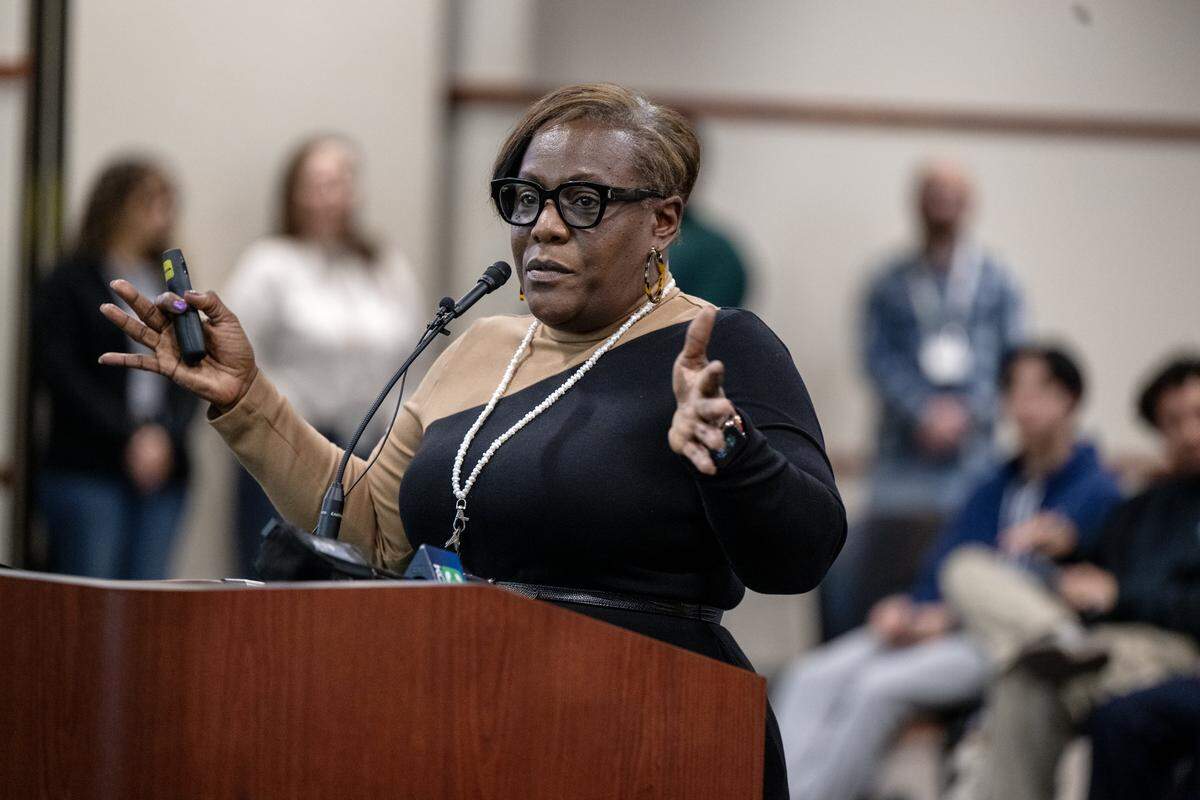
Marking left the district in early December, taking a job at Sequoia Union High School District in the Bay Area. She wrote that she sent the March email “given the lack of any factual statements being told to the community about what the board knew, who is accountable, and how critical the financial situation really is.”
“I’m concerned every time they issue a message that they are confident everything is going to be ok. I don’t believe they actually believe that, they are just that committed to hiding the truth,” she wrote in her email.
SCOE Superintendent Dave Gordon said that his team had received Marking’s email about “how and why” the district might have become financially distressed, but his office is focused on “trying to help SCUSD avoid insolvency.”
As of April, the effects of the deficit have already materialized. At each meeting, trustees face outrage over the 1,000 pink slips issued to district staff and parent despondency over the closure of preschool programs and other services. Allen suddenly stepped down as superintendent. A large, but still unknown number of SCUSD employees are slated to lose their jobs come July 1.
A statement Marking made to the board in June 2025, according to her presentation script, turned out to be prescient.
“Whatever deficit is determined as an ‘amount we are ok with’ turns into angry parents, crying employees and upset families at the podium in 9 short months when we make the necessary reductions to balance our budget,” Marking’s script read. “It will mean less staff and certainly administration at Serna, but with the numbers we are looking at, cuts at Serna will not be enough.”
The board will meet for a special meeting Thursday night to discuss possible school consolidations and get an update on its fiscal solvency plan. The district is slated to run out of cash in July.