‘Undeniable’ Del Campo High School students help solve road problems, county says
A little over a handful of Del Campo High School students could be the reason a road bordering their school becomes slower, less busy and safer.
Dewey Drive, the students told the Sacramento County Department of Transportation last spring, was too fast, too loud and needed more space for bicyclists. And the Sacramento County Department of Transportation agrees, according to Makinzie Clark, senior planner for the planning and programs division.
After some back and forth with the students and the teachers leading their traffic study club, the county department has created a draft of design improvements that it will submit for a Regional Active Transportation Program grant through the Sacramento County Area Council of Governments. The mockup includes a roundabout at the intersection just south of the high school and Will Rogers Middle School, protected bikeways and reducing a section of Dewey Drive to three lanes for motorists.
“It almost was undeniable that this was something that we needed to respond to,” Clark said, referring to the students’ efforts combined with the road conditions. “There’s already more outreach and more proof of community support than any other project I’ve ever worked on.”
“In this complex, complicated, challenging, limited-resources, limited-funding, world of transportation planning, this project is an example of things going right,” she added. Due to the support, the project has moved at a faster pace.
About seven students, give or take a few inconsistent attendees, involved in the school’s “Crash Analysis Research Studio” club developed their initial ideas after surveying students and teachers, walking up and down Dewey Drive to identify issues and utilizing radar guns to see how fast motorists were travelling on the 35-mph road, which is reduced to 25 mph during school hours.
“When schools are in session we have seen people going way over 40, 45, we’ve caught people doing 60,” senior Cheyenne Treft said Thursday during an outreach event about the project. Treft is vice president of the club.
Students embrace teachers’ initiative
Math teachers Carl Perricone and Nicole Miller started the club in 2024 after speaking about unsafe driving Miller had noted at an intersection near her house. Over school lunches, Perricone talked with his fellow educator about how behavioral change was possible through infrastructure improvements. That became the guiding principle behind both the club and a class that Miller taught last fall semester.
The two educators crafted the course around the teachings and practices of the civic engagement nonprofit Strong Towns. It culminated in Crash Analysis Studios where students presented their analyses on collisions and how the applicable roads could be altered to prevent further crashes.
The club, which has some student overlap, has a connected but slightly different purpose — outreach and application. This year, those efforts were focused on the Dewey Drive project.
The students first discussed some of their ideas with the transportation department during a field trip last spring to its office. Clark said the students’ and teachers’ ideas caught her attention and served as a launching point for the county’s efforts, which required the staff repeating some of the club’s research in a way that matched county standards.
Communication between the county and the school became consistent in the fall and ramped up earlier this year to about every other week. The club also coordinated with local groups such as CivicWell and Safe Routes to School.
Students organized walks along the roadway so community partners, including Clark and Strong Towns founder Charles Marohn, could get a better idea of how certain potholes, trash cans placed in bike lanes and the general road structure were deterrents for biking and walking.
Timing is everything: An early win with traffic light
During one of those tours, a student commented on how pedestrians have long waits at the stoplight immediately in front of their school. In response, Clark communicated with the transportation department and within weeks changed the timing of the light during peak hours before and after school.
Perricone said he doubts others have noted a district change, maybe even chalking up the easier experience to luck. But now, students don’t have to worry as much about being struck by cars turning out of the schools and onto Dewey Drive, Miller said.
The county transportation department does not have the funds to implement the overall project, as was communicated early on to the students. And other roadblocks popped up as the county and the school bounced ideas back and forth, including the department’s nixing a demonstration of the drafted Dewey Drive improvements, Miller said.
But the students were ready to think outside the painted lines, including brainstorming different painted lines.
They tried different methods, approached issues from different angles, compromised and learned more about how county government works. They considered how the road changes could up the value of nearby homes, which would eventually put money back into the county through property taxes and hopefully further transportation projects. They engaged in their community and even became less afraid of standing in front of government officials, according to senior Miguel Hernandez.
“It was kind of scary when we were talking about city meetings,” Hernandez said about speaking during meetings in Carmichael. “But it’s honestly not as scary as you think it is. It’s very simple.”
Senior Oliver O’Donnell said club experiences bolstered his confidence and public speaking skills.
Getting broader support with some treats
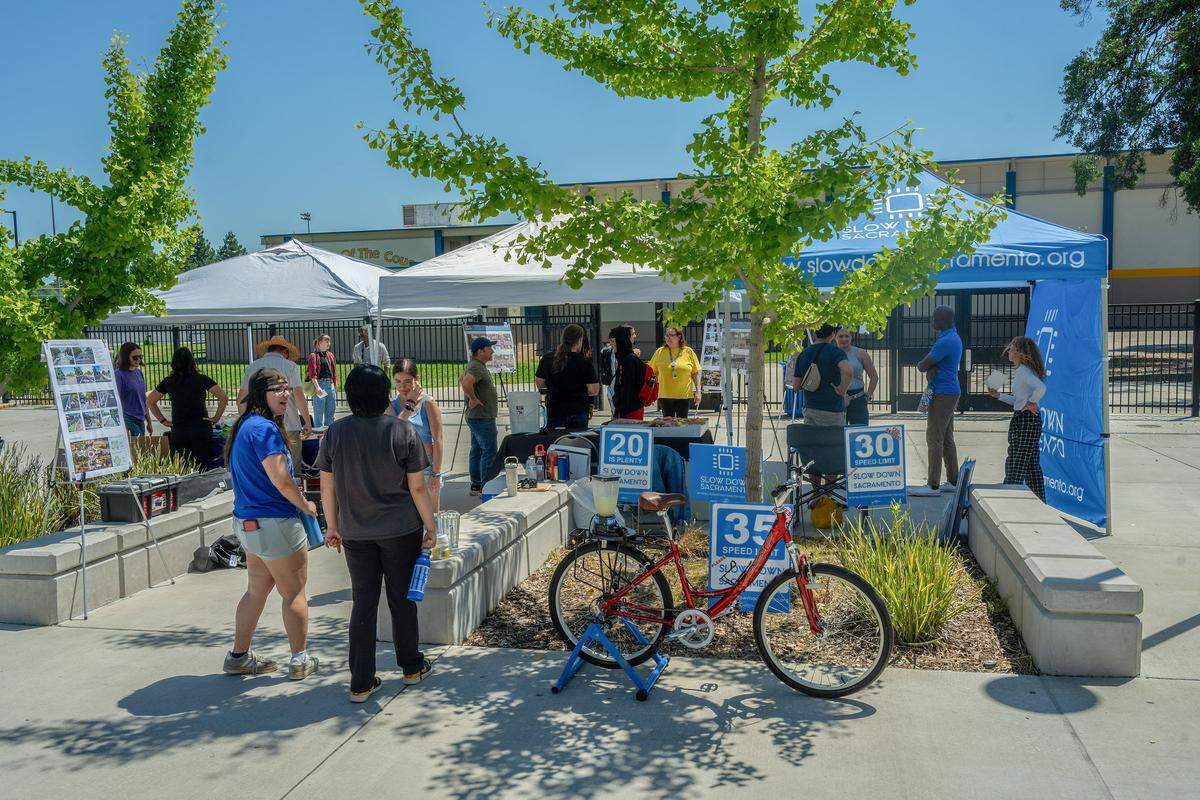
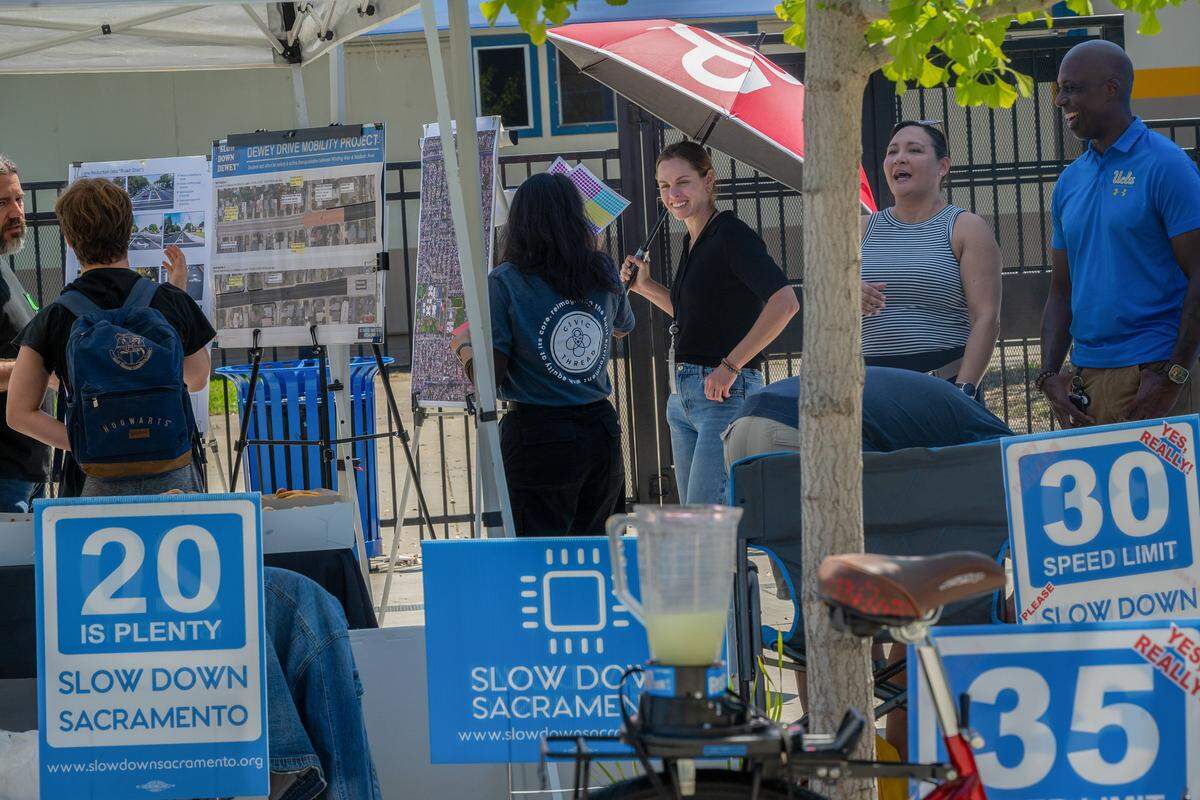
On Thursday afternoon, the club held an outreach event, which was also co-organized and attended by groups such as CivicWell, Safe Routes to School, Slow Down Sacramento and Civic Thread. Those who had walked to school or ridden their bicycle or scooter participated in a raffle for prizes. Poster boards displayed the department’s design draft for Dewey Drive. Some hopped onto a “smoothie bike,” using pedaling to power a blender filled with ice and lemonade.
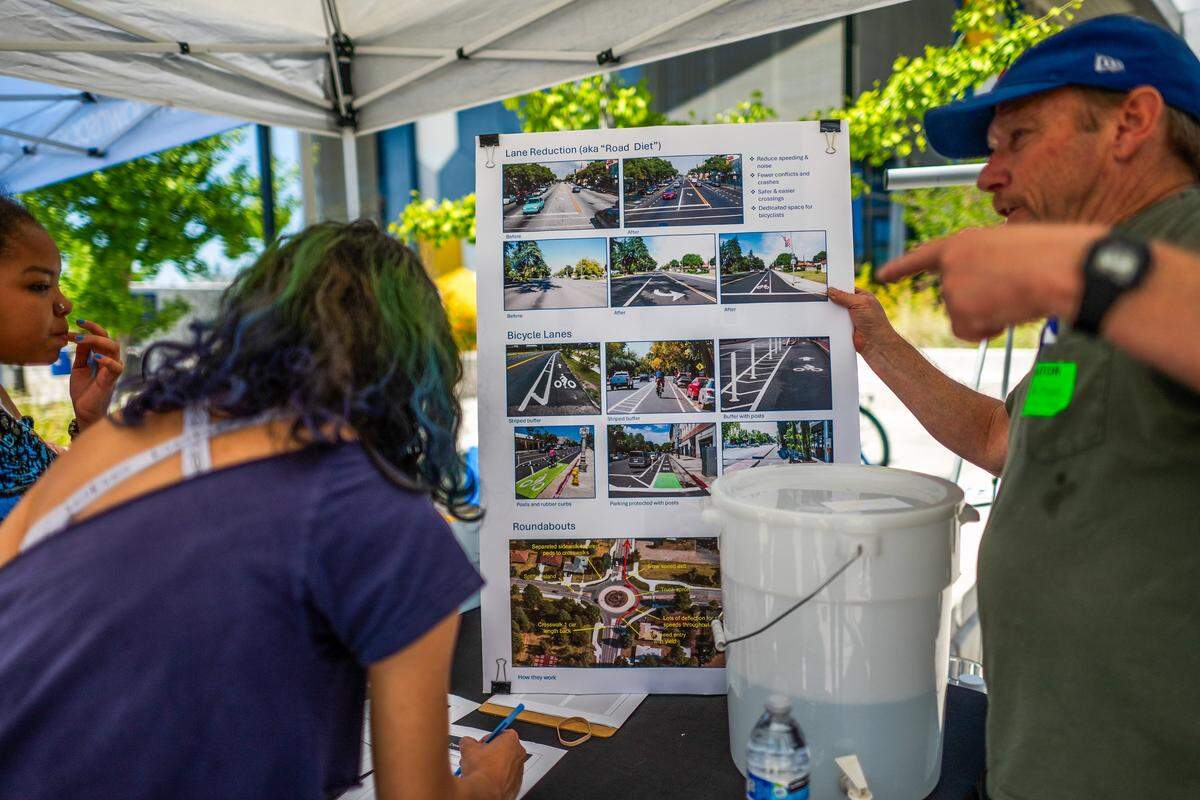
“I know you want some free food,” O’Donnell said to passing students, who found out the pastries were only granted to those that filled out a Dewey Drive traffic survey. Many did so before snagging a donut, adding to the pile of more than 560 surveys already filled out prior to the event.
Across the street, Clark surveyed about 30 middle school students, many of whom said people “drive crazy” on Dewey Drive.
All the survey results, engagement and comments on the new road design, will be added to the grant application, which has to be submitted by the end of September, Clark said.
Even though a competitive grant process waits ahead for the group, Treft is hopeful the group will get the end result they want.
“I’m hoping that, because we have these plans all sorted, and we’ve been coming out and talking to more students and parents, that hopefully they see that this is something that the community really wants, and they feel is very important,” Treft said. “I’m sure we’ll get a grant.”
And even if they don’t, Clark said the county will be seeking out more opportunities.