Sacramento activists open ‘Safe Ground’ for homeless campers. Will city shut it down?
A group of homeless activists opened a temporary “Safe Ground” homeless encampment just north of downtown Sacramento in recent days, renewing a years long push-and-pull with city officials who have refused to sanction a camp.
City Councilwoman-Elect Katie Valenzuela – who will be sworn in later this year to represent the central city – said she hopes the “Safe Ground” model will be replicated around the city.
But Councilman Steve Hansen, the district’s current representative who lives in the Alkali Flat neighborhood where the campground sits, said the property is inappropriate for such a project. Instead, he has proposed several other sites in his district for the activists to work with him to open cabin-style homes for the homeless.
The group will consider Hansen’s proposal, said Mark Merin, the longtime civil rights attorney who owns the site near 12th and C streets. For now, the camp remains open. Four homeless people are living in red and gray uniform tents with cots, spaced more than six feet apart. Organizers might add up to nine more tents. The site is fenced and has portable toilets, showers, sinks and drinking water.
The model, used in Seattle and other cities, is touted by supporters as an inexpensive way to provide homeless a place to stay where they can have their basic needs met, safe from assaults, rapes and violence, and without being worried about losing their belongings.
When the nonprofit, Safe Ground Sacramento Inc., opened a similar project nearby several years ago, the city shut it down. But that was before a federal court decision in Boise, Idaho, where courts ruled that cities cannot cite people for camping outdoors if there are no shelter beds available. It was also long before the coronavirus, which prompted the Centers for Disease Control to release guidelines that say police cannot clear encampments.
But the city might intervene again.
Merin says there is not a permit process that exists in the city for the type of pilot project he opened. City Attorney Susana Alcala Wood said the city asked Merin to apply for a special event permit to open the campground, and he declined.
“Operating unregulated campgrounds in the City creates risks for not only city neighborhoods, but also the campers themselves who may not be provided the necessary safe and healthy living conditions,” Alcala Wood said in a statement. “The City has no option now but to explore enforcement options against Mr. Merin’s unregulated campground and require him to properly submit an application to hold a special event on this property.”
Those enforcement options could include an injunction, Alcala Wood said.
Mayor Darrell Steinberg said he supports the Safe Ground concept, although he prefers tiny homes or cabins to tents. He declined to say whether the current site should be shut down.
“Longer term, we could use Safe Ground sites around the city for hundreds of tiny homes, which I continue to believe are a better option than tents,” Steinberg said in a statement. “The sites should be picked collaboratively by the sponsors and the city with engagement from the surrounding neighborhood, should meet county public health standards and should have a city permit. I also think we should work to make sure these sites offer the services needed to get people the help they need to transition to permanent housing.”
Neighborhood complaints about homeless camp
Hansen said he has received complaints from residents and the Sacramento Montessori School nearby that loitering and camping has increased since the Safe Ground opened. Merin, who also lives in Alkali Flat, said the campers have been telling people not to loiter and that the project will improve the neighborhood over time, which has a severe existing homeless problem.
Uartine Gentry Jr., 59, moved into the Safe Ground after he was told to leave the La Quinta motel a few blocks away, where county officials are placing homeless to protect them from the coronavirus through Gov. Gavin Newsom’s Project Roomkey program. He said a staff member told him to leave because she was threatened by him. He said he lost all his belongings, including his three tents, in the process.
Janna Haynes, a Sacramento County spokeswoman, said Gentry “was asked to leave for numerous violations to our code of conduct” but that “we do not confiscate belongings and even in challenging circumstances, we always allow those leaving to gather their belongings.”
“They put me out at 8 p.m. at night with nothing,” Gentry said. “No bus pass, no nothing. So I stayed on the streets for four days then I came here. I don’t know what I would’ve done.”
Before the motel, Gentry was staying in a tent along the Sacramento River behind Capitol Casino, he said.
It’s always been hard for Gentry to find a place to use the bathroom since he started sleeping outdoors in 2016, but it’s gotten more difficult amid the coronavirus, Gentry said.
“There’s no bathrooms, period at all,” Gentry said. “You can’t use them in the store, you can’t use a bathroom anywhere. The next best thing is outside. That’s all we got.”
So far he likes the community.
“It’s safe,” he said. “It’s gated. I’m tired.”
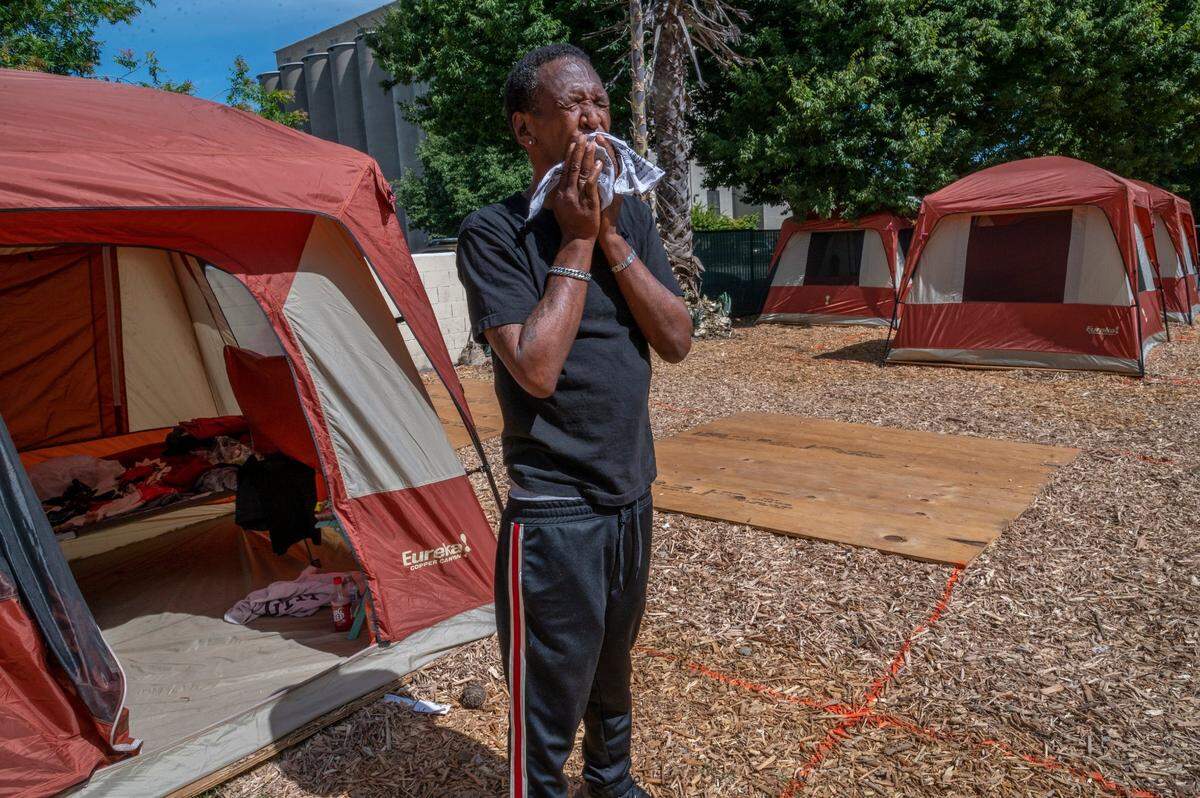
The camp is self-governing, meaning residents set rules through a democratic process. One such rule they’ve set, Merin said, is a curfew.
“As I told some neighbors who told me who were concerned, I said let’s just try it out,” said Valenzuela, who will take over Hansen’s council seat in December. “This is far better than having folks sleep on the sidewalks and in the streets and in the parks. This will allow people dignity. It will allow people safety. It will allow them to build relationships in the communities they call home.”
City opposition to Safe Ground
The council has traditionally not favored the Safe Ground model, with the exception of Councilman Allen Warren. But last fall, more members started to support it, and it was included in the Five Point Proposal presented by Sacramento Housing and Redevelopment Agency and Councilwoman Angelique Ashby to address the homeless crisis.
City and SHRA officials have recently been implementing more creative approaches to the homeless crisis, such as a cabin community for homeless youth it’s opening at a church parking lot in north Sacramento.
The city historically has focused on opening large shelters. During the 17 months a facility on Railroad Drive in north Sacramento was open, 658 people spent time in the shelter. Of them, 164 were placed in permanent housing and another 100 got temporary housing, city officials said last year when it closed.
Steinberg called Railroad Drive a success but said he hopes to house more people more quickly in future shelters, moving people to housing every four to six months.
But those large shelters with expansive services are pricey.
The Railroad shelter cost more than $5 million in city and private money. Planned shelters under the W-X freeway and in Meadowview are set to cost about $10 million each to open and run for two years. The cost of providing services to the “hardest to serve” among the homeless population contributes to those high price tags.
The city’s shelters include contracts with organizations such as Sacramento Covered and Sacramento Self Help Housing to help people find housing. The city also contracts with organizations for mental health and medical care, as well as help getting documents lost during homelessness.
Hansen said the Safe Ground model does not provide people enough of those services so they can successfully move out of homelessness.
“It has to include services so people can find their way out of homeless, not just be more comfortable in homelessness,” Hansen said.
Merin said the model provides some of those services, including rehousing, without expensive contracts. A Safe Ground with 45 people would cost about $3,900 per person per year, Merin said.
“If we were running the city’s housing program, we wouldn’t have homeless people on the streets,” Merin said. “And we could do it for one tenth the present cost.”
A January 2019 count found there are an estimated 5,570 homeless people in Sacramento County, the majority of whom are sleeping outdoors and in the city. About 30 percent of those sleeping outdoors were over age 50, making them more vulnerable to the coronavirus.
This story was originally published June 10, 2020 at 4:18 PM.