Homeless people and advocates in Sacramento describe danger at camps after woman’s death
Christina Qualls has been living in secluded homeless encampments along the American River in Sacramento for so long that she sees it as home, a familiar place of her own.
That’s during the day.
Her cheerful demeanor changes quickly as she describes what’s like to live in these remote encampments at night, forced to sleep in tents tucked under busy freeway overpasses and deep among the bushes and tall grass. She said it’s hard for anyone to find you if you need help.
“Creepy, scary, cold as hell,” Qualls described the encampments at night. “Hearing fireworks go off right around here, gunshots go off. It echoes throughout this entire river ... It’s creepy, scary, all that, but I deal with it.”
She says she’s “scared” while describing the place she’s forced to call home, a spot not far from where a homeless woman was found dead with injuries from a possible assault over the weekend. She didn’t know the woman, but news of her death has reverberated throughout this homeless community.
Qualls, who says she’s been raped before while living along the river, carries a pocket knife for protection. She would prefer sleeping in a motel with a locked door, but sometimes she become restless and wanting to return to her tent along the river near the Highway 160 overpass.
It’s one of these homeless encampments along the American River bike trail, where police believe Kathy Lynn Robbins was living. The 64-year-old woman was found dead near mile-marker 3 along the bike trail Saturday afternoon, according to a Sacramento Police Department news release.
Homicide detectives canvassed the area to search for witnesses or evidence that could help them determine the circumstances that led to the woman’s death. Police officials said Sunday they did not have a suspect description. Authorities on Tuesday were seeking tips to Robbins’ death on the Sacramento Valley Crime Stoppers website.
Sexual predators target homeless women
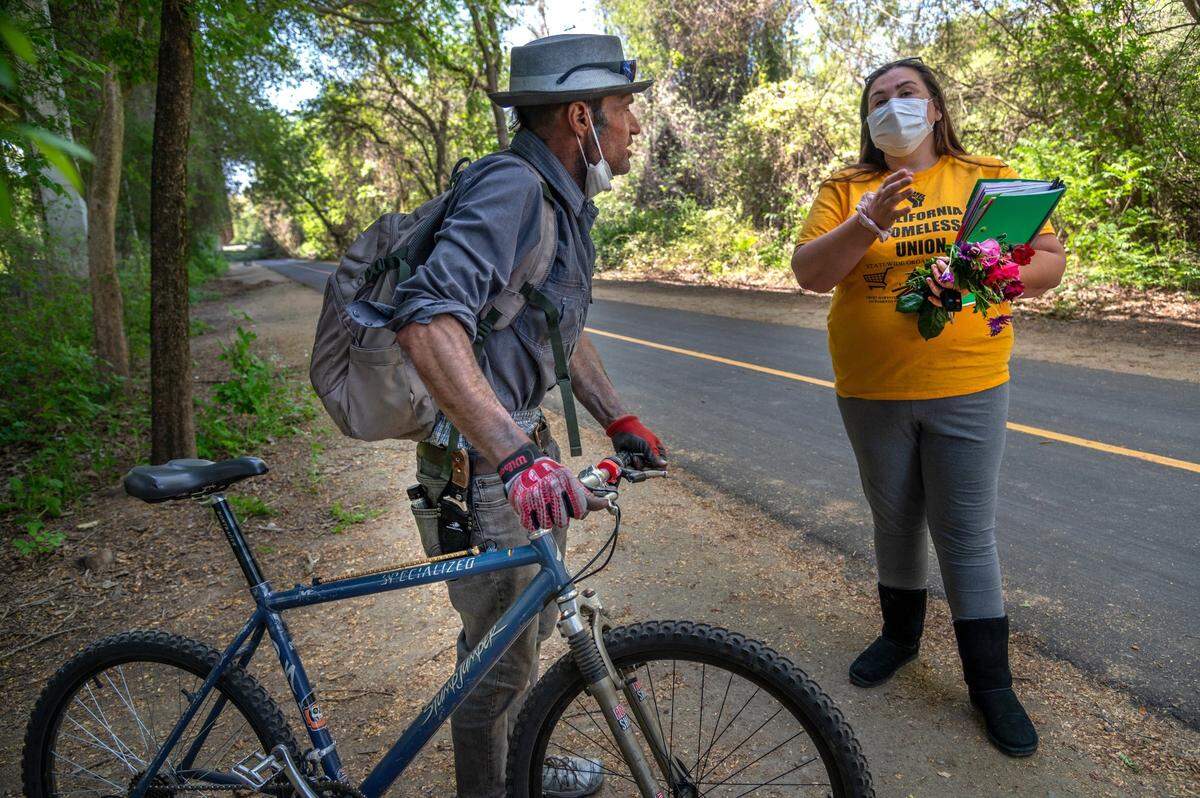
Crystal Sanchez, president of the Sacramento Homeless Union, said they used to hand out locks to secure zippers on tents. But she said that won’t stop an attacker cutting through their tent as women are targeted by sexual predators along the river.
“They don’t get any protection out here,” Sanchez said about homeless women living along the river. “There’s nowhere to run. There’s nowhere to escape, there’s nowhere to protect yourself.”
She said it’s very common to hear from a homeless woman that she’s been sexually assaulted several times in one week. And it’s not just women, Sanchez said, men are being assaulted or sexually assaulted. She’s handed out pepper spray to women, showing them how to hold their keys between their fingers to use in self defense.
“That’s somebody’s daughter, somebody’s mom,” Sanchez said about the homeless women who have been repeatedly victimized.
Christopher Lamb has been living in a tent with his wife along the American River bike trail for the past few years. He says the area offers them some privacy, with their tent tucked amid bushes under the highway overpass giving them enough space away from the trail.
Like Qualls, Lamb said the area is much different at night. He’s set up makeshift devices around his tent to alert them of any unwanted intruders.
“I don’t feel 100% safe, not at all,” Lamb told The Sacramento Bee. “You just don’t walk up to somebody’s camp, things like that. Personally, I’m not too scared. Do I walk around with a weapon? Yes.”
What really worries Lamb is a scenario in which he and his wife have an argument and she walks away from their tent on her own. Lamb said there are people out there along the river who are just looking to take advantage of vulnerable people.
Encampments serve as homeless ‘neighborhoods’
Shannon Dominguez-Stevens is the director at Maryhouse, which serves as a daytime hospitality shelter for homeless women and children in Sacramento. She said these homeless encampments are “basically neighborhoods” for the homeless people forced to live there.
She said guests at Maryhouse knew well the homeless encampments located not far from where Robbins’ body was found Saturday. They knew of other homeless people who have lived there, but not Robbins. Nevertheless, Robbins’ death had a chilling effect at Maryhouse, another harsh reminder of the dangers homeless people face, she said.
Joe Smith is the advocacy director at nonprofit Loaves & Fishes in Sacramento, which offers a variety of services to homeless people in need. He said these encampments along the American River allow homeless people to keep out of sight of police, park rangers or nearby residents.
“They’re off the beaten path, dug-in in private places wherever possible,” Smith told The Bee.
But these hidden encampments make it difficult for homeless people to get immediate help if they’re being attacked, especially at night.
He said women, elderly people, LGBTQ and transgender people are all “extremely vulnerable” members of the homeless community. Smith said they seem to be in “constant peril,” whether they’re victims of violence or suffering under the elements because they don’t have a safe space to live.
“The bottom line here is people need four walls and a roof and a door that locks to keep them safe at night,” Smith said. “It’s something I’ll go home to tonight and not take for granted thinking about what happened to this woman this weekend.”
This story was originally published April 16, 2021 at 5:00 AM.