
Homeless people stock up on water. Why does Sacramento trash their supply?
AI-generated summary reviewed by our newsroom.
- City sweeps in Sacramento often discard water containers of unsheltered residents.
- Legal right to water in California contrasts with limited access for the homeless.
- Water delivery programs expired in 2024, leaving community groups to fill growing gaps.
Whenever Earlene Applegate wants a sip of water, she has to take a hike.
The nearest fountain to her North Sacramento homeless encampment requires a 20-minute trek along is unshaded asphalt. To minimize trips, Applegate, 57, typically fills plastic jugs with seven or eight gallons of water. She transports the stock to her encampment with a shopping cart.
In early April, her routine was disrupted. Applegate said the city of Sacramento swept her living area and arrested her for camping.
“I got out of jail, and I had nothing, not one thing,” Applegate said. “I had my wallet and the clothes I was wearing, and that was it.”
After being released downtown at 4 a.m., Applegate returned to North Sacramento. She said her jugs and cart had been trashed. In order to wash her hair, scrub her body, cook her food or quench her thirst, Applegate had to purchase new supplies and make the walk again.
California was the first state in the country to enshrine a legal right to water. Then-Gov. Jerry Brown signed Assembly Bill 685 in 2012, establishing “policy of the state that every human being has the right to safe, clean, affordable, and accessible water adequate for human consumption, cooking, and sanitary purposes.”
But members of Sacramento’s homeless population say their rights are discordant with their realities. Applegate’s walk to the fountain can take upwards of an hour roundtrip; some of her homeless neighbors, hoping to save time, settle for nearby fire hydrants. Now, as temperatures in Sacramento creep toward triple digits, Applegate worries that scant water access will damage her health.
“I get heat stroke easy,” said Applegate. “I gotta keep my hair soaked and my shirt wet, or else I’ll pass out.”
Stopped services
Sacramento provides free drinking water at more than 160 locations, according to city spokesperson Julie Hall. The city’s water fountains are primarily concentrated in parks and sports complexes. Hall said water is also available at community centers.
The city’s parks schedule varies with the seasons. Between July 16 and Aug. 16, parks close at 8 p.m. In the winter, the schedule is tighter. For the 61 days between Nov. 5 and Jan. 5, parks — as well as their fountains and bathrooms — close as early as 4 p.m.
Sacramento has 18 listed community centers. Four are currently leased to nonprofit organizations and five must be rented or reserved ahead of use.
The closest city-run community center to Jessica Welch’s North Sacramento encampment requires a 30-minute walk across a highway overpass. It is open from 8 a.m. to 8 p.m. Monday through Friday, and 8 a.m. to 12 p.m. on Saturday
If Welch, 39, needed to use the restroom before bed at 9 p.m., or at any time on Sunday, none of the city’s community centers would be open.
Like Applegate, Welch is overwhelmed by the heat. In the seven months she has been homeless in Sacramento, Welch said she has passed out eight times. Showers, she said, are impossible. To clean her body, she brings a sponge to a public bathroom and stands over the sink.
In Sacramento County, the average person uses 109 gallons of water each day. Welch gets water once or twice a day, “if I’m lucky.”
“We have nobody out here,” Welch said.
In the past, Sacramento’s homeless residents could rely on the county for water. Using federal funds from the American Rescue Plan Act, Sacramento County contracted with nonprofit SANE to deliver bottles to local encampments. By June 2024, SANE was distributing 16 pallets of water each week.
But by that summer’s end, the program expired.
“Funding for these services have been exhausted,” Sacramento County spokesperson Janna Haynes said in early July 2024. “The COVID-19 pandemic is over and water delivery is now the responsibility of each jurisdiction as part of street management and outreach.”
The county’s leftover stockpile of water was held by Community HealthWorks, another local nonprofit. People living in unincorporated parts of the county can still receive water from the nonprofit while supplies last, according to county spokesperson Elizabeth Zelidon, but cities had to coordinate with Community HealthWorks to pick up and distribute the water.
Sacramento’s mayor at the time, Darrell Steinberg, announced in mid-July 2024 that the city would deliver water to Camp Resolution — an encampment with about 50 homeless residents that leased the land from the city.
One month later, the city handed the encampment an eviction notice and water distribution ceased.
Sacramento does not have plans to distribute any more water to homeless people, said Hall, “but the City will continue its efforts to connect people experiencing homelessness with services and support they need.”
The city’s largest service for homeless people is its shelter system, and it has reached capacity, Department of Community Response Director Brian Pedro said in April.
When Camp Resolution closed at the end of August 2024, Sacramento County had 2,700 unsheltered homeless residents, according to the county’s Homeless Management Information System. By June 2025, the number of unsheltered homeless people in the county ballooned to 3,700.
Pedro said the shelter’s waitlist exceeds 3,000 people, and the city has no immediate plan to get them off the streets.
Community clashes with city
Crystal Sanchez often drives around North Sacramento with her Mazda minivan full of water.
Sanchez is the president of the Sacramento Homeless Union, a community organization run by formerly homeless people serving homeless residents through direct services, case management and legal support. In late July, she distributed 9,200 water bottles to encampments and, earlier in the month, she delivered another 8,000. Sanchez said the size and frequency of distributions is dependent on donations to the Sacramento Homeless Union.
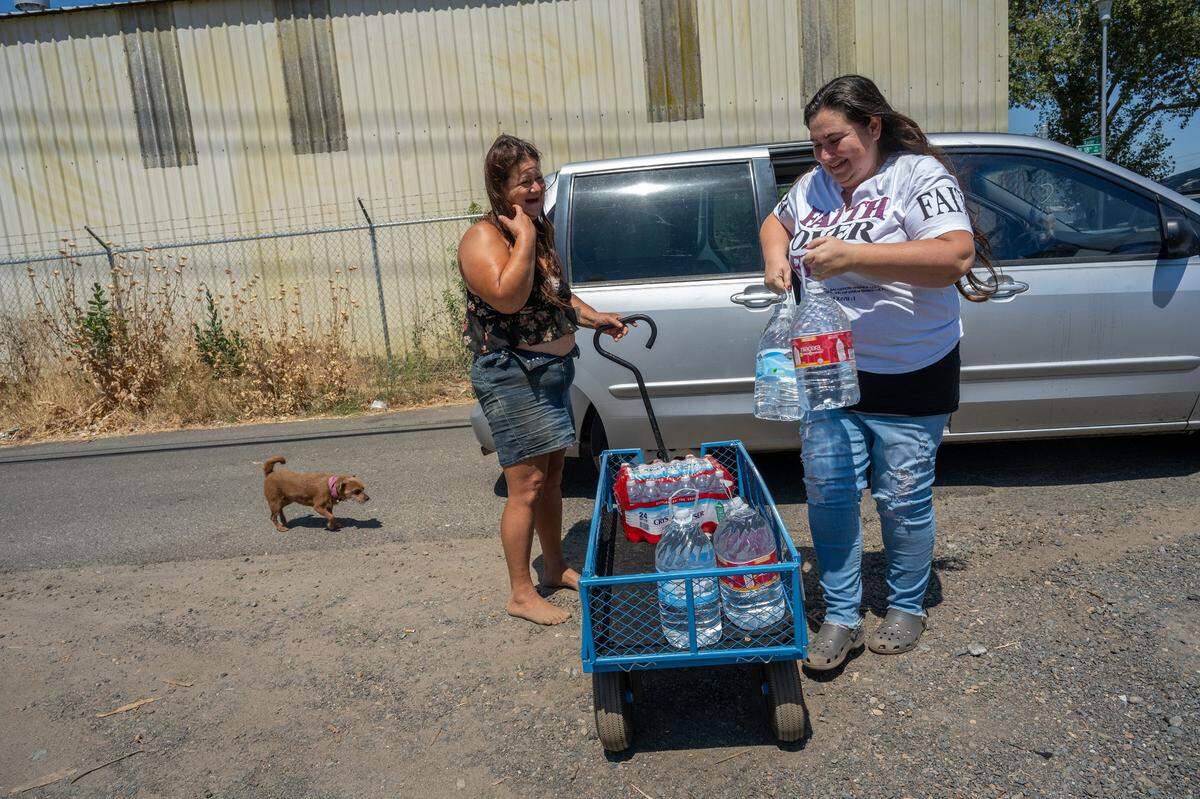
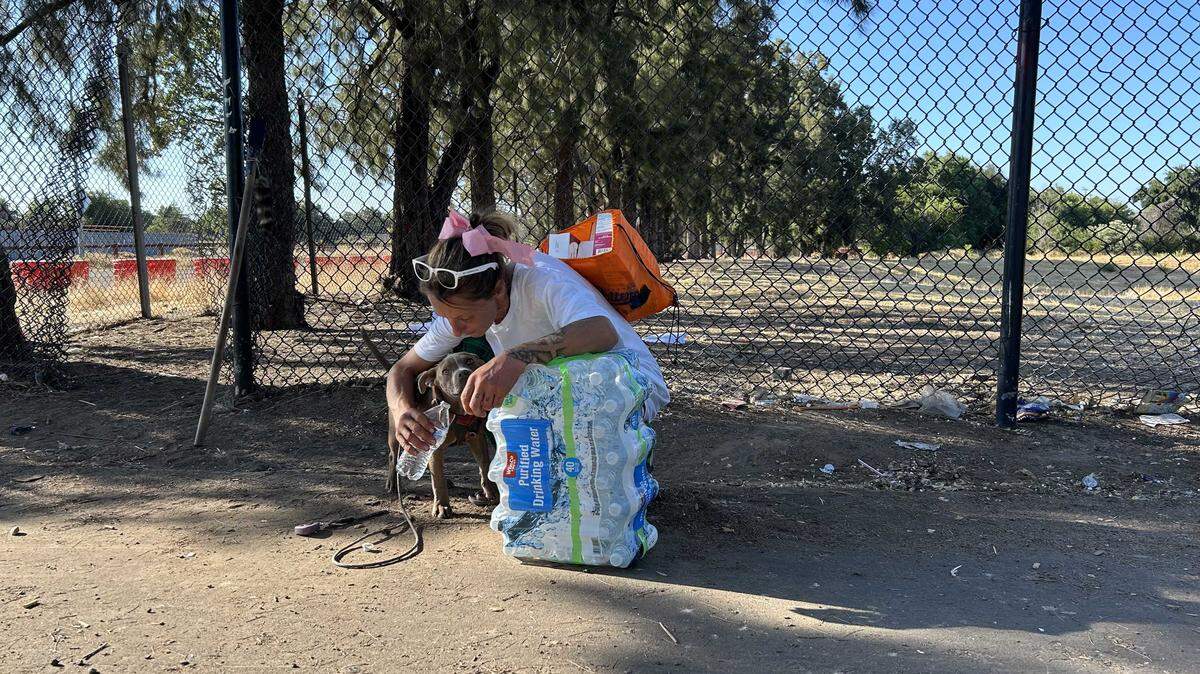
Welch received from Sanchez a case of 40 16.9 fluid ounce water bottles. As long as she does not use any bottles for laundry or bathing or sharing with neighbors, she said the water will last two days.
To store water from public fountains and the Sacramento Homeless Union, Ginger Gibbons used her disability checks to purchase a seven-gallon royal blue container, a 150-quart hard sided cooler and a purple jug emblazoned with “Barrel of Fun.” She also bought a six-gallon powder blue storage container — twice.
She said that all of them — the cooler and the jug and both types of blue containers — were discarded by the city during encampment sweeps. From April to the end of June, Gibbons said her encampment was swept five times.
The city’s homelessness response team has reported discarding 1.6 million pounds of garbage since April. The team states that, during sweeps, “Life necessities are left in place, unless the individual to whom they belong is subject to arrest; personal property with objective value may be removed but held for safekeeping at a City facility.”
Gibbons’ containers together cost more than $200 according to receipts reviewed by The Bee. She said none were kept in a facility.
According to Sacramento Police Department Sgt. Daniel Wiseman, there isn’t a fixed list of life-essential items, and officers instead determine what to discard based on their training, experience and guidance from the City Attorney’s Office.
“For something like a water bottle, it could depend on factors like how many there are, whether they’re full, and the overall context,” Wiseman said.
Each time her containers are discarded, Gibbons buys more. She said back injuries keep her from making long walks to the water fountain. Her neighbors go for her and, using the containers, bring her water to drink.
“If I didn’t have friends to go and get water for me,” Gibbons said, “I would have no water.”
This story was originally published August 9, 2025 at 5:00 AM.