
Police have patrolled Sacramento schools for years. Is it time to get cops off campus?
Check out more our stories in the Tipping Point series. Click here.
• • •
Uniformed police officers have been a fixture on Sacramento-area school campuses for years. School resource officers, or SROs, serve many roles, from security guard to counselor.
But is it time to get the cops off campus?
Amid a growing national debate over the role of policing, some districts are scaling back or removing uniformed police officers from schools. Two members of the Sacramento City Unified School District board and some community groups want the district to end its contract with the Sacramento Police Department. Minneapolis Public Schools severed its long relationship with the city’s police department in response to the police killing of George Floyd. Other school districts in the country, including in the San Francisco Bay Area, followed suit.
The Natomas Unified school board approved a new resolution on June 10 that will allow the district to continue hiring SROs, but also calls for the California Legislature and police department to implement reform and reduce conflict. The new contract between Natomas Unified and the Sacramento Police Department runs from July 1 to June 30, 2022.
Some contend the placement of uniformed officers in schools is an example of over-policing, especially for students who live in neighborhoods where residents have more frequent – and sometimes negative – interactions with police officers. There is also a growing concern about the financial burden caused by school contracts with police that can reach into the millions of dollars. Several student groups have expressed concerns that permitting SROs on campus invites racial profiling.
Sacramento City Unified voted to reduce the number of resource officers on district campuses in November 2019 by more than half when it renewed its contract with the Sacramento Police Department. The school board approved the new contract in a 5-2 vote, with board members Leticia Garcia and Mai Vang voting against it. The $560,000 contract is part of the district’s Plan to Reimagine School Safety, which includes implicit bias training and a director of school safety with an annual cost of $1.4 million. Officers who serve elementary, middle and high schools patrol anywhere between 25 and 30 schools divided by geographical zones.
The contract ends June 30 and the option for renewal will need to be discussed in future board meetings. The district’s budget woes prompted criticism from activists who called for money to be spent on counselors, not police.
Vang and Garcia have expressed their disappointment over the board’s decision to renew the contract. In a recently published opinion piece in The Sacramento Bee, they called for the school board to vote to end the contract with the police department.
“Unfortunately, the board has done the opposite,” they stated. “It has extended the contract and thereby reinforced the notion that school safety relies on having police officers in our schools. This must change.”
On Tuesday, several local organizations, including Sacramento Area Congregations Together, the Sacramento City Teachers Association, the Black Parallel School Board and Brown Issues, held a press conference outside the Sacramento City Unified School District office to call for the district to not renew its contract with the Sacramento Police Department.
The organizers also called for an alternate safety plan and for school board members to pledge to not accept money from the police union for their election campaigns. Vang has signed onto a growing list of local elected officials who intend to refuse donations from law enforcement groups.
“Our young people brought their stories to every single board meeting, and they did not listen,” said Alma Lopez, the statewide coordinator of Brown Issues, an organization focusing on Latino issues in the community. “The district was pressured to reduce the SROs. But that is not enough.”
SRO program and its role in Sacramento schools
The first documented SRO was placed in Flint, MI., in 1953, according to the International Foundation for Protection Officers. Fresno police were among the first to have a presence in schools in 1968 in an attempt to promote a positive public image of officers.
About 42 percent of public schools had at least one SRO one day a week in the 2015-2016 school year, according to the National Center for Educational Statistics. In California, about 1.8 million students, or 29 percent, are enrolled in schools with an officer at their campus, according to 2014 Civil Rights Data Collection.
Some school districts have contracts with various law enforcement agencies, and services range between tens of thousands of dollars in smaller communities to over $1 million in urban districts.
The Placer County Sheriff’s Office provides Placer Union High School District with seven SROs, four of whom are stationed at high schools. Folsom Cordova Unified has six officers contracted through Rancho Cordova and Folsom Police. Elk Grove Unified has a lieutenant, sergeant and 10 SROs, and two are contracted through Elk Grove Police to work with schools.
Sacramento City Unified once had about 20 SROs from the Sacramento Police Department, with one officer assigned to each of the districts’ high schools. In recent years, that number dwindled to eight. The district now has three officers and a sergeant.
“It’s a little harder being a rover, going from school site to school site,” said Gabriel Hernandez, who has been an SRO for two years and a Sacramento Police officer for five years. He chose to be an SRO, he said, because he wanted to work with youth.
“I built an awesome relationship with these kids,” Hernandez said, reflecting on the times when he was stationed at one high school and let students sit in his patrol car and ask him questions. “Having SROs at schools is not only important, but it’s vital, because you play a critical role in bridging that gap in the best way possible between our youth and law enforcement in a positive way.”
Hernandez said officers are careful not to be “over-enforcers,” and often refer students to counseling programs that could better serve their needs.
Police involvement in school fights is what concerns activists like Lopez. She said some teenage fights are being labeled as “battery against a civilian.”
“The role of cops is not to discipline our students,” Lopez said. “That’s for school staff to decide on what is the next step to take. It’s important that school is a place where students are learning to become adults.”
Lopez said SROs are problematic when they don’t have a defined role on campus and could contribute to the school-to-prison pipeline. Instead, students need counselors, nurses and social workers.
And while SROs are still present in Sacramento city schools, their response time to disruptive activities such as fights has increased dramatically since the move was made to not station officers outside each campus.
“Time is life,” Hernandez said. “Hopefully, God forbid in the event of a mass casualty event, we are already here, we can respond, we can engage and coordinate additional resources. We can triage, and we can neutralize the threat if it comes to that. That’s the worst case scenario.”
Doug Parsi, Director of Training at SafeDefend — a company whose technology allows teachers to use a fingerprint to set off a campus-wide alarm and notification in an event of an emergency — said police presence on campus is a deterrent.
However, overall, armed officers on campus have rarely prevented a school shooting.
Parsi, a former police captain with experience in active shooter situations, said most times in a school threat, the threat is from a student already on campus — not an intruder.
Armed guards at three high-profile fatal school shootings, including Marjory Stoneman Douglas High School in Parkland, Florida, were unable to stop school shooters from killing students.
Police calls to Sacramento schools
In Sacramento, officers have responded to threats against local schools and students via social media, some involving multiple schools and school districts at a time.
Between August 2019 and May 2020, 154 calls were made to police from the McClatchy High School campus or regarding the campus, according to the district’s data. More than 130 calls to law enforcement were made regarding John F. Kennedy and Burbank High Schools. About 120 calls were made from or about Hiram Johnson High, and 45 for Rosemont.
The calls were for a wide variety of reasons: shots were fired near a school, requests for welfare checks, child abuse and sex crimes reports, or for abandoned vehicles.
Between January and May 2019, McClatchy, Hiram Johnson and Burbank high schools each made at least 25 calls to law enforcement, according to district data.
The calls were for a variety of reasons: shots fired near the school, welfare checks, child abuse and sex crimes.
Other than being a presence at schools during arrival and dismissal times, SROs are on campus during lunch breaks and walk through campus greeting and building connections with students, parents and staff. They also are tasked with patrolling parking lots, adjacent streets and areas where students tend to gather after school.
But policing schools could expose school districts to legal trouble, according to the ACLU. Some police departments and districts have been sued for excessive force and discrimination, forcing districts to financially compensate victims and change district policies.
The ACLU says school officials are more likely to refer incidents on campus to officers if they involve students of color.
Native Americans are 3.4 times more likely, Black students are 2.7 times more likely, and Hawaiian and Pacific Islander students are 1.4 times more likely to be referred to an SRO, according to the ACLU. Students with disabilities make up 12 percent of the nation’s student population, but make up 23 percent of police referrals and 23 percent of arrests.
And students at schools where more than 80 percent of students are from low-income households are seven times more likely to be arrested than students at schools where less than 20 percent of students are low-income, according to the U.S. Department of Education Office for Civil Rights.
Students share concerns profiling
When Jorge Chavez made jokes about classmates on social media, he didn’t expect it to land him into a fist fight at school. Last year, he found himself throwing punches at Luther Burbank High School with three other students.
While many fights are broken up by campus security or teachers, school staff chose to take Chavez to the office and notify two SROs. Chavez was asked for his address, how much he weighed and his eye color by an SRO.
The two officers handed him a citation with four charges, including battery against a civilian, before his mom arrived on campus. He was given a court date and an appointment with a probation officer at juvenile hall. He was suspended for two weeks, and his criminal record has since been cleared.
“When I told the probation department I was there because I got in a fight, and I had never been in any trouble before, they asked me what I was doing there,” Chavez said. “He told me, ‘This place is for serious stuff.’”
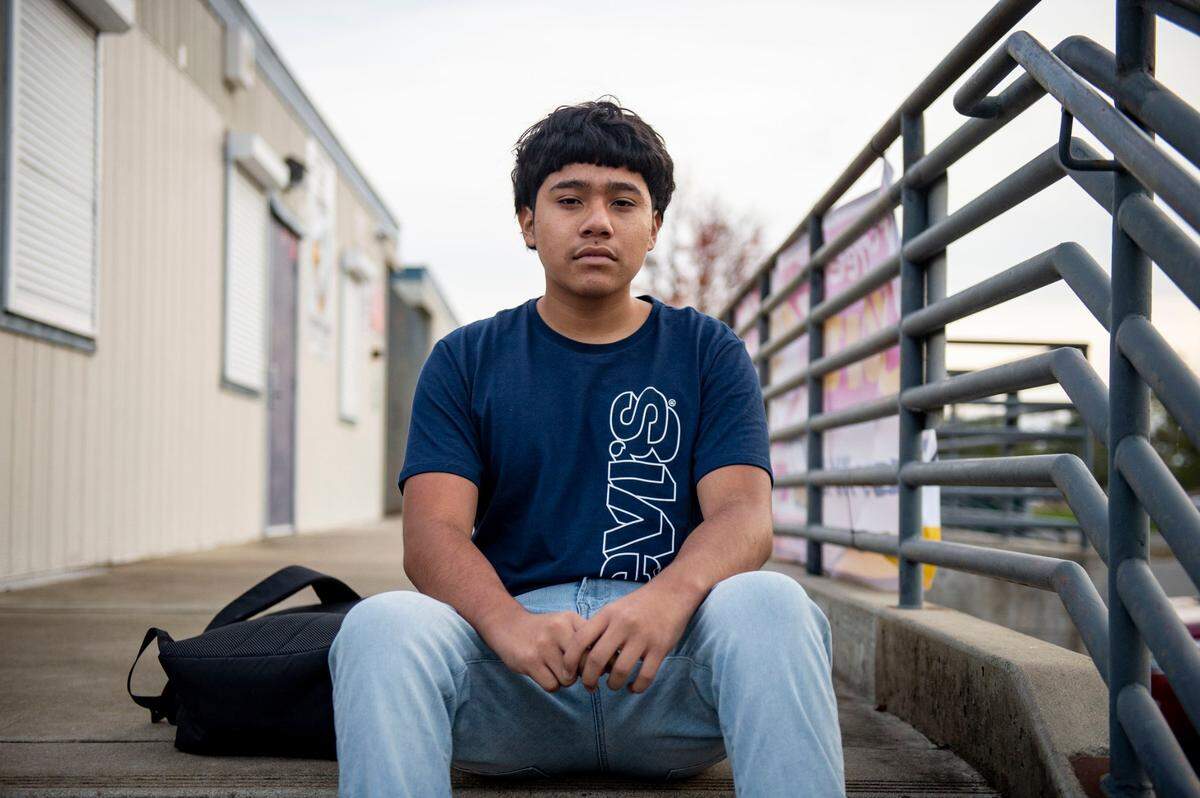
Burbank High School is in the Sacramento City Unified School District, home to several students who contributed to the ongoing debate about SROs at school board meetings.
“We feel like we are criminals,” said Chavez. “I personally feel like I don’t have a lot of freedom with them being around, and they are supposed to make us feel safe but we are not really safe.”
Community organizers and activists say that when SRO programs are implemented with policies designed to protect students of color, programs can be productive. For example, the Elk Grove Unified School District has implemented policies using the ACLU’s strategies that require districts to only call law enforcement for a clear list of offenses.
Two years ago Elk Grove police would be called for a wide range of disruptive behaviors, including an uncontrollable child or a fight on campus. Now, Community Safety Specialists handle low level offenses: loitering, defiance, profanity, failure to participate in class, physical altercations that do not involve aggravated assault or a weapon, possession of alcohol or small amount of marijuana, and possession of a tool that can be used, but is not, as a weapon- nail clipper, butter knife, pepper spray.
Sacramento City Unified hired a school safety director, who will develop, train and implement school safety plans.
Lorreen Pryor, president of the Black Youth Leadership Project, said she is not opposed to SROs, but opposes the officers policing non-criminal matters and disproportionately targeting Black students. She regularly attends school board meetings in districts throughout the region, asking for data on how SROs are trained and how often they are in contact with students.
“A lot of times, we say it’s the officers, but no it’s the admin and staff, because they’re calling the officers onto the campus,” Pryor said. “So we need to talk about what we are training our staff to do, what we are expecting them to do, when we are calling them. This is not their personal customer service hotline.”
Elk Grove Unified spokeswoman Xanthi Pinkerton said the district’s policy relied on community input.
“(The policy) clearly delineates the role of site administration and the role of law enforcement,” said Pinkerton. It includes enabling police “to be more nimble in response to emergencies at any school site within their region.”
An arrest increases a minor’s likelihood of a future arrest, says the ACLU, and effects their ability to find work, while pushing them out of school and into the school-to-prison pipeline.
But officers like Hernandez say that while they lean on the schools to handle discipline, and work in the interest of not taking students to juvenile hall, officers still have to abide by state laws and procedures.
“Victims do have rights, and we respect those,” Hernandez said. “Whenever we could, we implement restorative justice practices. My goal is to humanize the uniform and humanize the badge for staff and students alike who may not have had interaction with law enforcement.”
This story was originally published June 18, 2020 at 2:12 PM.