
What it will take to return downtown Sacramento’s K Street to a place you want to visit
Check out more our stories in the Tipping Point series. Click here.
• • •
On an abnormally warm February evening, hundreds of Sacramento Kings fans filled downtown’s K Street before a game at Golden 1 Center against the Miami Heat. Fans filed onto the street from all corners of the downtown core or arrived on crowded light rail trains. A new Taco Bell Cantina was packed, just as it had been most days since opening a week earlier.
It was the kind of scene Sacramento leaders dreamed of for decades as they tried – again and again – to recreate a version of K Street reminiscent of its heyday in the 1940s and 1950s, when the bustling corridor resembled a six-block miniature Manhattan.
“K Street continues to be the umbilical cord or the cultural and civil backbone of our city, from when we were born until now,” said City Councilman Steve Hansen, whose district includes downtown Sacramento. “It becomes a fixation.”
Despite the progress, K Street — or rather, “The Kay,” as the area between Seventh and 13th streets has been rebranded — remains in a state of change at the dawn of a new decade. It has issues lingering from years of neglect and failed action, but also has the appeal of cutting-edge new commercial enterprises. It can be full of life one night, dark and empty the next. Tens of millions of dollars have been invested in the street, and yet empty storefronts and lots still dot the landscape.
The next five to 10 years will be critical for the health of K Street and downtown Sacramento as a whole. Will the former Main Street of the Central Valley fully prosper once again, or will big dreams fall short?
History of K Street
K Street was at its peak in the 1940s. It stood as the centerpiece for a thriving downtown and had a buzz that felt like a San Francisco business boulevard. World War II launched what some call the second Gold Rush in Sacramento, bringing workers into the downtown railyard, the riverfront and Air Force bases, Sacramento historian Marcia Eymann said.
There were few suburbs at the time, so many workers lived downtown in apartments, some known as SROs for single-room occupancy. They shopped on K Street at Weinstock Lubin, Montgomery Ward, and Ransohoffs. Movie theaters such as the Crest and Esquire (both marquees are still prominent on K Street) doubled as stage-show venues. The J, K, L street central business district corridor had more than its share of bars, eateries and night clubs.
.JPG "5-03182013-50001799A (1).JPG")
“The streets were filled with people,” Eymann said. “It was an active time. Sacramento was growing. The majority of people were living in the city.”
But the renaissance was short-lived. As car ownership became more common and middle-class families sprawled into the suburbs in the 1960s, shopping centers and new housing in areas such as Citrus Heights, Arden Arcade and Roseville gutted K Street’s retail core, leaving blight in its place.
That launched a handful of generally unsuccessful City Hall efforts to revitalize that stretch of downtown, starting with turning K Street into a version of a suburban retail center by banning cars. They even copied a suburban term of that era, calling it the K Street Mall.
The 1990s and early 2000s saw a period of economic revival on the western edge of the district, when the city helped finance what became the Westfield Downtown Plaza shopping mall. But that did little for much of the rest of K Street. And by 2011, Downtown Plaza was a failure. Most stores were closed.
That left city leaders in a quandary about what to do. They had considered trying to lure a few multiplex theaters to K Street, halfway between Downtown Plaza and the Sacramento Convention Center in hopes of enlivening the blocks in the middle. That plan didn’t go anywhere because theater developers rightfully saw the mall as a dead zone. Instead, they went on to remodel their suburban theater locations.
At the time, Hansen says, negative trends were intertwined.
“Downtown Plaza was deteriorating,” Hansen said. “The state was furloughing workers. It was a challenging economy. We were seeing restaurants close by the day. There was a general malaise in the downtown core.”
It was time again for a rethink.
What changed on K Street?
The city decided its biggest problem was that no one lived downtown anymore. After state workers left at 5 p.m., the area was a dead zone.
Essentially admitting its failed pedestrian mall effort, the city in 2011 reopened the street to cars, so at least people could drive down it and see what was — or mainly, wasn’t — there.
Then the effort received a dose of good luck.
Westfield sold its mall for a rock-bottom bargain price of $22 million in 2012 to JMA Ventures of San Francisco, though JMA wasn’t initially sure what to do with the site. The NBA stepped in next, helping the city keep the Kings but demanding the city and team build a new arena, and to do it downtown. The city first tried land it owned in the Railyards, but their preferred space was a tight squeeze and the Downtown Plaza site reemerged as the best spot. (Some developers had floated the idea nearly 20 years ago, but Westfield wasn’t budging at the time.)
“People love to hate the arena, but you can’t deny it is bringing energy and investment into the city that is producing revenue,” Hansen said. “It was like a defibrillator on the city’s heart. What we saw after that was this renewed sense of confidence in the central city, particularly downtown. We saw properties changing hands. That generates revenue for the city. And then finally we saw projects coming along behind them.”
BEHIND THE STORY
MOREWhy we reported this story
Downtown Sacramento’s K Street was once a vibrant entertainment and shopping district, reminiscent of a miniature version of Manhattan. But those days are long in the past, despite millions of dollars being spent.
What needs to happen for K Street to recapture its former glory? Is that even possible? And will shoppers and residents ever return to an area that is often dominated by homeless and crime?
Click on the arrow in the upper right to read more.
What is Tipping Point?
This story is part of Tipping Point, a journalism project focused on telling the stories of the Sacramento region’s evolution. We have formed a team of reporters and editors who are writing weekly stories focused on the challenges and opportunities in the region.
We’ve brought you stories about how Woodland is changing as new residents move there from Davis, the viability of downtown’s restaurant scene and where the Sacramento region’s real estate market is headed.
Stay in the loop and subscribe to our Tipping Point newsletter here.
Support local journalism. Support The Sacramento Bee
In-depth articles such as this are reported by journalists who live right here in the Sacramento area. And Sacramento Bee’s investigative journalism makes a difference in our communities and in our state. Your support makes it possible.
Subscribe today, and #ReadLocal with us.
The Kings ownership group – with the help of a subsidy from the city – constructed Golden 1 Center, and it opened in 2016. A hotel and condo tower followed, along with a now vibrant shopping and entertainment district dubbed Downtown Commons.
After the Punch Bowl Social restaurant, the second business to open in Downtown Commons was trendy clothier Urban Outfitters, which abandoned its Arden Fair Mall store to do so. The message was clear: times had changed, and with suburban malls across the U.S. facing their own challenges, downtown Sacramento was once again worth investment.
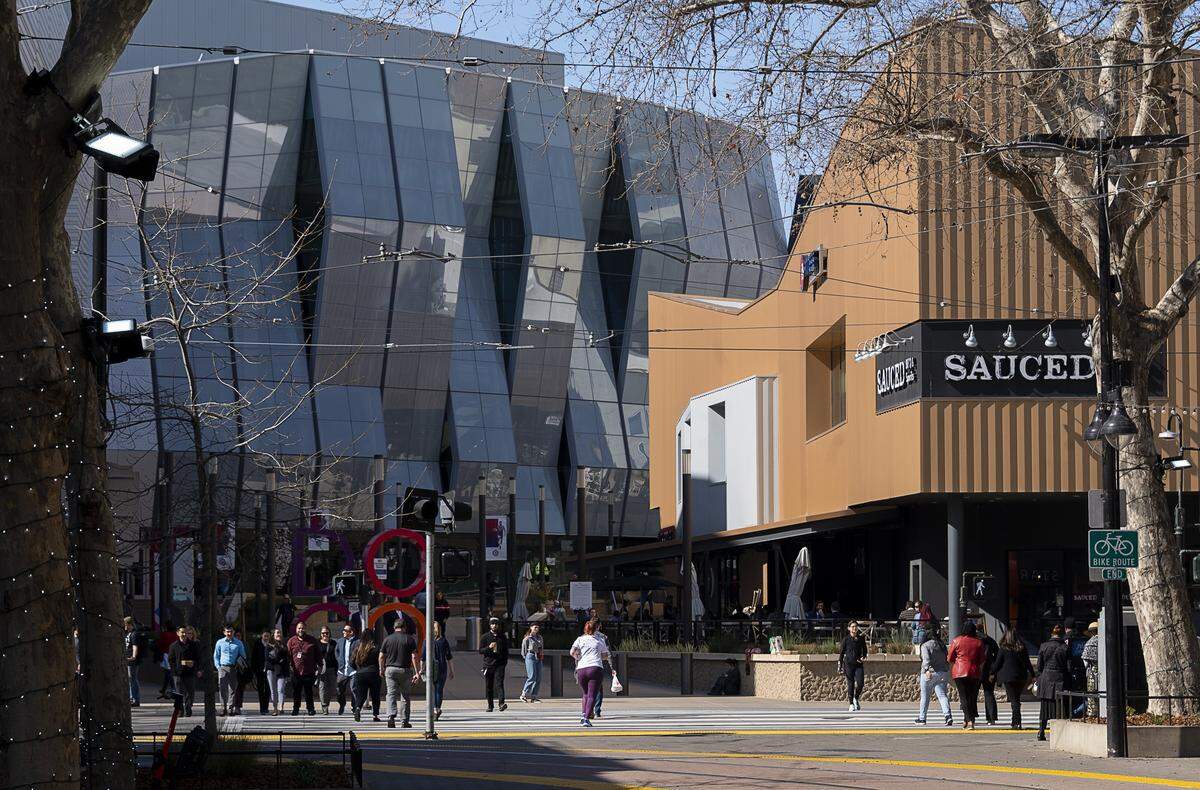
That’s the reason Macy’s, which just announced plans to close 125 stores across the U.S., continues to pour money into its DoCo cornerstone rather than sell the property or rent the space out. Recent additions like a small-scale living section, virtual reality and the sale of beer, wine and bar bites on an outdoor patio are clearly meant to attract downtown residents and workers or people headed to Golden 1 Center events.
“When I first came here (in 2016), nobody was hanging out like this. It just wasn’t happening,” Macy’s store manager Dorla Licausi said, gesturing toward the rest of DoCo from the patio. “Slowly but surely, as the (complex) continued to open, we kept seeing an uptick in traffic.”
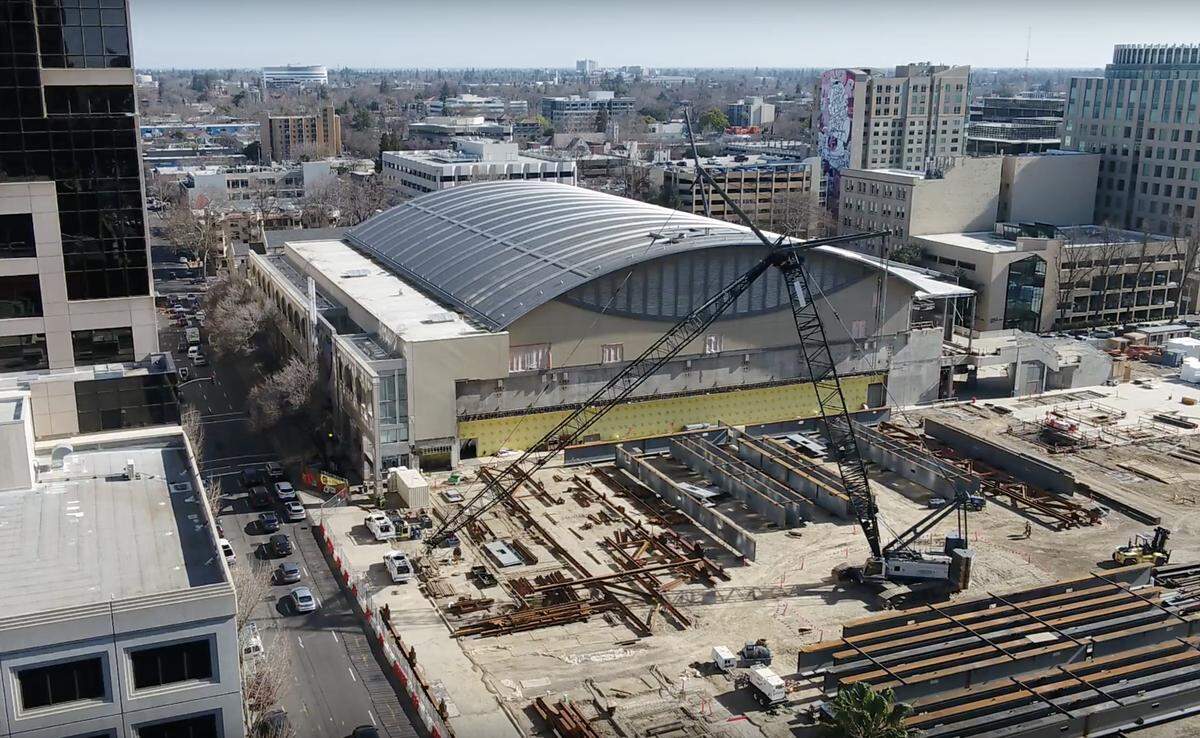
Trendy new restaurants and bars fill some blocks, while other stretches remain empty. K Street’s flux is most visible where it intersects 13th Street and cranes cut through the downtown skyline. The former Sacramento Convention Center’s $350 million demolition and rebuild is scheduled to be completed next year and should provide a big boost to surrounding businesses, including hotels new and old in the surrounding vicinity.
Tech firms have also gobbled up competitive real estate near the arena, starting with SkySlope and Rhombus Systems, both companies with a youthful energy and a sense that their environment should be work-live-and play. Cambria Solutions bought a 22,000-square foot building at 730 K St. and turned it into the sparkling glass headquarters for the growing IT/management consulting firm with outposts in Los Angeles, Atlanta, Washington D.C. and five other cities.
High-profile openings have made K Street interesting once again. They’ve also highlighted or even contributed to the social stratification clearly visible to anyone who walks down the street.
Homelessness, crime in downtown
There’s no tiptoeing around it: homelessness and crime are two of the factors keeping K Street from reaching its ideal form.
Downtown has the largest concentration of homeless in the region aside from the American River Parkway, and business owners and police have cited the issue as a factor keeping some customers from the area.
It’s easy to find downtown workers and visitors complaining about trash and feces strewn around K Street on social media. Some efforts at solving the problem have been successful; others, like replacing traditional benches with seats people can’t lie on, have drawn the public’s ire.
A stretch by Ninth and K streets earned the nickname “s--- alley” among local business owners, one told The Bee in 2018. Police presence around Golden 1 Center increased around the start of the 2018-19 Kings season after a spike in crime on K Street, but that didn’t deter a deadly shooting at El Rey that December. The restaurant owned by ex-King Kenny Thomas closed shortly thereafter amid many other problems.
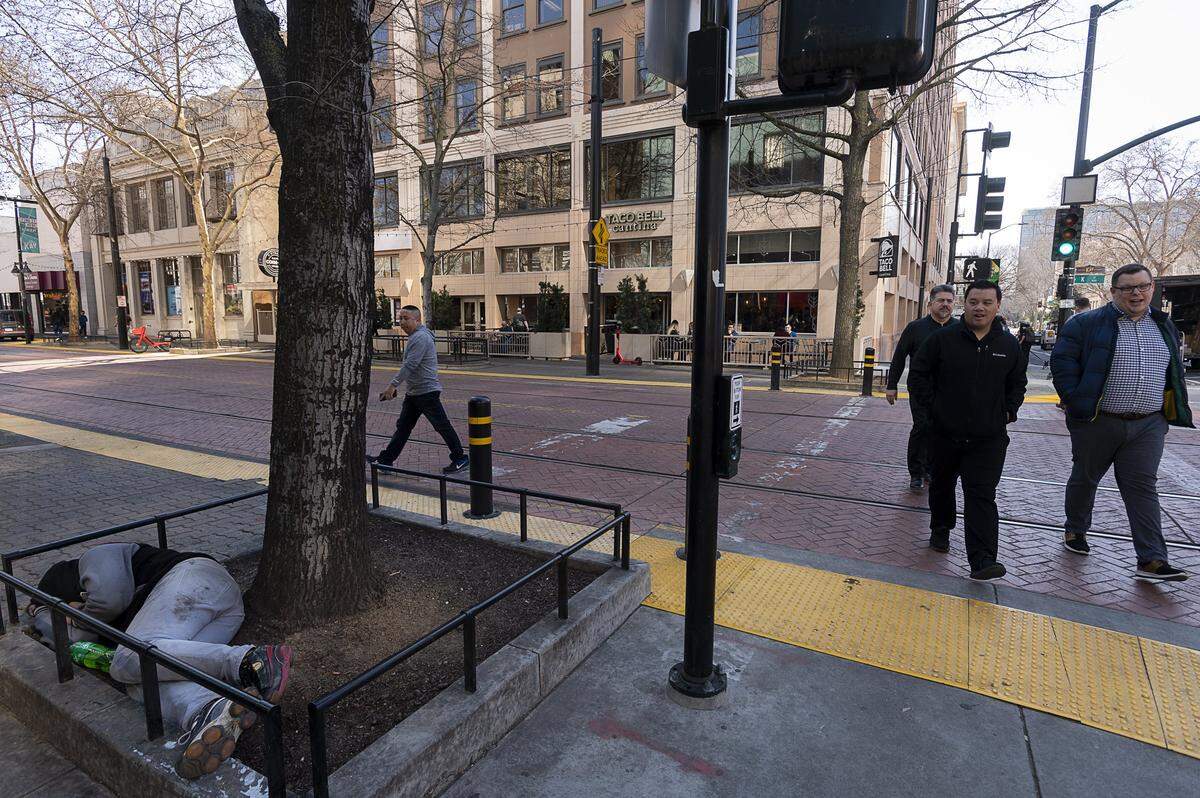
Golden 1 Center’s opening cleaned up nearby blocks. But that pushed those living on the streets further down K Street, said Empress Tavern executive chef/co-owner Michael Thiemann, who recently closed neighboring restaurant Mother to open Jim’s Good Food in midtown.
“The area around (Golden 1 Center) got nicer, where the surrounding area, due to the land mass displacement, got rougher. So you can imagine the added challenge,” Thiemann wrote in a text message.
There’s little housing relief nearby for the homeless. Apartment construction across Sacramento over the last five years has significantly favored the rich and middle-class over those with lower incomes, and most new downtown projects fit that trend.
That also contributes to rising rent costs for restaurants along K Street, several of which saw rates of $3 to $4 per square foot last year. Adjusting prices accordingly can turn off customers, especially those coming in from the suburbs, where meals are generally cheaper and parking more plentiful.
Then there’s Golden 1 Center itself, which has sourced 90 percent of food and drink ingredients from within 150 miles since opening. When a Kings game starts at 7 p.m. and arena concession options include Centro, Petra, LowBrau and Star Ginger, dinner at a restaurant outside the arena is less a necessity than an option for fans.
“When (Golden 1 Center) opened, the primary marketing messages (were) the food offerings. I do believe that they built an incredible gigantic restaurant with a basketball court in the middle,” Thiemann wrote. “I wish the (K)ings were as good as their food.”
Housing is the solution
Housing, both for people living on the streets and those with disposable income, remains the biggest and best answer to K Street’s thorniest problems, city officials say.
The city has turned the Capitol Park Hotel – a former low-income apartment complex – into a temporary homeless shelter that houses more than 100 people. The shelter will transition next year into a permanent housing site for formerly homeless.
Notably, it sits across the street from a lot where developers are planning a 200-room Hilton Hotel that likely will cater to tourists and people conducting business at the state Capitol.
Mayor Darrell Steinberg said the two buildings sharing the same block make a statement: The city can reinvigorate K Street and help the homeless simultaneously.
“We are struggling in different neighborhoods around the issue of (housing) to alleviate the homeless crisis,” he said. “I hope people will look at the Capitol Park Hotel’s proximity to signature downtown investments. It may not be perfect. But the business community has said to me it has not been a problem. I strongly believe it (the permanent housing site) is going to improve the quality of life in the corridor because people should be indoors.”
It’s a start. More is needed. Meanwhile, a paltry downtown housing stock for even those in better financial positions raises concerns for the viability of the swath of new retail operations around DoCo.
Downtown housing developers have made some progress over the last few years, opening the Bel Vue apartments for lower-income residents as well as The Hardin apartments at Seventh and K, which has 137 units, many for lower-income earners. Earlier, the M.A.Y. Building at 11th and K opened with 21 upscale units. But residential space often takes longer to build than retail, and it’ll take major projects to make a sizable impact.
The Kings and CFY Development Inc. have filed permits to start work on a 150-unit complex with 10,000 square feet of retail space at Eighth and K. Developer Nikky Mohanna is planning a 15-story building with 186 apartment units, a 200-room hotel and dorm-style rooms for 64 young Capitol staffers in a 15-story building at 10th and K.
Three ambitious projects near K Street would also bring waves of residents downtown:
After years of arm-twisting by the city, a development company is finally formally seeking permits to build a project called Anthem Cathedral Square 153 apartments and retail at 11th and J streets on what is generally considered downtown’s most blighted block. The Metropolitan project would put 193 units across J Street from Anthem Cathedral Square. And the under-construction Sacramento Commons will bring 436 apartments between Fifth and Seventh and N and P streets.
Then there are the temporary downtown residents, the tourists and convention attendees who come into Sacramento for a day or five, eager to try the surrounding restaurants and walk the city center. Hotels like the Canopy by Hilton (Ninth and L streets, 275 rooms), The Hyatt Centric (Seventh and K, 172 rooms) and The Exchange (Fourth and J, 100 rooms) should lend the area around K Street an influx of dollars and foot traffic when complete, which will be key in keeping business afloat, said Michael Ault, executive director of the Downtown Sacramento Partnership.
“The reality is, downtown will always need to be a destination. We don’t have the numbers for housing to support the development and retail that’s happening here,” Ault said. “Obviously, social issues need to be managed. Visitors are a big part of the street population downtown. We have become a destination, and we need to make sure that experience continues.”
K Street’s renaissance is far from complete, but it’s aggressively underway, and not a moment too soon. Railyards development centered around Sacramento Republic FC’s new MLS stadium should pick up in the next couple years, and is expected to eventually double the city’s downtown.
It’ll be tough enough to build a thriving entertainment district on largely desolate land south of Richards Boulevard; it’ll be harder still to make the two arenas connect without a solid existing downtown stretch – and that starts along K Street.
“You’re now starting to see that stretch really evolve to entertainment venues, live music, things that tie that pedestrian spine together,” Ault said. “This is K Street’s time ... to entrench itself with these amenities and build itself out to establish some real roots here.”
This story was originally published February 20, 2020 at 5:00 AM.