California gas prices could fall under a new law. Will you see it at the pump?
AI-generated summary reviewed by our newsroom.
- California law allows E15 sales while air board reviews, aiming to ease prices.
- Refinery closures and a recent Chevron blast cut state output and pressure supply.
- Experts say E15 may lower costs modestly but firms decide if savings pass on.
A new California law to allow the sale of gasoline with a higher concentration of ethanol could have a modest effect on consumer spending as gasoline production in the state slows, two experts said.
Gov. Gavin Newsom said he was looking to stabilize gas prices when he signed Assembly Bill 30 into law Oct. 2, months before the scheduled closures of two California refineries and — in a startling coincidence — hours before an explosion and fire damaged parts of a south state Chevron refinery. Although oil consumption has generally fallen since 2000 as cars become more efficient and electric vehicles become more common, the state still relies heavily on fossil fuels.
E15 fuel is a mixture that is 15% ethanol by volume and 85% unleaded gasoline; currently, California allows the sale of gas that is up to 10% ethanol by volume. The fuel is approved for vehicles with a model year of 2001 or newer. The California Air Resources Board is still analyzing E15’s potential public health and environmental effects. AB 30, which went into effect immediately, allows the sale of E15 to start while the state awaits the final decision from the air board.
That could relieve some pressure on fossil fuel companies in the state. The Phillips 66 refinery in Wilmington — a Los Angeles neighborhood not far from the Chevron explosion — is set to close in December, while a Valero plant in Benicia — just southeast of Vallejo in the North Bay — will close next year. These planned closures would reduce statewide production by 18% and are likely to raise prices; the unplanned explosion was also expected to drive up prices in the short-term.
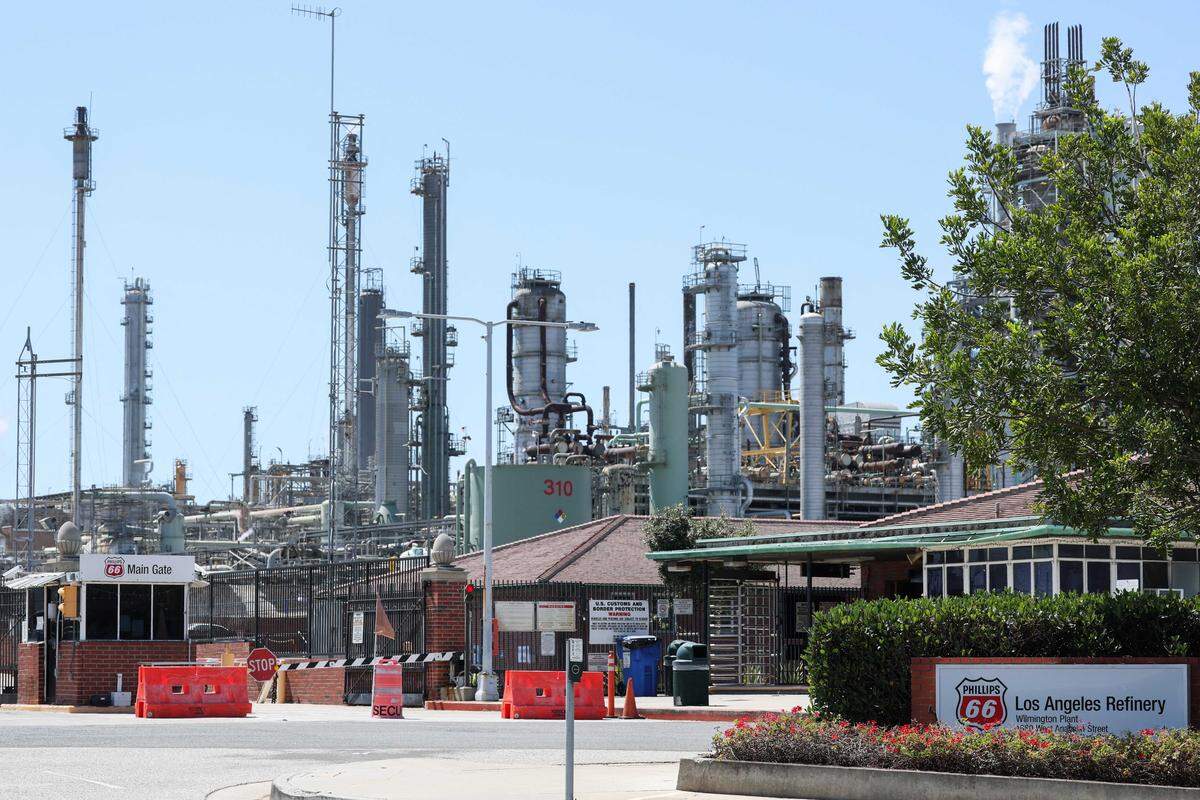
As of Monday, a week and a half after the refinery fire, the average price for a gallon of regular unleaded gasoline in California was almost $4.67 per gallon, according to AAA. That’s almost three cents higher than a month ago and about the same as Oct. 13, 2024. In Sacramento, the average was $4.62, down from $4.74 a year ago and well below the record high of $6.44 reached in June 2022.
Newsom’s office has said that E15 sales could reduce gas prices by as much as 20 cents per gallon. Colin Murphy, co-director of UC Davis’ Energy Futures Research Program at the Institute of Transportation Studies, said that may be overstated. It’s hard to predict gas prices in the first place, he said, and E15 implementation will come with industry costs because it will require changes to the supply chain and likely new or modified gas station equipment.
Ethanol, which is distilled from corn, is itself more expensive than crude oil, said Bulat Gafarov, an assistant professor at UC Davis’ Department of Agricultural and Resource Economics. Gafarov explained that the cost reductions to producers would be indirect: Most of the savings would come from lower carbon credits and the increase in the amount of available gasoline once it’s thinned out with ethanol. He said that any benefit to consumers would be relatively short-term.
Still, Murphy said that introducing E15 seemed like “a sensible option”: It’s likely slightly lower carbon, and it could take pressure off the state’s oil supply. But when Californians start using E15, there will “not be a big night-and-day difference” in terms of price and performance.
“The main thing you have to remember is, gas prices are set by gas companies to maximize their profit,” Murphy said. Using 5% more ethanol per gallon would cut costs to fossil fuel companies. “Whether they will pass that savings on to consumers? That’s up to them.”
California gas prices have a ‘mystery surcharge’
Because most California gasoline and diesel is refined in-state, California’s market sees less competition than other states. Murphy called California “an energy island.” The lack of competition seems to contribute to higher gas prices for consumers.
Since 2015, Californians have been paying 20 to 30 cents per gallon more in a “mystery surcharge” that appears to be unrelated to the state’s environmental restrictions and higher taxes. Severin Borenstein, a professor at UC Berkeley’s Haas School of Business and the former chair of the California Energy Commission’s Petroleum Market Advisory Committee, identified the surcharge by analyzing years of gas prices in the state and comparing them to costs in other states.
Since 2015 in particular, he wrote in the Los Angeles Times, “the price gap has jumped higher than costs and taxes can explain.”
Borenstein observed in the data that the mystery surcharge on top of costs and taxes was, on average, 2 cents per gallon between 2000 and 2014, and never went higher than 12 cents per gallon during those years. After a refinery explosion in 2015, he said, prices spiked and the mystery surcharge that year went up to 48 cents a gallon. It came back down from 48 — but the surcharge never returned to its pre-2015 levels.
Since fuel prices do not fully reflect costs in California, it’s not clear how much of the savings from E15 would show up at the pump.
“They don’t have to pass savings on to the consumers,” Gafarov said. “It’s a big ‘if’ question, right?”
Smaller cars would help California gas consumers
In the past, Americans have often shifted to buying smaller vehicles when gas prices rose, since smaller vehicles use less gas. MarketWatch reported this trend in 2024 — sales of smaller cars were rising faster than sales of larger cars and trucks. But automakers have found that bigger cars are more profitable, and they’ve offered fewer and fewer compact and subcompact options in the U.S. Cars in the nation have gotten significantly bulkier in the last 35 years: In 2023, the Insurance Institute for Highway Safety said that since the early 1990s, “the average U.S. passenger vehicle (had) gotten about 4 inches wider, 10 inches longer, 8 inches taller and 1,000 pounds heavier.”
And although vehicles have become much more fuel efficient over the last 15 years, the bloated size of vehicles undercuts that efficiency. Researchers from the UC Davis Institute of Transportation Studies worked on a study released in 2023 that found “energy demand and CO2 emissions could have fallen 30% more between 2010-2022 if vehicles had stayed the same size.”
That extra gas burning has harmed not only the planet, but also consumers’ wallets.