They wanted speed bumps to fight Sacramento traffic. They got red tape instead
All this arguing with the city of Sacramento began more than a decade ago because Nora Williams has always loved sitting on her front porch. That gave her an unbeatable view of drivers speeding down her Tahoe Park street, and that got her angry.
“There’s a lot of pedestrian traffic, there’s a lot of people that are walking their dogs, walking their children, kids playing out in their yards, bicycles,” said Williams, now 68. “I started to get worried at the amount of traffic that comes through.”
Around 2013, after she’d already lived in the house for a few years, Williams learned that the city had a mechanism for residents to request speed bumps. She thought that would solve the problem on 62nd Street: Drivers would be forced to slow down, and she and her neighbors would be safe.
It seemed like a no-brainer.
She contacted the city, obtained a petition form, walked the block collecting signatures from about a dozen neighbors, submitted it to the Sacramento Department of Public Works — and waited. The traffic survey showed the street didn’t meet the criteria: not enough vehicles were traveling faster than 30 mph on the 25-mph street.
That was disappointing. But it wasn’t the first time Williams had been told “no.” She’s persistent. She figured she’d just try again.
Twelve years and three failed attempts later, she said she’s summoned more grit than she ever thought a speed bump would require. It made her reflect on the entire city.
If she was having this much trouble getting a speed bump, who else in Sacramento was struggling?
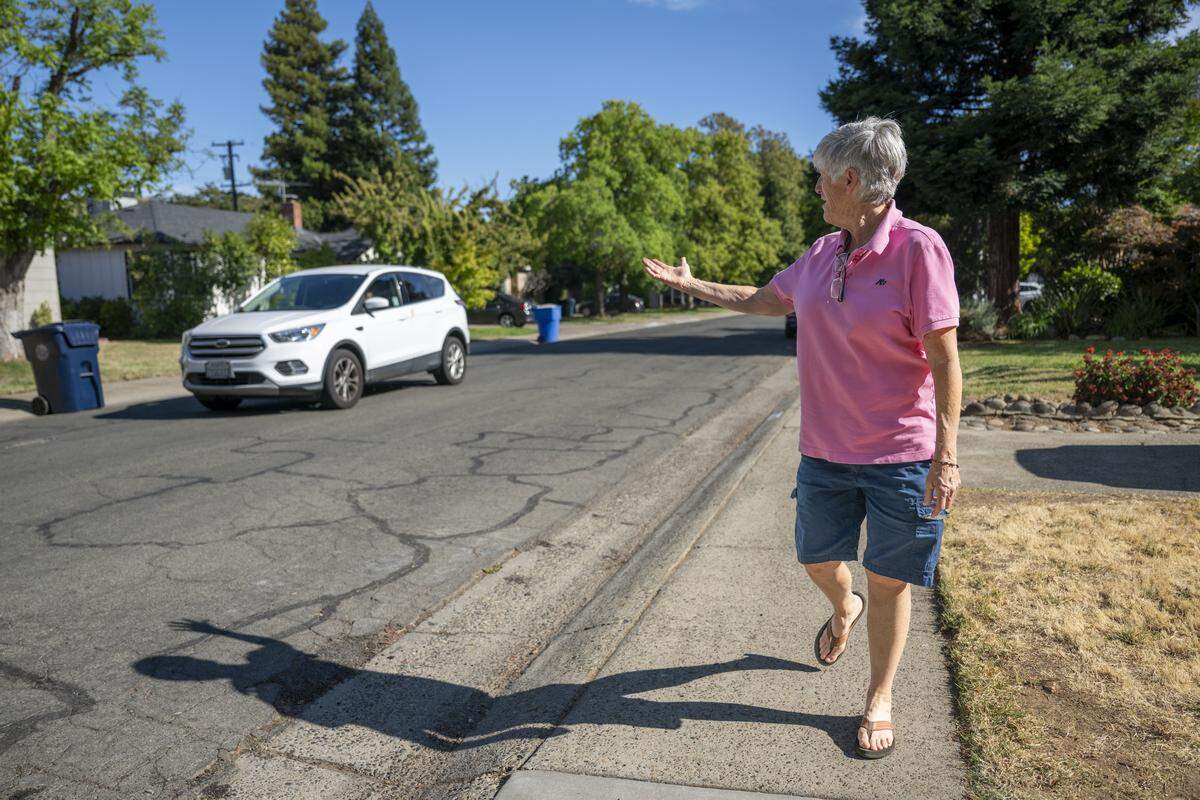
Controversial speed bump criteria
The city’s speed bump program — technically a speed “lump” program — is one of the more accessible ways to request an infrastructure improvement from the Department of Public Works.
Residents on low-speed residential corridors must first submit a petition signed by at least 10 neighbors. The city then measures vehicle speeds for a 24-hour period on a weekday when schools are in session. If at least 15% of drivers exceed the posted limit by more than 5 mph, the street qualifies for lumps, triggering a mail-in election.
At least 25% of ballot recipients must vote, and two-thirds of those votes must support the lumps. If the neighborhood clears all those hurdles, the city installs the bumps. This year, 24 streets were approved.
Williams’ street hasn’t met all the criteria. In some years, it passed the speed test but failed the vote — she said it once received a majority but not the two-thirds required. In other years, it didn’t meet the speed threshold and never advanced to a vote.
City data from a recent survey showed 7% of drivers on 62nd Street were traveling between 25 and 29 mph. About 26% were under 15 mph. Just 14 drivers went 30 mph or faster — not enough to meet the 15% threshold. One traveled between 65 and 69 mph, but most stayed between 30 and 34.
In total, nearly 1,200 vehicles passed the sensors. About 9% were speeding, and only a few were significantly over the limit.
After years of advocacy — and earlier studies showing higher speeds — Williams was frustrated.
“I think it’s a valid concern,” she said. “It shouldn’t be this difficult of a process to get safety installed in our neighborhood.”
A city official said the Department of Public Works is trying to prioritize the neighborhood streets that are in the most need.
“In order to be cost-efficient and utilize tax dollars and city money in places where there is the most need, we have an expectation that there actually is speeding on the street,” said Megan Carter, the city traffic engineer.
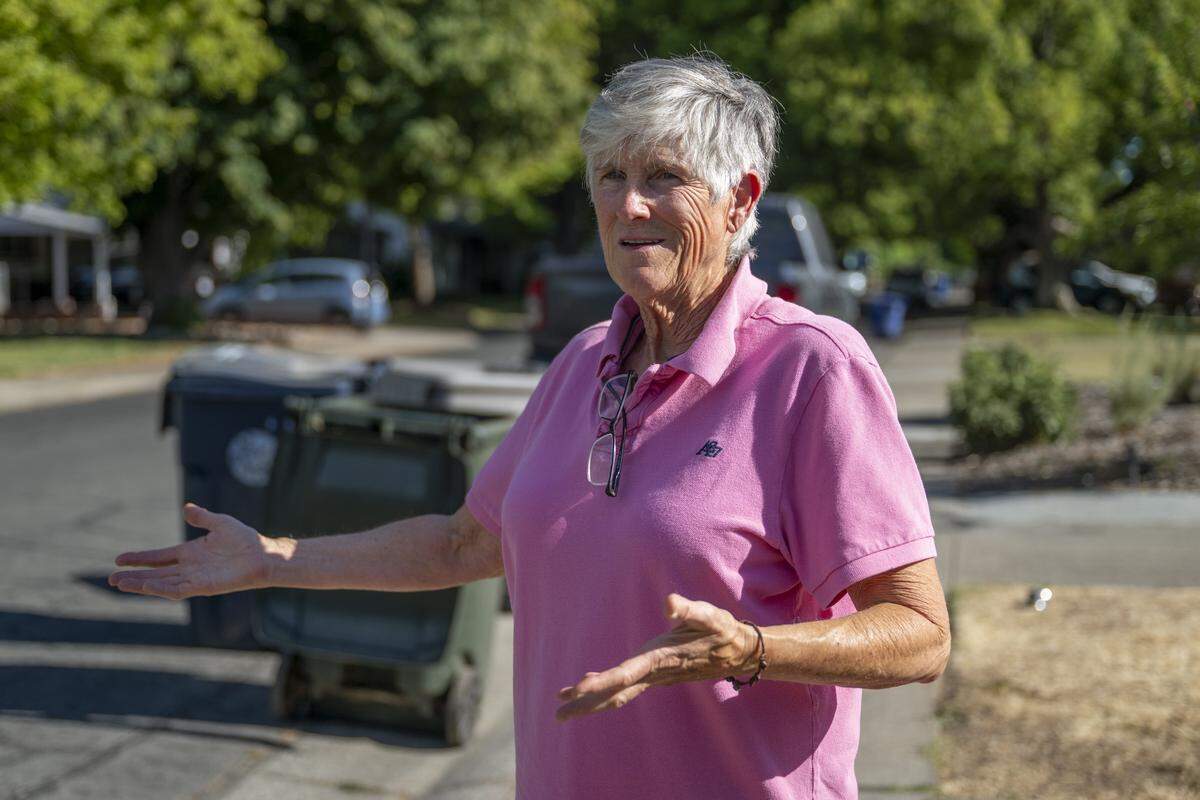
Williams believes the threshold should be lower. Even if fewer than 15% were speeding, she said, it still endangered pedestrians. She also suspected the data could be skewed by neighbors pulling into driveways. And she thought the vote might have been the worst part of the whole thing: Why would the city let people decide democratically whether drivers could hurtle through a neighborhood without obstacles?
“I’ve written letters to the mayor, I’ve written letters to City Council members,” Williams said. “I think that having people vote on the street for the safety of others doesn’t seem like a great process. I think that there should be other ways to determine safety on the street.”
The city has expanded the program in recent years. Since 2022, Sacramento officials have budgeted between $500,000 and $650,000 for the program, Carter said — more than double the funding from before 2020.
Traffic patterns changed during the COVID-19 pandemic. Shutdowns in 2020 and 2021 reduced commuting, and emptier roads led to higher speeds. Some of those habits persisted and virtually no one was in their way.
“Driver behavior changed,” Carter said. “We started receiving a lot more complaints about speeding in residential neighborhoods.”
When the city bumped up the speed lump budget in 2022, Carter said, “Our intention that year was, any street that qualified, we would have enough budget to cover it.”
But the city’s funds are still limited, and although speed bumps are a relatively cheap infrastructure intervention, the Department of Public Works still has to prioritize. Currently, those priorities are set based on the speed lump program guidelines last updated in 2014, which rely on the current speed limit and the 85th percentile rule.
Speed rules ‘like an oxymoron’
Rory Hodgson, an attorney in East Sacramento’s Alhambra Triangle, tried unsuccessfully to get speed lumps on T Street.
In 2022, the street qualified after data showed enough motorists exceeded the posted speed limit by more than 5 mph, but Sacramento Regional Transit blocked the installation. In 2025, speeds were too low to meet the threshold. He wrote to a city traffic investigator: “This doesn’t make sense.”
“This poor neighborhood just gets s--- on,” he said in an interview. “It’s a working-class neighborhood, and it’s like the armpit of Sacramento.”
Hodgson has three children — 11, 8 and 2 — but he won’t let any of them play outside.
“Even getting into your car on the street is dicey,” he said. He feels “afraid when I get out of my car every day…and when I load my kids in the car.”
He once placed construction cones in the street to slow traffic, but a city employee told him not to interfere before the speed study. The best-case scenario, the staffer’s email implied, was for speeds to be high on survey day.
Hodgson said the system seems to reward dangerous driving during the study period.
The logic, he said, seemed backwards. His street has a 30 mph limit, but he believed it should be 25 because it’s a residential zone. To qualify for speed lumps, 15% of drivers must exceed 35 mph — just to reduce speeds to 20 or 25. But when Hodgson told a city traffic investigator he wanted to decrease the 30 mph speed limit to 25 mph, the investigator warned him in an email that the plan could backfire. Under state law, a speed study that found many drivers going faster than the speed limit could lead the speed limit to be raised.
Hearing all this, the lawyer said, “It’s like an oxymoron.”
In part because of statutes such as the “85th percentile” speed law that favors the speeds at which drivers are already traveling — even if they’re unsafe — Carter said the city is in a bit of a bind.
“We still have to follow the law,” Carter said. Generally, the city can’t “set speed limits arbitrarily (based) on what we want the speed limit to be.” And she said that if the city simply changed the limit on Hodgson’s street, drivers could challenge it in court.
Then again, she said she sympathized with residents who want slower traffic through their neighborhoods.
“I totally understand those community concerns there,” she said. “It’s a tough thing, right? Their perspective is, they’ve got kids playing on the street, or it’s where they live.”
The concerns are well-founded: Higher speeds increase the risk to pedestrians and cyclists in particular. Although the law sets speed limits at increments of 5 mph, the chance of serious injury or death increases considerably at all speeds over 20 mph, and a 5 or 10 mph increase could heighten the danger enormously. The AAA Foundation for Traffic Safety has said that when a driver strikes a pedestrian while traveling at 23 mph, the average risk that the pedestrian will die is 10%. By the time the driver reaches 32 mph, the risk jumps to 25%. At 42 mph, the chance of death is a coin flip.
And those are just the average risks. For a child — whose smaller bodies are more likely to suffer impact to vital organs — the risk of death is higher.
Speed bumps part of road safety plan
Sacramento’s elected officials have said repeatedly that they want safer roads. In 2017, the City Council made a “Vision Zero” pledge to end traffic deaths by 2027, but Sacramento is far from reaching that goal. This year, at least 30 people have died in collisions on local streets.
However, as Carter pointed out, a majority of the deaths happen on roads that wouldn’t qualify for speed bumps or lumps. Often these crashes occur on corridors wider than two lanes with speed limits at or above 40 mph.
Higher speeds on side streets may not be killing many residents, but neighbors said they have an insidious effect. They scare people out of walking or biking, and they discourage parents from letting their kids walk to school or play outside. They cause stress, so much so that Wilson finds herself screaming at drivers to slow down on 62nd.
Carter said that she wants her staff at the Department of Public Works to review the speed lump guidelines in 2026 and perhaps add more options for neighborhoods beyond just lumps.
This story was originally published December 21, 2025 at 5:00 AM.
CORRECTION: A previous version of this story and accompanying photo captions incorrectly identified Nora Williams.