‘California refugees’ move to Idaho for lax vaccine laws. They want lawmakers to know why
Shalee Brindley and her husband were ready to leave the Bay Area. They couldn’t afford to buy a home for their family — and with their daughter approaching school age, Brindley felt a looming deadline to leave California.
California law requires childhood immunizations for almost all students. Brindley didn’t plan to vaccinate her child.
As the couple searched for a new state to call home in 2017, Idaho’s vaccine laws sealed the deal. In Idaho, Brindley wouldn’t need a doctor to sign off on a medical exemption for her daughter. She needed only to submit a form saying she chose not to vaccinate.
“I’m a mother. And I’m also a California refugee,” Brindley, a Meridian resident, said at a hearing in Boise in August 2019. “I came here in search of medical freedom.”
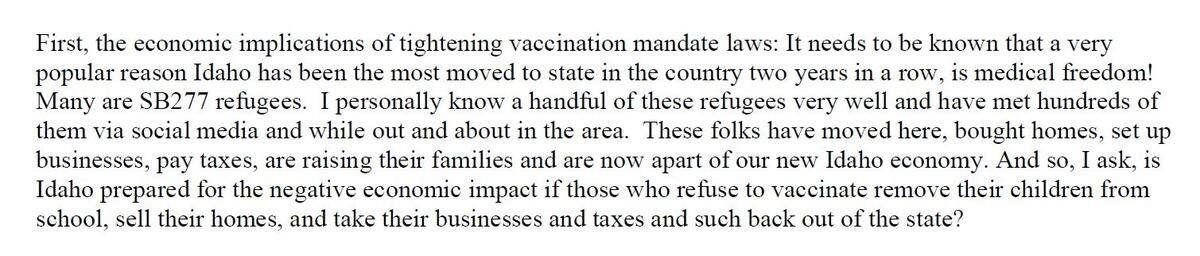
Brindley was one of more than two dozen people who told state officials last summer that they moved to Idaho because of the state’s limited regulation — specifically, the ease of getting a vaccine exemption for schoolchildren.
They said vaccine mandates take away a parent’s right to make medical decisions for their children, and they voiced concerns about vaccine safety.
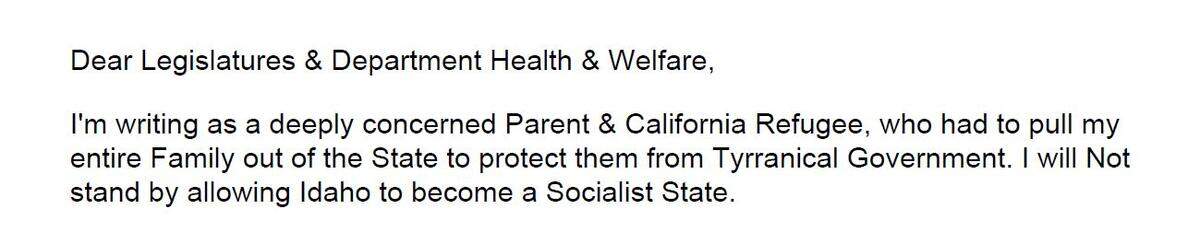
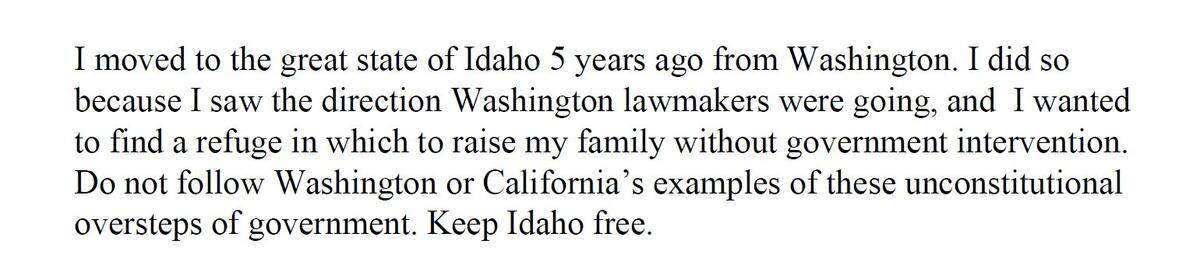
Several people who testified at hearings or via email described themselves as a “refugee” of their former state.
They urged lawmakers and the Idaho Department of Health and Welfare not to change Idaho’s permissive rules. Neighboring states like California and Washington have tightened the rules for vaccine exemptions in response to outbreaks of diseases like the measles.
The Idaho Legislature last month voted to keep Idaho’s existing rules, according to Idaho Education News. Legislators narrowly voted to keep the meningitis vaccine on a list of immunizations for high schoolers.
California, other states now require vaccines
Idaho’s laws for childhood immunizations are among the most lax in the country. It is one of 15 states that allow vaccine exemptions based on a personal belief — not just for medical or religious reasons.
Washington, too, is among those 15. But last year, that state removed the exemption for the “MMR” shot, a vaccine against measles, mumps and rubella.
California has made a series of changes to its vaccine exemption laws since a 2015 measles outbreak tied to Disneyland. The law, known as SB277, made it so schoolchildren need a medical reason to be unvaccinated. A change to California law last year added a new layer of oversight, seeking to limit exemptions that have a questionable medical basis.
The pediatrician who wrote the bill, California Sen. Richard Pan, told the Statesman that he heard from people whose babies and children couldn’t be vaccinated against diseases like the measles. They called on lawmakers to take action, he said.
“If you wonder, why do we pass these bills, It’s because we don’t want people to catch these diseases,” Pan said. “Medical freedom is not (about) having to end up in a hospital because you got a preventable disease. … I want the right to be able to have my kids safe in school.”
Pan noted that the vaccine mandate is only for attending schools. “People can home-school or get independent study through public schools if they don’t want to vaccinate their children,” he said.
Utah also allows non-medical exemptions but enacted a law in 2017 that puts conditions on those exemptions.
Brindley’s and others’ comments came during a public hearing period. State officials held hearings and took written comments as part of a lengthy process to overhaul Idaho’s administrative rules. The Idaho Statesman obtained written testimony and recordings of public hearings through an open records request to the Idaho Department of Health and Welfare, which ran the hearings.
Dozens of sets of Idaho health and welfare rules were up for debate last summer. But vaccines were the hot topic at the hearings and in written comments.
Many people, including health care providers, urged Idaho officials not to further loosen the exemption rules for childhood immunizations.
Public health experts warn that outbreaks become more likely when fewer people are vaccinated — and those who can’t receive vaccines, such as babies or cancer patients, aren’t shielded from potentially deadly diseases.
“I have three students who are medically prohibited from receiving immunizations, and their parents have to be ever vigilant that they are not exposed to certain communicable diseases that could put their lives at risk,” one school nurse from Hazelton wrote. “Luckily, because our immunization rate is high, they will most likely be protected from those diseases. However, if requirements are loosened, this will not remain the case.”
Vaccination rates on the rise in Idaho
While pockets of Idaho have lower immunization rates, the majority of Idaho parents immunize their children against diseases like measles, pertussis, chicken pox and rotavirus.
About 94% of students in Ada County and 95% in Canyon County had the MMR vaccine in a recent school year, while some parts of North Idaho had rates as low as 82%, the Statesman reported in February 2019.
According to state data, Idaho’s childhood vaccination rates may be on the rise. They were below the U.S. average in the mid-2000s, then increased to at or above the U.S. average by the mid-2010s.
Still, Idaho babies and children have died in recent years from vaccine-preventable diseases like pertussis (whooping cough) and the flu. Idaho also has seen a surge in hepatitis A infections. The state has, so far, mostly dodged the nationwide re-emergence of measles.
The rate of non-medical exemptions filed by Idaho parents has increased in the past three school years, according to state data.
“The Idaho Department of Health and Welfare strongly supports immunization as one of the easiest and most effective tools in preventing serious vaccine-preventable diseases,” Elke Shaw-Tulloch, administrator of Idaho’s Division of Public Health, said in an emailed statement.
Vaccines, like any other medical procedures, carry a small risk of side effects. The most common is a sore arm or a low fever, the U.S. Centers for Disease Control and Prevention says. Severe side effects from vaccines are rare or extremely rare, the CDC says.
Shaw-Tulloch said the state believes that requiring immunization “for children attending Idaho schools is the most consistent and effective policy to ensure protection against those diseases. We also respect a parent’s right to exempt their children from school immunization requirements.”
BEHIND THE STORY
MOREHow we did this story
The Idaho Statesman last year obtained, through an open records request, the written and verbal testimony of people who offered public comment on Idaho’s health and welfare rules.
The records included 591 pages of written testimony and several hours of recordings from public hearings, which the Idaho Department of Health and Welfare held in Boise, Twin Falls, Lewiston, Coeur d’Alene, Idaho Falls and Grangeville in August 2019.
Several people who testified said they relocated to Idaho because of its relatively lax vaccine rules. Seeing their comments as an opportunity to explore the perspectives of people who feel so strongly about vaccine exemptions that they uprooted their families, the Statesman contacted them to request interviews.
Six people responded, most declining an interview. A few of them clearly weren’t aware that their comments would be a public record and voiced concern about backlash for their beliefs. As a result, the Statesman decided not to include names of those who submitted written testimony.
Why Idaho? The exemptions
As other states like New Jersey consider tightening their vaccine laws, Idaho becomes an attractive place to relocate, several people said in public comments and in phone calls and emails with the Statesman.
One woman who submitted public comments said her family was “in escrow (on a home) in Moscow,” while others reflected on what had brought them to Idaho months or years before.
Some opposed vaccinating their children to protect others from communicable disease.
“I’m new to Idaho. I moved here for the freedoms of this state,” said Lou Munilla, who testified in North Idaho.
“We are about the individual in America. I don’t care about the herd, I care about my family, about my children,” he said at the hearing. “But we need to defend this state. … This state is the fastest-growing state in America. And I think it’s because the few people that have a brain left are coming here.”
He said fellow Idahoans should defend the state “with our life, and I will defend it with my life and my weapons.”
Munilla, a father of four, told the audience at the hearing that he is a licensed civil engineer with a master’s degree from Stanford University. He mentioned his occupation and education to make a point that “we are not ignorant rednecks,” he told them.
Munilla did not respond to a Statesman request for an interview.
‘Anti-vaxx’ backlash
Some Idaho newcomers told the Statesman they were hesitant to go public with their stance on vaccinations. One person said they prefer to stay “under the radar” with their views, “even amongst family.” At least one person used a pseudonym to testify.
Sara Walton Brady, a longtime, outspoken advocate against vaccine requirements, said at last summer’s hearings that people with “a different voice in this discussion” are subject to “censorship and bullying,” and that they’re “ridiculed, made fun of.”
The animosity over vaccines is well-known. Most are cases of online bullying or social media attacks organized by anti-vaccine groups. As legislation moved through the California Legislature to limit vaccine exemptions, two cases made headlines: an “anti-vaxxer” shoving Pan; and a woman throwing a cup of blood at lawmakers.
Brindley said in an interview with the Statesman that she was surprised by the reactions she got when she started to question vaccines.
“It wasn’t until I got started that I started seeing how polarizing this issue was,” she said.
As for why she didn’t want to vaccinate her daughter, Brindley cited a family history of health conditions such as asthma and Crohn’s disease and a concern that vaccines could trigger them in her child. (Studies have found no association between vaccines and asthma or vaccines and Crohn’s disease. The Asthma and Allergy Foundation of America and the Crohn’s & Colitis Foundation recommend people with those conditions get vaccinated, because they’re at higher risk of getting sick or developing complications from vaccine-preventable diseases.)
Brindley said that, after California tightened its vaccine rules, very few health care providers were willing to sign a medical exemption for children. Those who were willing had long waiting lists, she said.
So, the family moved to Meridian, where Brindley’s daughter now attends school.
“I’m very grateful, because I do feel that Idaho is more liberty-minded,” Brindley said.
This story was originally published February 9, 2020 at 4:00 AM with the headline "‘California refugees’ move to Idaho for lax vaccine laws. They want lawmakers to know why."