
Newsom’s recall defense gets big money + Sentencing reform + Help wanted as economy recovers
Good morning and welcome to the A.M. Alert!
NEWSOM RECALL RAKES IN THE CASH
Via Lara Korte...
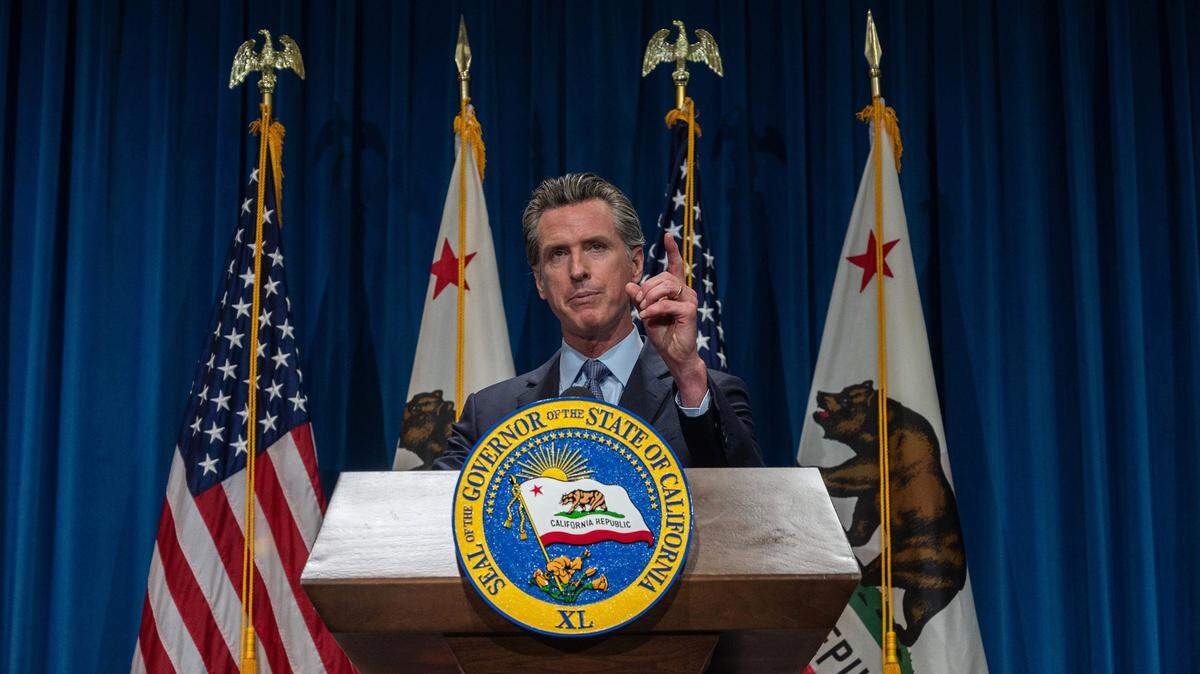
Gov. Gavin Newsom’s team had a big fundraising run last week, reporting more than $4 million in contributions by Friday. Netflix CEO Reed Hastings kicked in $3 million, a significant move considering Hastings put up $7 million backing Los Angeles Mayor and fellow Democrat Antonio Villaraigosa in the 2018 gubernatorial primary.
Newsom also reported several six-figure donations, including some big money from labor groups.
Here’s who else chipped in to Newsom’s Stop the Republican Recall committee last week:
- $150,000 from Elizabeth D. Simons
- $150,000 from the Union of American Physicians and Dentists Small Contributor Committee
- $400,000 from the United Nurses Association of California/Union of Health Care Professionals PAC (UNACPAC) Small Contributor Committee $400k
- $300,000 from the Southern California District Council of Laborers PAC
- $200,000 from the California State Council of Laborers PAC
- $100,000 from the California Attorneys, Administrative Law Judges, and Hearing Officers in State Employment. The union represents California state attorneys.
On the flipside, the recall proponents aren’t doing so hot. Organizers confirmed last week that spokesman Randy Economy has left the team. Orrin Heatlie told The Bee there’s no animosity, the campaign simply can’t afford to pay him. Since the petition qualified, donations have slowed to a trickle, he said.
“People took a sigh of relief and just backed off,” he said.
SENATORS DISCUSS PRISON SENTENCING REFORM
Sens. Dave Cortese, D-San Jose, Scott Wiener, D-San Francisco and Nancy Skinner, D-Berkeley, will hold a news conference Monday at 11 a.m. to discuss their bill, SB 300, which would reform California’s felony murder special circumstances law.
Current law holds that a person must receive either the death penalty or life in prison without the possibility of parole if they are convicted of murder with special circumstances, even in cases where the person did not kill anyone or intend for anyone to die.
SB 300 removes that mandatory minimum sentence and gives judges discretion in sentencing, “and provide those currently sentenced to die in prison an avenue for resentencing if they did not directly perpetrate a death, did not aid or abet a killing and had no intent to kill,” according to a statement from Cortese’s office.
“This would offer recourse to hundreds — potentially more — of Californians currently awaiting execution or condemned to die in prison for someone else’s actions,” the statement said.
An average of 130 Californians each year are sentenced to die in prison for a crime they did not commit, according to Cortese’s office.
Cortese, who authored the bill, joins co-authors Wiener and Skinner, as well as Joanne Scheer, the founder of the Felony Murder Elimination Project, in discussing the bill.
NEWSOM WANTS A BOOM, BUT THERE MIGHT BE A STUMBLING BLOCK
Via Dale Kasler...
Marvin Maldonado, co-owner of the Federalist Public House in midtown Sacramento, generally likes the massive economic stimulus package proposed recently by Gov. Gavin Newsom.
He’d like it even more if Newsom could somehow find someone to work a busy shift at Maldonado’s beer-and-pizza emporium.
“If he could wave a magic wand and find folks to come back to work,” Maldonado said. “I’m hard-pressed to find anybody willing or able to work a Saturday night.”
Maldonado’s dilemma illustrates the unusual state of the economy, in Sacramento and across California, as vaccinations increase, more businesses reopen and the nation climbs out of the COVID-19 recession.
Unemployment is still high — 6.6% in greater Sacramento in April, the latest data available — and legislative leaders are rallying behind Newsom’s breathtaking $100 billion plan to get California “roaring back,” as the governor put it. The statewide unemployment rate is 8.3%.
Yet a big part of what’s holding back the recovery isn’t a lack of demand from consumers — the factor that traditionally strangles economic growth, said Chris Thornberg, founder of Beacon Economics consulting in Los Angeles. Rather, it’s the inability of restaurants, retailers and others to hire enough workers to serve the newly vaccinated customers who have cash to spend and are lining up at their doors.
“The idea that you need to stimulate the economy is laughable at the moment,” said Thornberg, who’s also director of UC Riverside’s Center for Economic Forecasting and Development. “You have some parts of the economy that are over-heated and desperately trying to man up.”
The California economy is clearly recovering. Employers statewide added 101,000 jobs in April, more than one-third of the nationwide total. California has recouped almost half of the 2.7 million jobs that disappeared last spring. Greater Sacramento has recovered more than two-thirds of the 128,000 jobs that vanished in the first month of the pandemic.
Despite the progress, the labor shortage is taking its toll, especially in the service industries that were hit so hard when the pandemic began and the first stay-at-home orders were issued. Entire supply chains got disrupted and haven’t fully recovered.
“It’s not just the restaurants,” Maldonado said. “Our linen service — they’re short of drivers. Our wholesalers — they’re short of drivers.”
QUOTE OF THE DAY
“It’s about time Dominic Foppoli did the right thing & resign. It should have happened immediately. He has brought incredible pain & trauma to so many women and dishonor to the Town of Windsor. Now, we look to the justice system to hold him accountable for his egregious actions.”
- Sen. Mike McGuire, D-Healdsburg, via Twitter. Here’s the San Francisco Chronicle story about the multiple sexual assault allegations against Foppoli.
Best of the Bee:
California businesses will be able to open their doors on June 15 without the COVID-19 capacity and social distancing restrictions that have been in place for more than a year, according to the state’s top public health officials, via Hannah Wiley.
California’s Uber and Lyft drivers must start switching to electric vehicles, via Dale Kasler.
If Newsom invested in public health agencies before COVID, how many could have been saved? Via The Sacramento Bee Editorial Board.