
Caltrans wants millions of more dollars to clear thousands of California homeless encampments
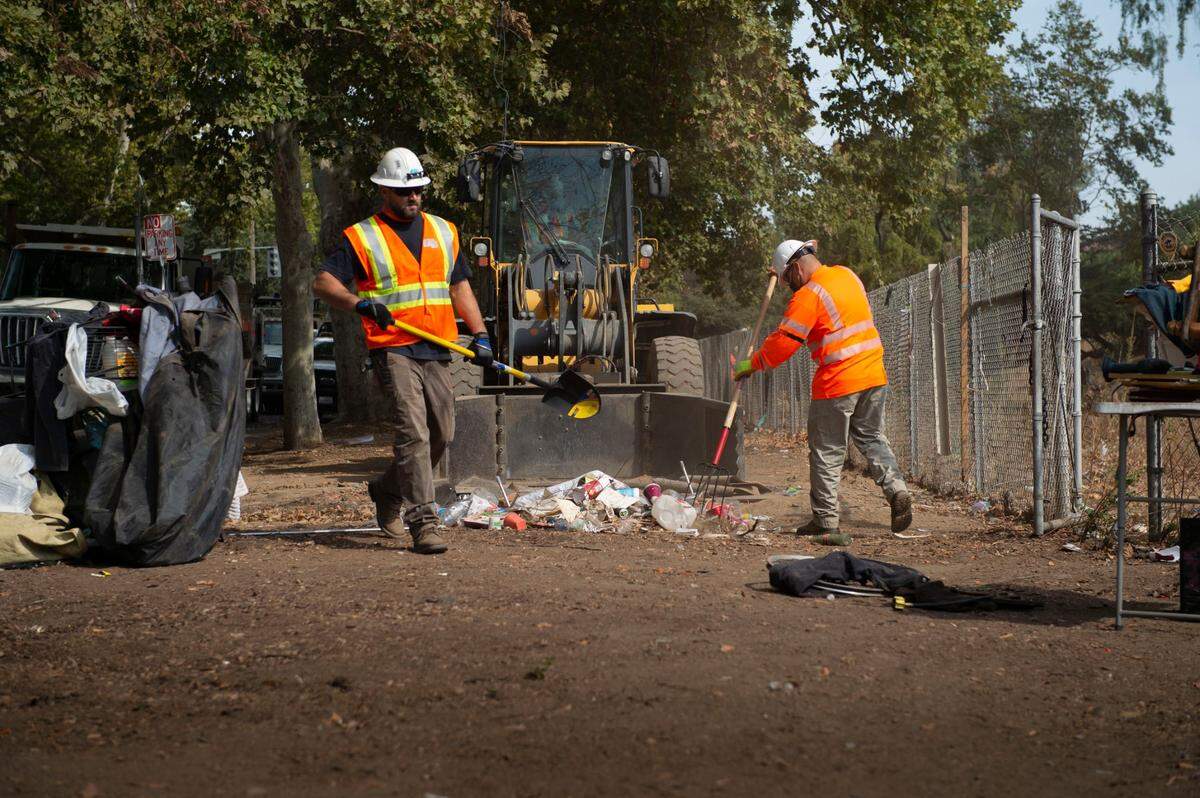
Caltrans says it is struggling to keep up with the number of homeless encampments popping up on its properties and is seeking millions of dollars to help clear them.
The California Department of Transportation has requested $20.6 million over the next two years to remove hazardous materials from encampments on its properties. It is also asking for an additional $5.8 million to expand its newly established Office of Homelessness and Encampments.
In a proposal to the state’s Department of Finance, the agency said it planned to hire seven employees for a new “Homeless Solutions Team” and also add 10 coordinators to the current 20-member Caltrans team tasked with overseeing clearance of encampments on its right-of-way properties.
“Caltrans cannot solve homelessness; however, it is clear the Department cannot ignore the impact this humanitarian crisis is having on the people experiencing homelessness, the traveling public, and the transportation network,” the budget request reads.

Caltrans to clear thousands of encampments
Clearing encampments has been a priority for Gov. Gavin Newsom, especially as he’s presided over historic budget surpluses during his first term in office. But the agency’s ask comes as California faces a $22.5 billion budget hole in the upcoming fiscal year, which could make it more challenging to secure additional dollars.
Caltrans reports it’s on pace to close 1,200 encampments in this fiscal year — up nearly 500% from the 269 cleared last year. But that’s only a fraction of the more than 5,000 encampments on its rights-of-way, the agency reports.
Officials say the encampments damage the state’s transportation infrastructure and pose safety issues for unhoused residents living there. The agency estimates it has spent more than $104 million over the past six years making emergency repairs on its properties.
A large Bay Area encampment in Oakland was the site of more than 100 fires in 2022. One caused fatalities and others have threatened serious damage to one of the city’s major freeway interchanges, according to the agency. Caltrans is taking a phased approach to close and clean sections of that encampment — dubbed Wood Street — but several dozen holdouts are still living there amid an ongoing legal battle.
Caltrans officials say they cannot keep up with the rate at which encampments are developing on its properties. The agency said the additional money will mean less damage to the state’s transportation network, encampment closures that connect homeless residents with social services and stronger partnerships with local leaders and service providers.
Cities say more homeless resources needed
Caltrans plans to distribute the new homeless response positions across the state based on areas of greatest need. Los Angeles would get five. Oakland would receive four, followed by San Diego with three and San Luis Obispo, Stockton, Marysville/Sacramento and San Bernardino with two.
LaTonda Simmons, Oakland assistant city administrator, welcomed the potential new resources but said the city also needs more state funds to boost its transitional housing for those in the encampments.
“Without expanded affordable housing opportunities along with sustained emergency shelter, encampment closures will only perpetuate displacement and the mission of housing our homeless cannot be realized,” Simmons said in an email. “Everyone deserves a safe and affordable place to live, and ultimately, we know the solution to homelessness is housing.”
Sacramento Mayor Darrell Steinberg said he is in full support of Caltrans’ request.
“And there needs to be an ever-increasing amount of collaboration between Caltrans, the county, the city to actually get people out of these encampments permanently with housing and services,” Steinberg said. “Voluntarily first, and involuntarily, if necessary.”
Steinberg said he’s also in favor of Newsom’s push for more results and accountability from local agencies receiving state homelessness funds. He said cities and counties need to do “whatever it takes to to wrap around and care for these people,” including mental health outreach.
“The governor’s plea ... is really the same as the plea I hear from the residents of my city, which is: ‘Clean up these encampments.’” Steinberg said. “And that’s imperative. How we go about doing it is equally important. And that means that we must insist that cities and counties together engage in consistent, assertive outreach to the people living in these encampments.”

Advocates opposed to Caltrans cleanups
Homeless advocates opposed to encampment clearance argue cities and agencies like Caltrans are wasting millions of dollars to merely shuffle unhoused people from one area to another. They say this frequently makes it more difficult for service providers to locate those who need assistance.
Caltrans in 2021 cleared a homeless encampment in Midtown Sacramento along 29th Street between F and H streets, sending many of the unhoused living there a block north. The agency posted notices about the clearing at the camp ahead of time, but they had a phone number for a hotel voucher referral line that was disconnected.
Cleanups have also turned dangerous for some unhoused residents. A Caltrans worker clearing a Modesto homeless encampment with heavy machinery in 2018 fatally hit a sleeping woman.

The agency in 2021 worked with Sacramento city officials to open a Safe Ground site near Sixth and W streets where homeless residents could go during a freeway expansion project. That site is now closed, but Caltrans “does have properties available for lease for emergency shelters that the city could take advantage of, which includes safe parking sites,” said Edward Barrera, an agency spokesman, in an email.
Sacramento’s 2021 Comprehensive Siting Plan to Address Homelessness included five Caltrans properties under the W-X freeway that would have featured 200 tiny homes. But the city agreed to drop the plan to use the sites after a resident sued Sacramento over alleged California Environmental Quality Act violations.
Barrera did not say whether Caltrans has any upcoming plans to clear more Sacramento encampments. He said the agency provides 48 hours of advance notice prior to a cleanup and “(works) to notify social service providers of the estimated closure time and date so that those providers can conduct outreach to connect people experiencing homelessness with essential services and available shelter/housing options.”
But in places like Sacramento, where local officials have banned overnight camping along the American River Parkway and near schools, encampment cleanups mean Caltrans property is just one more place where homeless people cannot be, said Bob Erlenbusch, executive director of the Sacramento Regional Coalition to End Homelessness.
“All this does is move our unhoused neighbors from one place to another without actually providing them any services which they desperately need,” Erlenbusch said. “If they do feel that they have to move people for safety reasons, they should be giving them somewhere to go, coupled with services.”
This story was originally published January 23, 2023 at 6:00 AM.
CORRECTION: This story has been updated to correct the number of Homeless Solutions Team positions Caltrans wants to add. The agency plans to hire seven employees to create the team.