
This mom fights against trans rights in California. Now, she’s taking her cause to DC
The argument over the right of transgender young people to legally access gender affirming health care arrived at the U.S. Supreme Court.
Justices heard oral arguments Wednesday in the case of United States v. Skrmetti, which originated in Tennessee after the parents of a transgender teenager sued the state for banning gender-affirming health care, calling the ban a violation of the Equal Protection Clause of the 14th Amendment.
“We are simply asking the Supreme Court to recognize that when a law treats people differently based on their sex, the same equal protection principles apply, regardless of whether the group impacted by the law happens to be transgender,” said Chase Strangio of the American Civil Liberties Union, who will make history Wednesday as the first openly transgender lawyer to argue a case at the Supreme Court.
Gender-affirming health care and the rights of trans minors have become a flash point in American politics at large — including in liberal California, which established itself as a trans “sanctuary state” in 2022 amid nationwide pushback against gender-affirming health care for trans kids.
Legally, the case could have significant ramifications in Tennessee; in Skrmetti, the U.S. Supreme Court will decide whether or not the state’s law to ban gender-affirming health care for transgender minors violates the U.S. Constitution under the basis of sex discrimination. If a majority of Justices decide that the ban is unconstitutional, the Tennessee law will return to the state’s lower courts to be adjudicated on the basis of the Supreme Court decision, and trans young people in the state will likely be able to resume or begin to access treatment. If the Supreme Court Justices decide that the ban is constitutional, the law will remain in place in Tennessee.
The case could also have significant ramifications nationwide.
“The importance of a decision in Skrmetti cannot be overstated,” wrote Erin Friday, a Bay Area lawyer and parent whose daughter socially transitioned to a male identity at school without Friday’s knowledge.
She is one in a group of California parents’ rights activists who say the state’s health care and education system have been too quick to affirm kids who say they are trans, and headed to D.C. for the hearing.
“The decision in the case will reach well beyond whether Tennessee’s ban is unconstitutionally discriminatory,” Friday wrote in a Substack post last month. “In Skremetti, the Supreme Court must decide whether there is a classification called ‘transgender children’ and whether that classification is a suspect class warranting strict scrutiny, a very limited category that includes immutable characteristics such as race, alienage and national origin.”
To activists like Friday, there is no such thing as a “transgender child” because — despite broad consensus among the medical community that says otherwise — there is no such thing as being transgender.
“Can you be born in the wrong body? Can you be born with a brain that doesn’t match your body?” Friday asked The Bee. “I’m a firm believer you cannot.”
Court leans in favor in bans during arguments
During Wednesday’s hearing, the high court’s conservative judges said they were inclined to uphold state laws in half the nation that prohibit the use of hormone treatments for transgender teens.
Led by Chief Justice John G. Roberts Jr., they said there is an evolving medical debate over the use of puberty blockers and sex hormones for adolescents who suffer from gender dysphoria.
“My understanding is the Constitution leaves this to the people’s representatives rather than the nine of us,” Roberts said, adding that none of them are doctors.
Justice Brett M. Kavanaugh agreed.
“There is obviously an evolving debate” about the risks and benefits of these medical treatments, he said. “England is pulling back. That’s a yellow light.”
He said there were risks and benefits to the use of these hormones, but said the court should not decide which side is correct.
“It just seems to me the Constitution doesn’t take sides on how to resolve this,” he said.
Justices Clarence Thomas, Samuel A. Alito Jr. and Amy Coney Barrett appeared to agree. Justice Neil M. Gorsuch did not voice a view.
But the court’s three liberals argued just as strongly that the conservative state laws discriminate against transgender teens and should be struck down.
“Usually parents get to decide” what is the best medical treatment for their child, said Justice Sonia Sotomayor. “But Tennessee has decided to override them.”
The architect of California’s parent notification policies
In the past three years, Tennessee and 23 other states have adopted laws that forbid prescribing hormones and puberty blockers for those under age 18 for the purpose of gender transition.
Friday has spent the last three years lobbying at the Capitol and helped author parent notification policies that school boards passed at the local level when the California Legislature would not.
For Friday, the mission is personal.
When Friday learned that teachers and counselors at her daughter’s middle school in the Bay Area had begun to refer to her with a male name and male pronouns, Friday said she was “apoplectic.”
It was not the first time the school had angered Friday; she remembers her daughter and a group of friends hanging out at her house the day after a sex education class, in which each of the girls went around in a circle to share their gender identities and sexual orientations.
“I was really quite alarmed … I mean, ‘polyamorous’ for 11 and 12-year-old girls? That doesn’t really compute my mind,” Friday said, recalling the girls’ account of the class discussion.
Shortly thereafter, Friday’s daughter said she was a trans boy.
“It was like this slow roll,” Friday said. “She moved from pansexual to lesbian, and then she landed on trans. And I didn’t know that she had landed on it really, until I started hearing the school call her by a male name.”
Friday had left her job at a Bay Area law firm to be more present with her children during COVID-19 remote learning and to focus more on her daughter’s well-being; the previously “happy, bubbly kid,” Friday said, was at that point exhibiting serious signs of depression after connecting with an older, transgender teenager who Friday says “groomed” her daughter into adopting a trans identity via social media platforms like Instagram and Twitter.
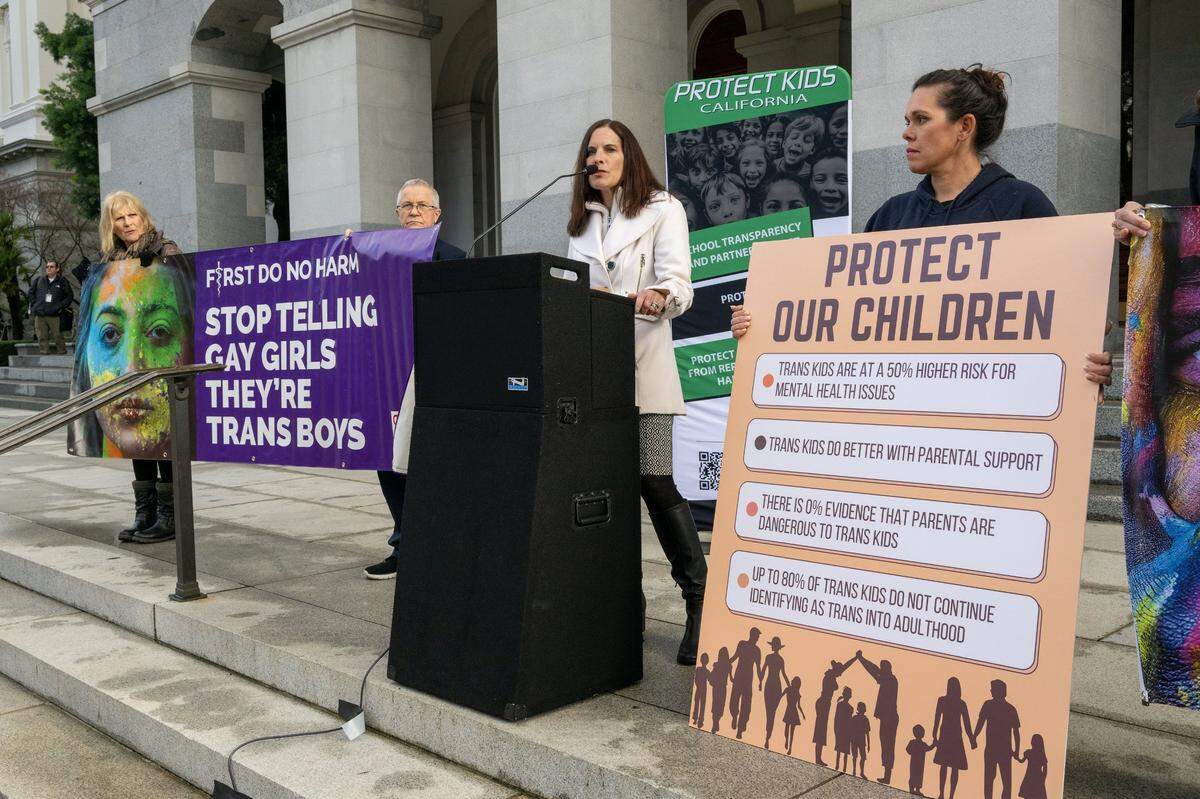
Over the course of about 18 months, Friday pulled her daughter out of public school and put her into a private one, and found a therapist out of the state — most California therapists, Friday said, immediately affirmed her daughter’s male identity.
With time away from screens, social media, and the influence of what Friday described as “grooming” from trans kids, counselors and LGBTQ groups, she said her daughter did stop identifying as trans.
But it was not without anguish on Friday’s side: the school, she said, sent Child Protective Services and uniformed police officers to her home when she didn’t affirm her child’s trans identity.
When her daughter ran away a few weeks later, Friday said she was too afraid to call the police for help.
“I couldn’t call the police because I knew that I already had a black mark, and I was going to have a second, and CPS was going to be back, and might take my daughter,” she said. Her daughter returned safely the next day, after a panicked full night worrying about where she was.
“I knew my daughter loves me,” Friday said. “We had a strong relationship. I got horrible, right? Because people told her to hate me. And so there’s this, ‘I love you-I hate you’ thing going on. But as a parent, you have to trust that that goodness is still in them.”
Friday and many other parents’ rights activists agree that gender dysphoria is a medical reality. The Diagnostic and Statistical Manual of Mental Disorders (DSM-5) says gender dysphoria is a “marked incongruence between their experienced or expressed gender and the one they were assigned at birth.” However, rather than treat it with gender affirming health care, Friday believes gender dysphoria should be treated as or alongside other coexisting mental health conditions such as depression and anxiety, or ADHD and autism spectrum disorder.
“Do I hate trans-identified people? I don’t. Do I want them not to have jobs? Of course not. Do I want them not to have education? No, I want them to get better,” Friday said.
This experience with her daughter motivated Friday to become involved in politics. She connected with the conservative Christian California Family Council, and testified at a Legislative hearing in 2021 for a bill relating to gender affirming health care. The response from Democratic lawmakers — Friday has been a Democrat her entire life — astonished her.
“I had one of the men say, ‘You know, if you had a good relationship with your child, your child will talk to you about this.’ And they were talking as if I wasn’t there. And I was so erased.”
That was the moment that Friday committed to a new political movement.
“You just called me a bad parent? Yeah, okay, it’s on.”
Parents’ rights in the California Legislature
In 2022, Friday and the California Family Council shopped a collection of bills about trans issues to various legislators at the Capitol. Republican Assemblymember Bill Essayli was the first to work with her on a parent notification policy bill.
Essayli, who was elected to the Assembly in 2022 after years working as a federal prosecutor, told The Bee that, unlike Friday, he does believe that being transgender is a real experience.
“It is a legitimate condition for some people,” he said. “But I believe that’s a very small percent of the population.”
But like Friday and other parents’ rights activists, he thinks it’s an issue of “social contagion.”
“There might be a social contagion element and whether this might be a popular thing to do, and these are kids who might be gay or lesbian and are confused and struggling and think this is the answer,” Essayli said.
“As a starting point, it makes sense to have the parents be involved in these decisions,” he said. “No one cares more than the parents. That’s a fundamental starting point for me.”
Essayli’s office, with the help of Friday, proposed a bill that would require school staff to inform a student’s parents if the student showed signs of transitioning — specifically, if they request to use pronouns, a name, facilities or a sports team that does not align with their sex assigned at birth.
The bill didn’t get a single hearing in the Democratic-controlled Assembly, and in November 2023, Friday drafted a ballot measure instead, taking the issue out of the Legislature and straight to voters. The measure would have barred gender affirming health care for trans minors in California, required parent notification policies in all of the state’s schools, and prevented trans girls from playing on girls sports’ teams. The petition to get it on the ballot garnered more than 400,000 signatures, but fell short of the required 546,651.
With both Essayli’s bill and the ballot measure failing to launch, school boards across the state ran with the proposed parent notification policy language, and passed their own versions at the local level.
“I don’t think the issue would have been localized if we could have had a hearing,” Essayli said. “I think (the Legislature) really made a mistake there.”
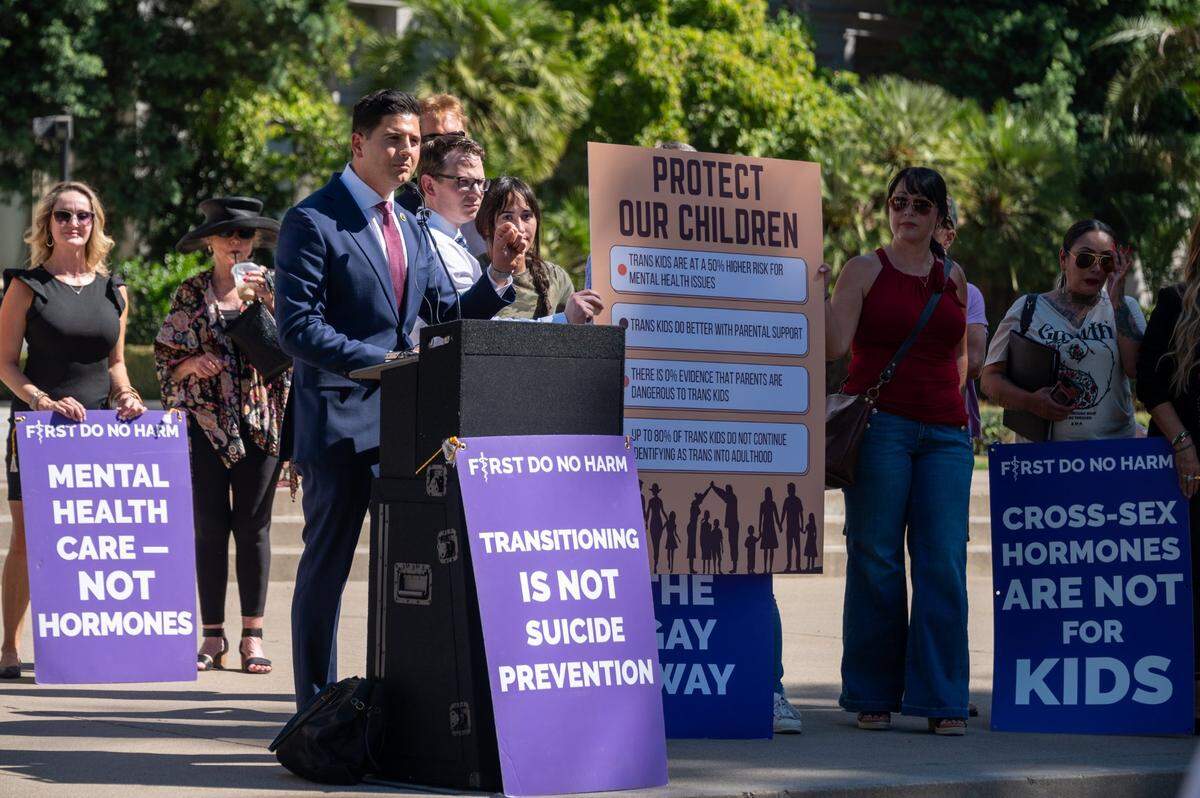
A former prosecutor, Essayli said that denying parents a platform to share their concerns about the issue might have at least validated those concerns and let them feel heard.
“The main thing about court is that (people) want their side to be heard. It’s the process, not necessarily the outcome,” he said. “If they keep trying to suppress speech, it’s going to come out in less friendly ways.”
Those “less friendly ways” included contentious school board meetings that went into the middle of the night, costly recall campaigns, and heated, almost-violent debates in the Capitol when the Assembly passed the very opposite of Essayli’s bill, making it illegal to require school staff to “out” trans students to their parents.
While his social media presence may sometimes indicate otherwise, Essayli remains measured where the Skrmetti case is concerned.
“I don’t know what the Supreme Court’s going to do,” he said. “We have to be very cautious and very careful. We have to be cautious with saying kids can 100% or 100% not get access.”
That said, he echoed the sentiment of many parents and anti-trans activists who say that children should not be making medical decisions that will have lifelong affects.
“It’s not a good idea to allow kids to get medical treatment before they’re adults,” he said. “Because it’s not clear in the evidence to me that that’s helpful.”
Parents of trans kids who have received such medical treatment disagree.
“Every decision we make as a family is to help give our children the future they deserve,” said Brian Williams, the Tennessee plaintiff in the Skrmetti case, on Monday. Williams’ daughter came out as transgender at the age of 13, and over the course of almost two years, began to medically transition.
“Today she is happy and healthy, a 16-year-old planning her own future, and looking at colleges … Her joy, her smile and her confidence would not be what they are if it were not for the health care that we, and her doctors, know is right for her.”
The rights of trans kids in California
In 2022, California designated itself the first sanctuary state for trans kids.
“In California we believe in equality and acceptance,” Gov. Gavin Newsom said when he signed a “safe haven” bill for trans kids from other states that September.
“We believe that no one should be prosecuted or persecuted for getting the care they need — including gender-affirming care. Parents know what’s best for their kids, and they should be able to make decisions around the health of their children without fear. We must take a stand for parental choice.”
The City of Sacramento followed suit last spring, when the City Council voted to make the city a safe haven for transgender people who come from states that ban gender-affirming care.
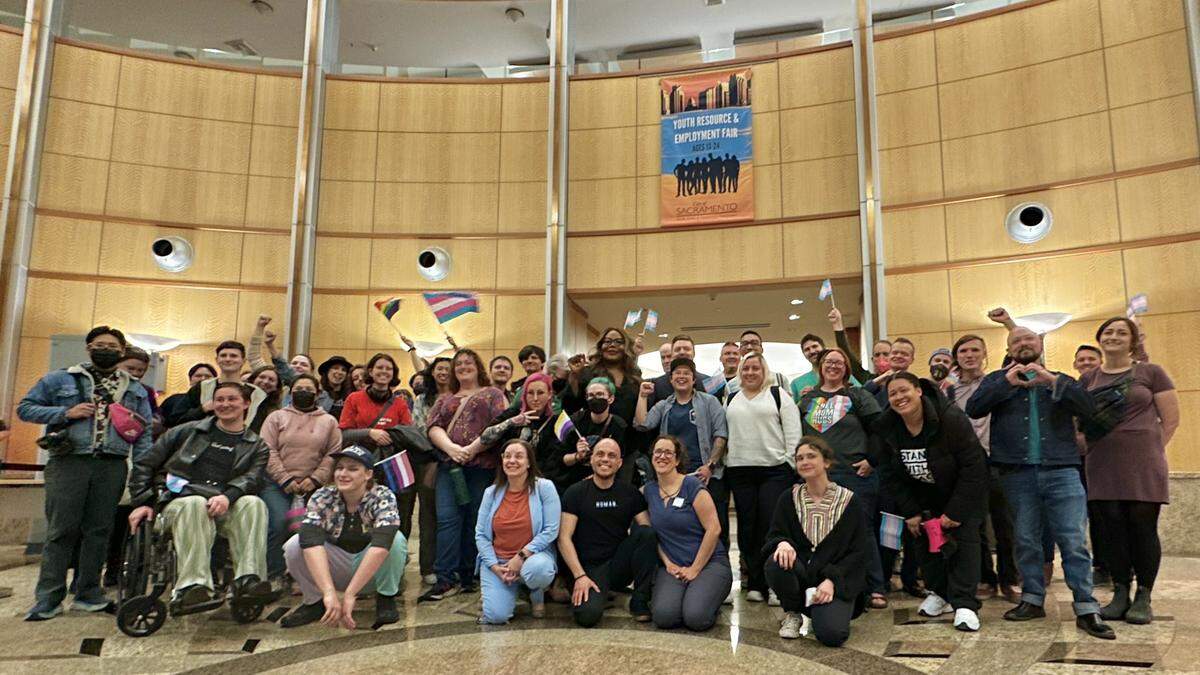
In California, trans-identifying minors can access gender-affirming health care with the support and permission of their parents. Such care includes hormone therapy, puberty blockers, and surgery.
In defense of Tennessee’s law during Wednesday’s hearing, Tennessee Attorney General Jonathan Skrmetti argued that practice of medicine is a matter for the state, and lawmakers there said the hormone treatments are risky and unproven for adolescents.
The Biden administration urged the court to hear the Tennessee case and to rule the law discriminatory and unconstitutional.
Solicitor Gen. Elizabeth Prelogar and ACLU attorney Chase Strangio urged the court to rule that because the laws discriminate based on sex and gender, they are suspect and should be struck down.
For transgender adolescents, these are “the only treatments that can relieve years of suffering,” Prelogar said.
The outcome of the Skrmetti case likely would not change California’s laws — but it could add fuel to the parents’ rights and anti-trans movement in the state, creating legal precedence to revoke some of the gains the trans community and their allies have made, such as the law barring forced outing in schools.
Friday has already filed a lawsuit against that law, which goes into effect next month. Essayli said he doesn’t “think it’s going to stand at the end of the day.”
Even if the Supreme Court decides in favor of the trans health care ban, Friday knows that her battle is still an uphill one in California.
“The case won’t save California kids,” Friday said. “But it’s a start.”
This story was originally published December 4, 2024 at 4:00 AM.