Celebrities sign letter pressuring California Gov. Gavin Newsom to regulate AI
AI-generated summary reviewed by our newsroom.
- Hollywood figures urge Gov. Newsom to sign SB 53 regulating AI companies
- SB 53 mandates AI firms report safety incidents and adopt security protocols
- Gov. Newsom, a Big Tech ally, signals support for AI guardrails
A host of who’s who in Hollywood is the latest group to pressure Gov. Gavin Newsom to sign a bill that would regulate artificial intelligence, according to a letter exclusively obtained by The Sacramento Bee.
“California is indisputably the epicenter of the current AI boom,” the letter to the governor read, which was signed by actors such as Don Cheadle, Mark Ruffalo, Fran Drescher, Rosie O’Donnell and Joseph Gordon-Levit. “The question is — can we trust big tech companies to build AI for the public good? And the answer is — no, we can’t.”
Encode, a youth-led group that advocates for AI oversight, submitted the letter late Wednesday to the governor’s office advocating for him to sign Senate Bill 53, whose chief sponsor is Sen. Scott Wiener, D-San Francisco. SB 53 would put guardrails on the burgeoning technology by requiring companies to adopt security protocols and report safety incidents to the state.
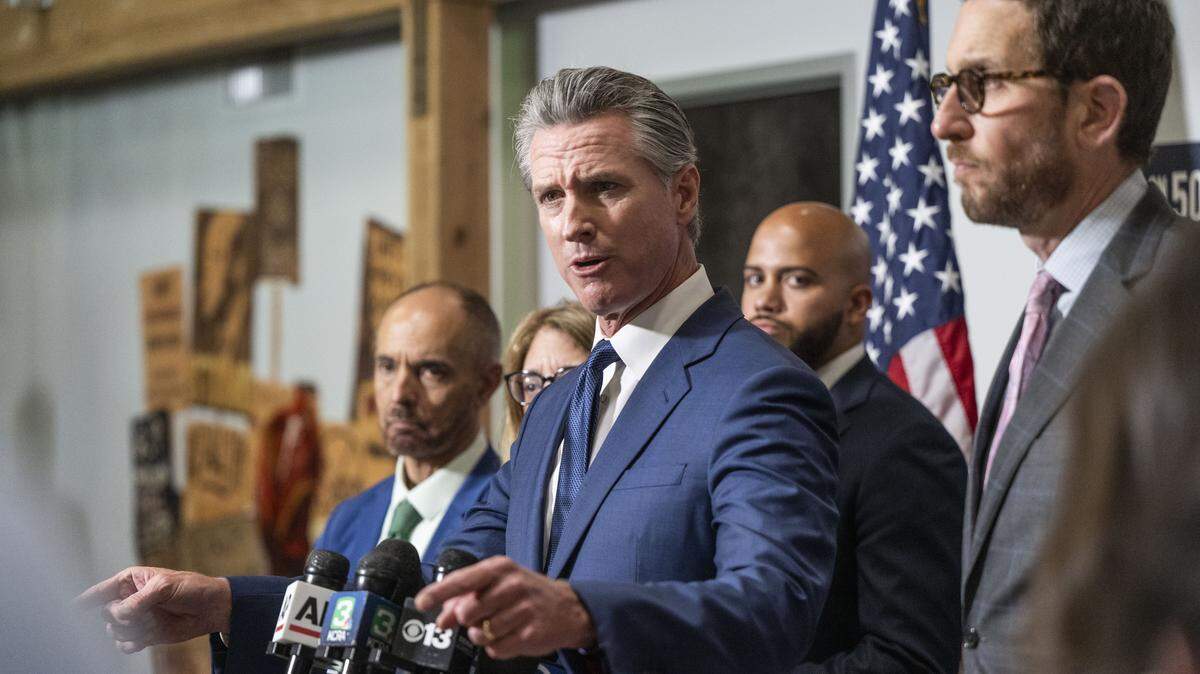
Newsom hinted to former President Bill Clinton on Wednesday that he would sign it, saying it “struck the right balance” by taking precaution without stymying innovation.
Sunny Gandhi, Encode’s vice president of political affairs, said in an interview he was optimistic that Newsom would sign SB 53, citing the governor’s remarks to Clinton and his creation of a working group of AI experts that recently published a report with policy recommendations.
“There’s a consensus that after two years, California needs to do something,” Gandhi said, pointing to lawmakers’ past failure to reign in social media. “There should be rules of the road to this ... We’re the only industrialized country in the world that doesn’t have a federal privacy statute.”
Newsom has been under pressure in recent years to adopt AI guardrails by advocates worried about the technology’s impact on unemployment by automating jobs and upending creative and media industries via its ability to generate new pictures, audio and other media using existing data. Others are concerned about people developing dependencies on AI-powered chatbots like OpenAI’s ChatGPT, which a Rancho Santa Margarita couple claimed in a lawsuit last month helped their son plan his death by suicide.
The governor, a longtime ally of Big Tech, has been reticent to adopt stringent oversight. He regularly boasts that California is home to 32 of the world’s top 50 AI companies, including Anthropic, OpenAI and Nvidia, which boasts a market cap of $4.3 trillion.
Last year, Newsom vetoed a similar bill from Wiener, SB 1047, that would have required companies to adopt protocols to prevent AI from enacting “critical harms” like shutting off power grids or developing weapons of mass destruction. Encode was also a sponsor of that bill.
The industry paid lobbyists millions to eventually defeat SB 1047. This year, as the White House has rolled back Biden-era AI restrictions, companies have created new political action committees to bolster their lobbying efforts in California as their chief executives have ingratiated themselves with President Donald Trump.
“Big tech is unable to prioritize anything but profits. That’s why government has to step in,” the Encode-sponsored letter read. “Unfortunately, with Donald Trump in power, our federal government seems far more interested in serving billionaire tech titans than the American people.”