Advocates call for Gov. Gavin Newsom to back off cut to healthcare for refugees
Ariam Araya knows firsthand what a difference state-funded healthcare makes to a new immigrant to the United States.
Araya emigrated to the Bay Area from the African country of Eritrea, a country under the rule of an oppressive dictatorship according to Human Rights Watch and the U.S. State Department. “I started from nothing,” Araya said, “I struggled with the language, culture and the overwhelming cost of living — navigating systems, especially healthcare, felt nearly impossible.”
Then she got enrolled in Medi-Cal, she said, and was able to address untreated physical and mental health problems she’d carried with her to the United States. “It gave me access to doctors, to treatment, to hope,” she said. Today, Araya helps refugees and political asylees transition into a better life in California.
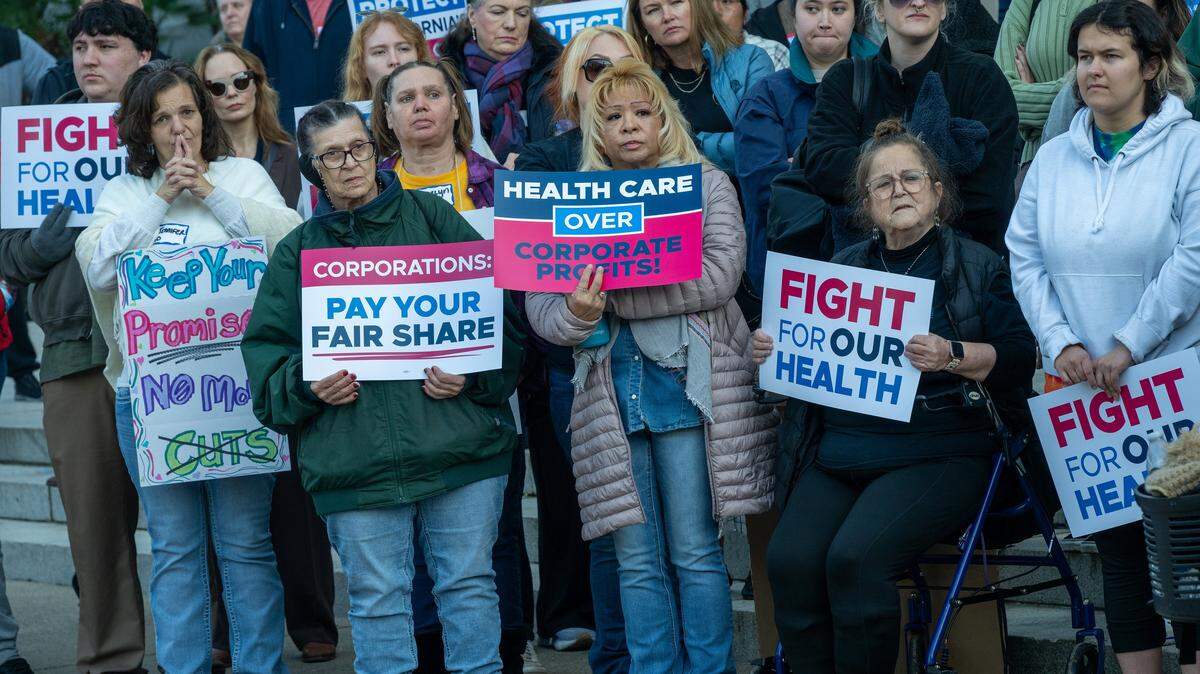
On Tuesday, at a rally near the state Capitol, she called on Gov. Gavin Newsom to drop a proposed budget cut advocates say would strip 200,000 humanitarian immigrants — people in the United States legally after fleeing domestic violence, political persecution or terrorism in their home country — of much of their state-funded health coverage.
The governor has proposed covering only emergency care and pregnancy costs for those immigrants.
Newsom has proposed cuts to healthcare for both undocumented immigrants and to those with legal residency through the nation’s asylum laws in response to federal cuts to Medicaid. Republicans ended federal healthcare for legally present refugees, and imposed significant restrictions on U.S. citizens’ eligibility for Medicaid as well, in last year’s One Big Beautiful Bill Act, a budget package that paired cuts to social programming with tax breaks that disproportionately benefitted corporations and the country’s wealthiest individuals.
The cut to the Medi-Cal coverage of 200,000 humanitarian immigrants would save the state around $1 billion a year, according to the Department of Finance.
The consequences of a state budget deficit
The governor and lawmakers are also dealing with a state budget deficit that is projected to be in the tens of billions of dollars in the coming years. Providing Medi-Cal to undocumented immigrants is just one piece of about $12 billion in discretionary spending state policymakers have added since the beginning of the COVID-19 pandemic, according to a report published by the Legislative Analyst’s Office this week.
The budget overall has grown by $100 billion since then, with increases in the state’s Medi-Cal burden, driven in part by higher costs of care, responsible for 25% of that figure. About two-thirds of the growth in the state’s Medi-Cal spending was driven by higher costs per enrollee, not by adding more people to the program, the analysts found.
Tuesday’s rally came as lawmakers prepare to receive Newsom’s May revise of his January budget proposal, which takes in changes to state revenues over the first half of the year. Earlier this month Senate President Monique Limón, D-Santa Barbara, and leaders in the Legislature’s senior chamber released their budget proposal, in which they pointed to revenues from the booming artificial intelligence industry and rejected Newsom’s cuts, including the one to humanitarian immigrants’ healthcare.
The Senate’s budget proposal does not reduce state spending, though the document is just an opening salvo in negotiations between governor, Senate and Assembly leadership that will ramp up when Newsom’s May budget publishes. Assembly Speaker Robert Rivas, D-Hollister, and budget writers in that chamber have not yet unveiled their own fiscal leanings for this year.
Newsom on April 14 warned lawmakers to prepare for budget cuts and said he did not want to leave a deficit for the next governor, Politico reported. How deep those cuts will be remains to be seen. Newsom’s January budget outlined a far smaller deficit, of just under $3 billion, than legislative analysts have, by projecting continued strong stock market returns from AI companies.
In a statement to The Sacramento Bee on Tuesday, a spokesperson for the Department of Finance indicated the governor would stand by the cut to the Medi-Cal program for refugees.
“Given the significant projected out-year deficits, the state cannot backfill for this change in federal policy,” the spokesperson said.
But advocates for immigrants say Newsom is going beyond the cuts enacted by President Donald Trump and congressional Republicans.
Proposed tax on large employers that don’t offer insurance
“It’s a longstanding law and commitment of the state to cover lawfully present immigrants, even if the federal government doesn’t pay,” Kiran Savage-Sangwan, director of the California Pan-Ethnic Health Network, told The Bee, “this would be a departure from that.”
Limón’s budget proposal includes the imposition of a new tax on large corporations in the state whose employees rely on Medi-Cal because they’re paid low wages and don’t receive employer-funded health insurance. That money would go to make up gaps in state-funded healthcare driven by the One Big Beautiful Bill Act. The measure’s most vocal champion has been Assembly Health Committee Chair Mia Bonta, D-Alameda.
The Senate budget drafters proposed setting the fee at levels that would generate $5 billion to $8 billion annually. Bonta has said the measure could raise as much as $17 billion.
Other rally speakers noted that the cut to immigrant healthcare programs, for both the documented and the undocumented, are coming even as state leaders have pledged to do everything in their power to protect them from the second Trump administration’s aggressive drive to deport people.
A doctor in residency in Fresno described seeing a young Guatemalan girl who had delayed treatment for a tumor in her eye because she was undocumented and feared drawing attention from U.S. Immigration and Customs Enforcement with a hospital visit. By the time she sought emergency room care, the tumor had spread, Dr. Yvonne Vigil-Calderon said. The girl died.
The governor’s budget proposal could drive more stories like that one, she said, by making healthcare unaffordable to more people. “Denying Medi-Cal to people with asylee or refugee status will mean more people coming through emergency departments for conditions that could have been treated, that could have been preventable,” she said.