Hundreds rally to get $12 billion research bond on ballot. Will it make it?
Ruby Kharod researches solutions to climate change at the Lawrence Berkeley National Laboratory. Erika Anderson is a postdoctoral scholar at UC San Francisco harnessing molecular biology to better understand the development of diseases. Lara Schwarz studies the effect of wildfires and heat waves on public health at UC Berkeley.
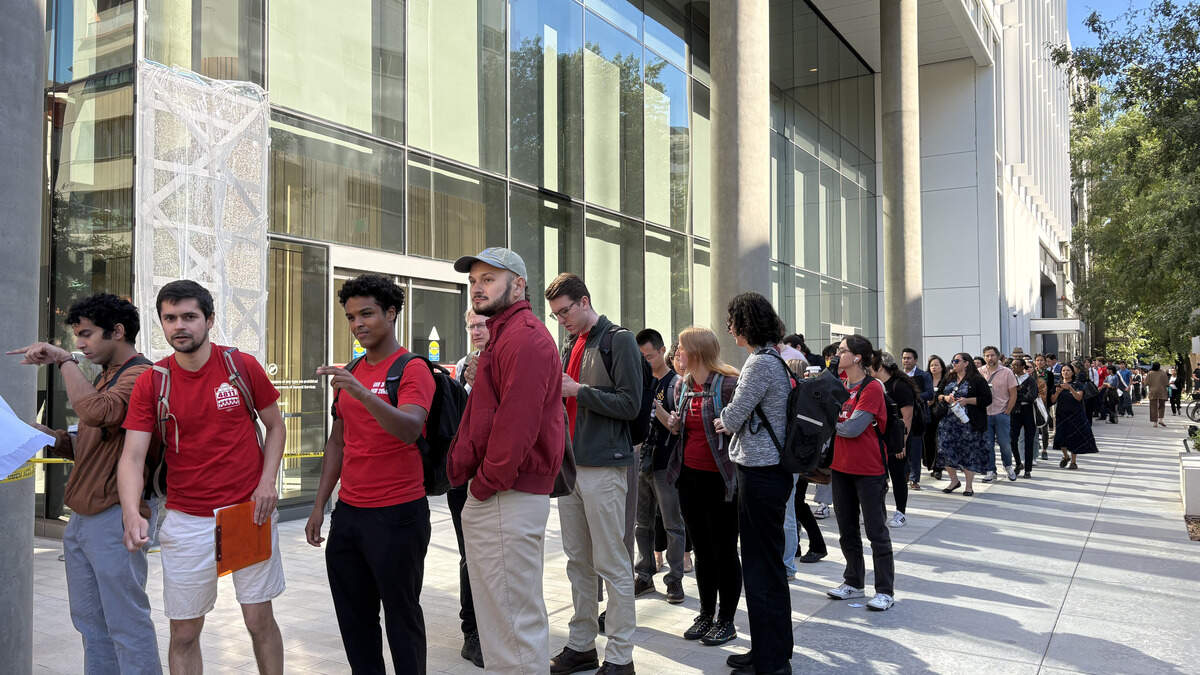
Early Wednesday morning, they made their way to Sacramento alongside about 200 students, faculty and community members to appeal to legislators to place a $12 billion research bond on the November ballot. Against the federal government’s massive funding cuts to scientific research, the proposed bond seeks to stabilize science funding in California by providing research grants and loans for medical, environmental and agricultural research.
“There’s a lot of uncertainty because a lot of our research is depending on federal funding,” Schwarz said. “It unfortunately makes me have to consider other alternatives than staying in academia in the U.S. (This bill) would change that by creating a funding source that ensures sustainability and the ability to continue doing this research in California.”
Depending on interest rates, the total cost of the bond to California taxpayers will be somewhere between $21.5 billion and $23.4 billion, according to a legislative analysis of the bill. A bond is a type of long-term borrowing that the state uses to raise money for various purposes. The state obtains the money by selling bonds to investors and agrees to repay it, with interest, per a specified schedule.
But the bond will only make it onto voters’ ballots in November if Senate Bill 895, authored by Sens. Scott Wiener, Aisha Wahab and Sasha Pérez, moves out of the Assembly Appropriations Committee and wins approval on the floor of the Assembly and from Gov. Gavin Newsom. And time is running out. The last day for measures to qualify to appear on the ballot is Thursday, June 25, according to the California Secretary of State. Now, supporters of the bond are hoping lawmakers will use their power to push the deadline.
At the committee hearing Wednesday, the room overflowed with supporters who queued up in the room and outside in the corridor to make public comment and emphasize the importance of the bill.
Assemblymember Buffy Wicks, D-Oakland — who chairs the committee — noted that the “normal protocol” required a three-party negotiated deal between Gov. Gavin Newsom, Senate President pro Tempore Monique Limón, D-Santa Barbara, and Assembly Speaker Robert Rivas, D-Hollister, before the bill can move forward. For now, it remains on the committee’s “suspense” calendar.
“It’s critically important that we reach a three-party deal to put this science bond on the ballot,” said Sen. Scott Wiener, D-San Francisco, in a statement. “Right now our state is hemorrhaging scientific talent because of the horrifying cuts made by the Trump administration, which endanger life-saving treatments for millions of families and California’s leadership on the world stage. Science can deliver miracles for Californians, but it needs stability and support.”
While the deadline to get the measure on the ballot is June 25, the legislature has the ability to waive the deadline for legislative measures, the California Secretary of State said.
There have been instances in past years when lawmakers have done so. In 2020, for example, Sen. Tom Umberg, D-Villa Park, authored a bill that called for a special election on five constitutional amendments to be consolidated with the general election in November — even though the ballot measure deadline had passed. The bill, which received the governor’s approval, asked the Secretary of State to bypass the Elections Code provision that requires a minimum of 131 days between the passage of a measure by the Legislature and the election it will be a part of.
The window, though, is a tight one, given the Secretary of State’s other upcoming deadlines for the Nov. 3 election.
Still, supporters of the science bond are holding out hope.
“There is still flexibility to get this done,” said Ximena Anleu Gil, a postdoctoral researcher at UC Davis and vice president of UAW 4811 which represents 60,000 academic workers at the University of California. “Given how important standing up for science is for people’s lives and our economy, we are confident that it can be done.”
In an email sent to union members Thursday morning, UAW 4811 leadership said the governor’s office was “interested” in the bond and Senate leadership “fully on board,” leaving only Assembly leadership yet to be convinced. The email urged members to reach out to Assembly Speaker Rivas to win his support.
In a statement, the University of California — which sponsored the bill — urged the Legislature to put it on the ballot to “help save scientific research across California.”
“Over the past 18 months, UC has faced an onslaught of lawsuits, investigations and threats from the federal government, including attempts to cut and freeze hundreds of millions of dollars in medical and scientific research funding,” a university spokesperson said. “SB 895 would not replace threatened federal funds, but it would provide vital supplemental long-term funding for research that drives lifesaving medical advancements, finds solutions to the world’s most pressing problems, and helps keep the nation at the forefront of scientific discovery.”
The bill has 48 co-authors and strong organizational support, including from Stanford University and the California State University. It passed on the Senate floor with 29 votes in support and nine against in May.
While the fate of the science bond remains uncertain, a separate initiative championed by doctors, nurses and patient advocates has qualified for the November ballot after receiving the 601,317 certified signatures it needed. If approved by voters, this measure will authorize $8.4 billion in state bonds for California-based public and nonprofit universities and medical research institutions to conduct research to prevent and cure diseases like cancer, Alzheimer’s and heart disease.
This story was originally published June 25, 2026 at 5:00 PM.