
Trump’s GOP rivals clash over Ukraine, talk tough on immigration as they struggled to stand out
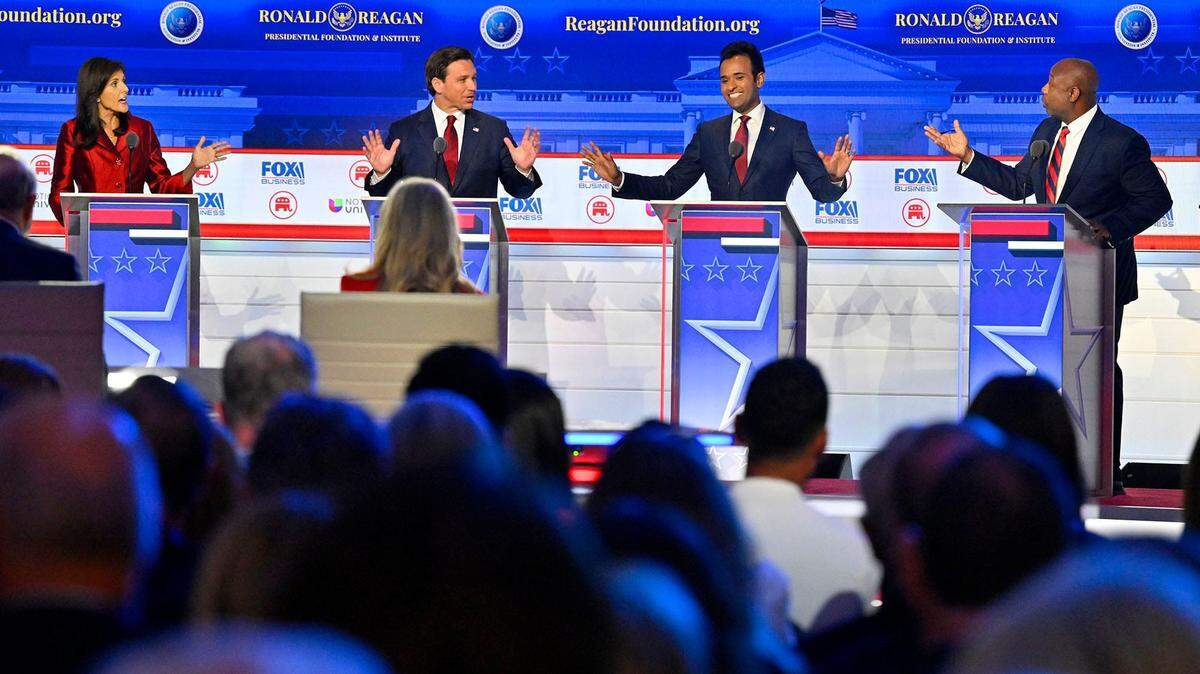
Seven Republican presidential candidates — but not frontrunner Donald Trump — clashed over the Ukraine war, talked tough on immigration and bickered among themselves as they struggled to stand out as the clear alternative to the former president.
Some belittled Trump. Former New Jersey Gov. Chris Christie called him “Donald Duck” for skipping the debate. Florida Gov. Ron DeSantis said Trump was “missing in action.”
But others were careful about distancing themselves from the former president, who has a huge poll lead over his rivals. They praised his efforts to crack down on illegal immigration and cut taxes, while only gently criticizing how federal debt soared during his administration.
None of the contenders has broken out of the pack as the obvious number two, and for some, this debate could be a last chance.
The next debate is scheduled for November, and the requirements to be included will be tougher. Time is running out for low-polling candidates to raise more money to remain viable, and the first-in-the-nation Iowa caucus is scheduled for January 15.
After the first debate, former South Carolina Gov. Nikki Haley’s more measured approach and entrepreneur Vivek Ramaswamy’s tough Trump-like talk got some attention.
So did DeSantis and Sen. Tim Scott, R-South Carolina, but the focus was on their more languid performance.
This time, Scott came out aggressive and remained combative throughout the two-hour debate, at one point getting into a heated disagreement with Haley.
They fought over the South Carolina gas tax and about $50,000 worth of curtains purchased by the State Department when Haley was the U.S. ambassador to the United Nations during the Trump administration.
Scott said Haley bought the expensive curtains. Haley told Scott “you got bad information.,” as they were already in place when she arrived. “Do your homework Tim because Obama bought those curtains,” she told Scott. They were bought during the Obama administration.
Did she return them, Scott asked.
“It’s the State Department’s Did you send them back? You’re the one who works in Congress. You get it done,” Haley snapped back.
DeSantis calmly and methodically recited what he called Florida’s economic and educational achievements. He reminded the audience he would be the first president since George H.W. Bush, elected in 1988, to have served in an overseas war.
And he pushed back at Trump on abortion policy. Trump last week said Florida’s ban on abortions after six weeks of pregnancy was a “terrible thing.”
DeSantis, who signed the ban into law, said Trump “should be here explaining his comment to try to say pro-life protections are somehow a terrible thing.”
Trump in the spotlight
Trump still got a piece of Wednesday’s spotlight. At virtually the same time the candidates were debating at the Ronald Reagan Presidential Library in Simi Valley, California, Trump was speaking at a non-union auto supplier in Clinton Township, Michigan.
The United Auto Workers strike against the Big Three automakers is in its 12th day, and President Joe Biden joined their picket line Tuesday.
Trump was speaking in Macomb County, long a blue-collar bellwether where Republicans have made strong inroads in once-solid Democratic territory, a voting bloc crucial to winning the swing state of Michigan.
He has made a distinction between being pro-blue collar worker — and not pro-union — though he did urge union members in the audience to convince the UAW to endorse him.
In California, Trump’s opponents picked up the pro-worker theme. Ramaswamy talked about having “a lot of sympathy for the workers.” Former North Dakota Gov. Doug Burgum insisted that Biden’s policies had led to worker discontent, and “this strike is at Joe Biden’s feet.”
Battle over Ukraine
The most fiery exchanges among the candidates involved Ukraine, a reflection of the schism among Republicans in Congress over whether to continue or limit U.S. aid to the embattled country.
“We are not going to have a blank check,” DeSantis said. “I watch these guys in Washington, D.C….they don’t care about the American people.” Spend the money on combating fentanyl deaths, on improving the quality of life in this country, he said.
“We have to level with the American people” on Ukraine, Ramaswamy said. “Just because (Russian leader Vladimir) Putin is an evil dictator does not mean Ukraine is good..we need a reasonable peace plan” to end the war.
Scott angrily disagreed. The nation’s vital interest is served by “degrading the Russian military,” he said. Stopping the Russians not only helps make the U.S. safer, but “we keep our troops at home.”
And, said Haley, a former U.S. ambassador to the United Nations, “a win for Russia is a win for China.”
Overall, though, there was little disagreement with Trump on most topics.
Tough immigration talk
They all vowed to get tough with border security. Ramasawmy cited what he called lax border protections as a reason for more crime. DeSantis vowed to use the U.S. military to go after Mexican drug cartels.
There was some irony in the tough immigration talk, since Reagan in 1986 signed into law a reform bill that helped some undocumented immigrants enter the country.
And a broad bipartisan coalition in 2013 passed legislation that provided a path to citizenship for undocumented immigrants. It got nowhere in the House.
Christie was sympathetic to reforms 13 years ago as governor of New Jersey. He said at the debate the border situation had changed, and the priority today is law enforcement first.
Former Vice President Mike Pence defended the still-unfinished border wall and insisted he’d take strong steps to secure the border. “I know how to do it,” he said.
The fentanyl crisis became part of this debate. Haley claimed that more people in this country have been killed by fentanyl than were killed in the Iraq, Afghanistan and Vietnam wars combined, which is true.
The debaters insisted they had ways to reduce the national debt. Among Scott’s ideas is a constitutional amendment requiring a balanced budget — a plan that has been debated for decades but gone nowhere.
Haley pointed out that Congress annually can’t balance its budget. Its inability to pass any budget is threatening to shut down much of the government Saturday.
“Where have you been?” Haley asked, as Scott tried to interrupt her.
Burgum said he could cut the size of the federal government because he’s shrunk the size of government in North Dakota. As a businessman, he said, “this is totally possible.”
This story was originally published September 27, 2023 at 8:18 PM.
.jpg)