
Gavin Newsom and Brian Dahle face off for governor. Where they stand on California issues
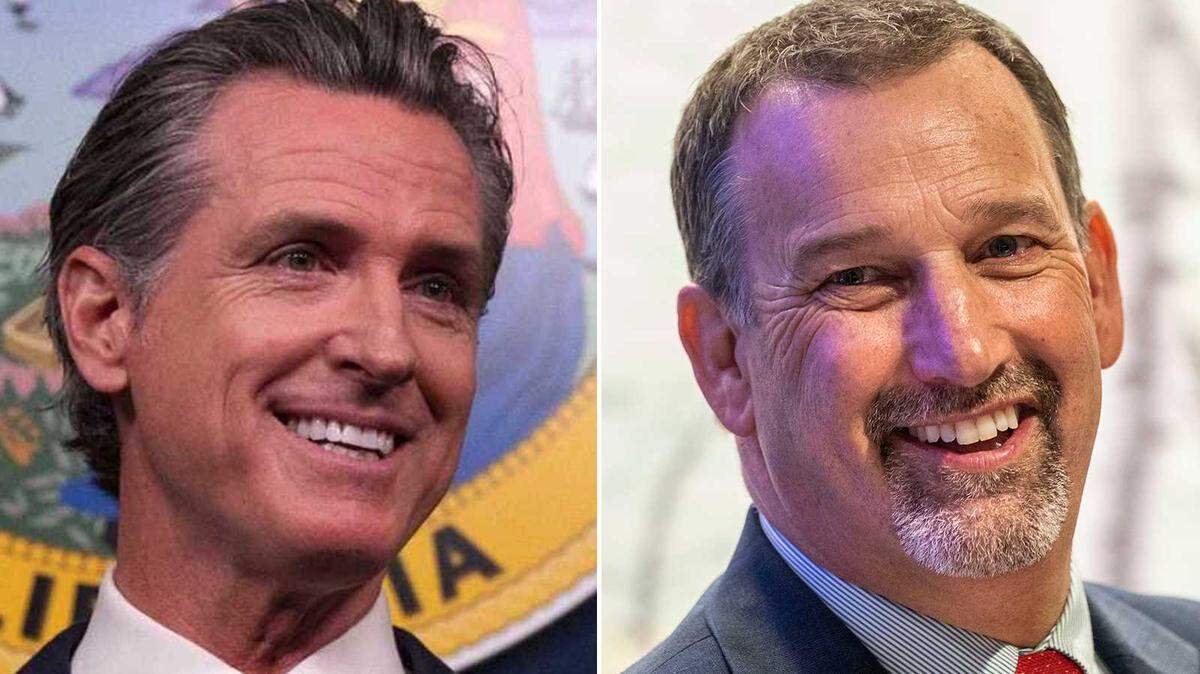
Brian Dahle
Party: Republican
Age: 57
Birthplace: Redding
Residence: Bieber
Occupation: Farmer and state senator
Offices held: State Senator, 2019-present; Assemblyman, 2012-2019; Lassen County supervisor, 1997-2012
Website: BrianDahle.com
What will be your top three policy priorities if elected?
The focus of my administration will be curbing California’s high cost of living, out-of-control homelessness and rising crime.
The state devotes millions of dollars annually to tackling homelessness but it remains one of the state’s most pressing issues. Why would you be more successful than the current administration?
First of all, a correction to the question: The state spends billions of dollars supposedly fighting homelessness, with little result. I will aggressively work to clear the many bureaucratic hurdles that developers face in getting new homes built to reduce the state’s dire housing shortage. I will work to restore sober living and transitional housing to support addicts through recovery. The state has stopped supporting these effective programs through misguided “housing first” laws.
Hard drugs – especially methamphetamine and fentanyl – are flooding our streets, ruining lives and leaving many users on the streets. We need more drug treatment for addicts, but the state also needs to much more aggressively fight drug traffickers in partnership with local and federal law enforcement.
As a Republican, how would you govern, given the Democratic supermajority in the legislature, to accomplish your agenda?
In the Legislature, I have worked hard to get to know other members of both parties and I have hosted well over 100 other members in my district to learn about the unique issues in rural northeastern California. I truly believe in listening, building relationships, and getting things done for the people we represent.
I also believe that even within the Legislature, there is a hunger for some common sense and humility in state government.
You’ve said that violent crime is of particular concern for you. What’s your plan?
I’d start with enforcing the law again. Over and over again serious criminals face no accountability from our justice system in California. This administration is actively working to free inmates early and close prisons, even as the state is still under court oversight for overcrowding. I’d put a stop to that.
We must aggressively use the Armed Prohibited Persons System to take known guns out of the hands of those who are barred from owning them, and prosecute illegal gun possession like the serious crime it is. Ballot measures over the past decade have not only reduced penalties but pushed responsibility for sentencing to local governments. I will better support counties so they can effectively deter crime and help those willing to change their lives.
Gavin Newsom
Party: Democratic
Age: 55
Birthplace: San Francisco
Residence: Fair Oaks
Occupation: Governor, since 2019
Education: Bachelor’s degree, Santa Clara University
Offices held: California lieutenant governor, 2011-2019; San Francisco mayor, 2004-2011; San Francisco Board of Supervisors member, 1997-2004
Website: GavinNewsom.com
What will be your top three policy priorities if re-elected for a second term?
I don’t think any of us could have predicted four years ago what the future would hold. A global pandemic and economic recovery, successive years of climate change fueled record wildfires, a historic drought and countless other crises. No one can predict what the next four years will bring California. As your governor, I promise you: Whatever challenges come our way, I will always lead the California Way — based on compassion, common sense, telling the truth, following science, treasuring our diversity, defending our democracy, protecting our planet and always planting seeds for the future.
The state devotes hundreds of millions — and more recently billions — of dollars annually to tackling homelessness but it remains one of the state’s most pressing issues. What improvements do you think you can make with another four years in office?
Our homelessness crisis is a challenge that was long in the making — the tragic product of insufficient affordable housing supply and the hollowing-out of our mental and behavioral health system since the 1970s and 1980s. We are doing everything we can to turn the tide. Since I took office, we’ve invested over $17 billion to combat homelessness. These dollars dwarf anything the state had done before. We pioneered Homekey — which delivers shelter beds faster and cheaper by converting existing buildings — and we’re holding local governments accountable by making them demonstrate that they’re putting our dollars to good use. Mental and behavioral health is a large part of this crisis. If we can’t provide comprehensive treatment, we won’t be able to help a lot of people. A big chunk of our $17 billion-plus homelessness investment includes funding to create housing and treatment options for people with behavioral health challenges. We’re also leveraging Medi-Cal to provide timely behavioral health care to people experiencing homelessness, in times of crisis. This is also why my administration worked with the Legislature to develop CARE Court — a framework for providing care and services to Californians experiencing mental health and substance use crises. I look forward to working with the Legislature to get CARE Court done this year, and it’s my hope that this will support the thousands of Californians living on our streets who have been the hardest to reach.
You’ve been criticized for going after Republican leaders in other states while California is struggling to address homelessness, wildfires, and a stressed power grid. What would you say to Californians who think you’re not focusing enough on their issues?
My state’s issues are first and foremost on my mind. What we’ve accomplished — even just in the last few months alone — should be able to speak for itself.
▪ My Administration spearheaded a significant increase in funding for California to manage forests and protect people from catastrophic wildfires - allocating $1.5 billion in last year’s budget alone, and this year adding another $1.2 billion. That’s compared to $200 million when I took office. We now have more equipment, vehicles, personnel, and intelligence to respond quickly and effectively to wildfires. We’ve put in the work to better prepare for these fires, with fuels reduction projects in vulnerable, fire-prone areas across the state and bolstering home hardening efforts to better protect structures that face greater risk. Cal Fire treated approximately 110,925 acres across more than 600 projects last fiscal year in preparation for this year’s wildfire season, exceeding the state’s goal of treating 100,000 acres by 2025. But we’re also thinking about - and acting on - how we can minimize the extremity of these fires, by implementing an all-of-the-above approach to tackling climate change, going forward with a $54 billion climate package - more than what just about every other country is spending on climate. We are phasing out the sales of new gas-powered cars by 2035, and I just signed world-leading legislation that will accelerate the ambitious climate goals that we had already set out to achieve.
▪ We invested an unprecedented $15.3 billion homelessness package, giving local government more dollars now than ever before both housing and behavioral health. We created the nation-leading Homekey program which, since its launch in 2020, has funded more than 200 projects and the creation of over 12,500 units for people experiencing homelessness — faster than any other program in the state and at a fraction of the cost. I just signed into law CARE Court, which gives us another tool to address untreated behavioral health and substance abuse issues, which is one element of this crisis.
▪ Over the last two years, we have added more than 4,000 megawatts of new capacity to respond to peak demand periods. Most of that is from battery storage that allows energy captured from the sun and wind to be used even when the sun is not shining or the wind is not blowing. But we are in a race against climate change. Over that same period, we have lost 1,500 megawatts of capacity from our hydroelectric plants because of the record drought facing our state. So we must go fast to bring more energy online. The Legislature took action this year speeding up the process to build new clean power plants and investing more money in the clean energy we need to power our state.
But the issues California is facing are not occurring in a vacuum. Homelessness is a growing issue around the country. Climate change, which drives extreme heat and the volatile wildfire seasons we’ve seen recently, doesn’t care about borders.
The issues I’m involving myself in other states for — like abortion rights and immigration issues — may not be pressing in California yet, but they do impact us. And they should impact everyone’s humanity. What Republican governors are doing is endangering people and their rights for cheap political points. And that is something that I will not stand by and watch. Their behavior — their bullying — cannot be allowed to spread further than it already has, and I am more than happy to step in and stop it if I have to.
How do you plan to enforce some of the ambitious policies you’ve introduced regarding the climate, housing development and early childhood education?
Accountability is of the utmost concern to this administration, especially right now as we really begin to gain momentum on our implementation of the foundation we’ve laid. We provide resources, funding, and above all partnership to locals — my office works closely with a number of partners and stakeholders during both the development and implementation of our policies.
For example: At the state level, we are providing more funding, reducing bureaucratic red tape and supporting “shovel-ready” projects to increase the housing supply. We created the nation-leading Homekey program to create new homeless housing units at a fraction of the cost of traditional affordable housing. Now, local governments need to correctly utilize the resources we’re providing them. This is why I’ve built in new accountability and transparency measures to ensure local governments are using the dollars we’re providing. We established a Housing Accountability Unit at the state agency level to work (with) local government officials to ensure compliance and, if needed, enforce these policies.