Slow start to California’s water year, as snow survey reflects relatively dry January
Four weeks after California water officials conducted the first manual snow survey at Phillips Station of the decade, the latest measurements of the state’s reserves reflect a lack of precipitation since then – even after a very heavy snowstorm struck the central and southern Sierra Nevada range.
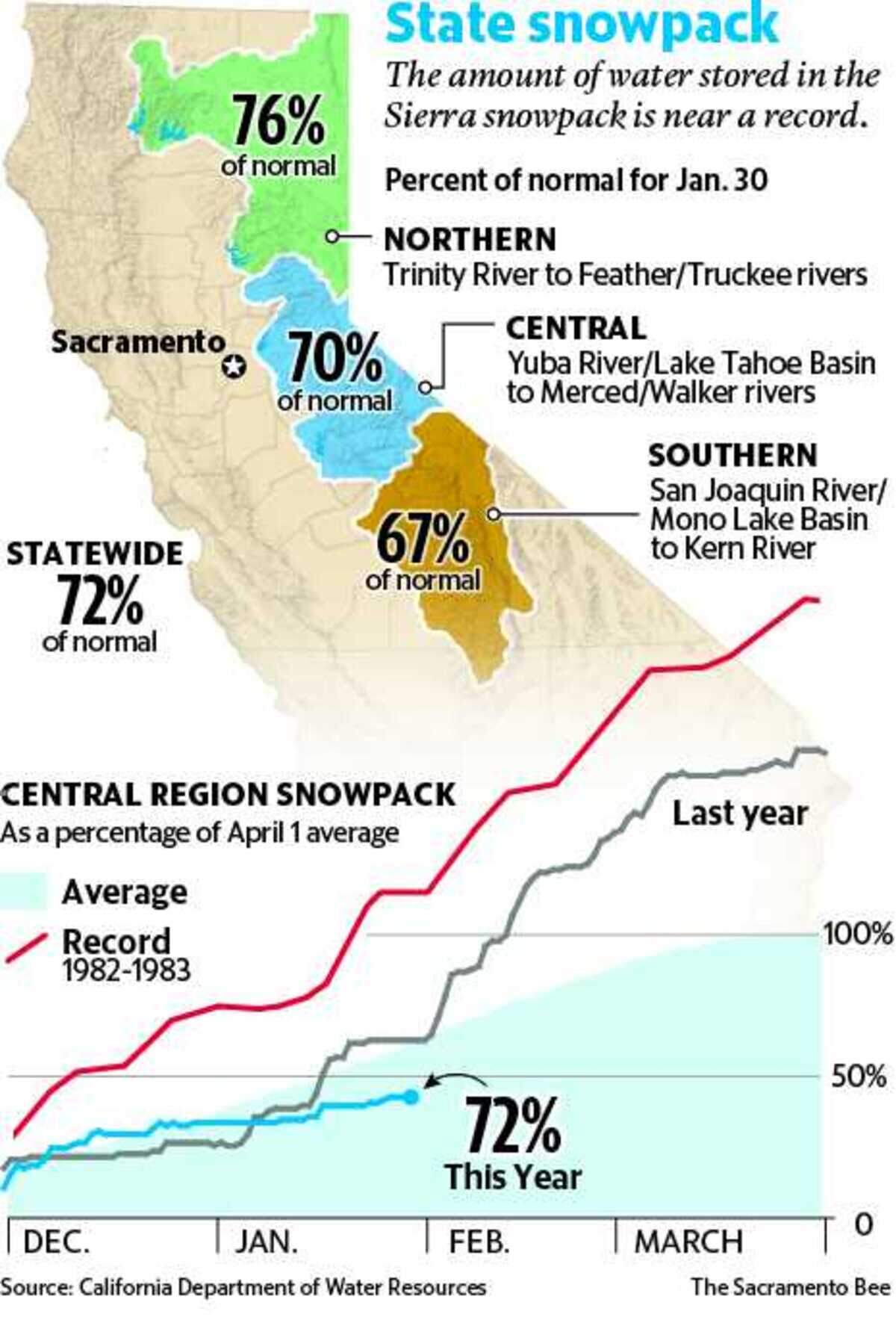
Department of Water Resources personnel trekked to the station near Echo Summit on Thursday for the second survey of the calendar year. After snow-water equivalent readings on Jan. 2 had measured 97 percent of the historical average for that date, and the statewide reading spanning the entire Sierra stood at 94 percent as of Dec. 31, both of those figures have fallen below 80 percent of normal, after a lack of sustained rain or snowfall throughout the Golden State.
DWR’s chief of snow surveys and water supply forecasting, Sean de Guzman, announced a snow-water equivalent of 14.5 inches, which was 79 percent of average for the end of January at Phillips Station. DWR’s data center showed a statewide water equivalent of 12 inches as of Thursday morning, 72 percent of normal for the date.
“Snow and precipitation statewide were well below average, but we still need to wait and see what the next few months will bring us,” de Guzman said, standing on a moderate amount of powder as he announced the results in a news conference streamed live on Facebook. “Luckily, our reservoirs statewide are either at or above their historical averages for this time in year, thanks in part to just how wet of a water year 2019 was as well as optimized reservoir operations.”
Of the state’s 12 reservoirs, all but two in Southern California (Lake Perris and Castaic Lake, each at 85 percent) were at 95 percent or higher than their historical average for the date, a DWR map shows. Nearby Folsom Lake and Lake Oroville are at 96 percent and 95 percent of average, respectively, and Don Pedro Reservoir is at 118 percent of normal.
De Guzman pointed out that it was a very wet February, March and April last year that boosted 2019 beyond average.
Two weekends ago, a severe storm system dropped close to 2 feet of snow across a wide span of the Sierra range and surrounding foothills. One person was killed and another injured in an avalanche at a Tahoe-area ski resort. Light snow lingered into the start of last week. Aside from those hectic few days, it was a quiet month in the mountains.
Things stayed dry in the valley as well, where Sacramento has received just over 1.1 inches of precipitation since New Year’s Day, with no rain in Friday’s forecast to boost January’s totals, according to the National Weather Service. That’s less than one-third of the historical monthly average of 3.6 inches, dating back to 1941.
This story was originally published January 30, 2020 at 12:14 PM.