
It’s not just Sacramento — we must demilitarize Placer County, Citrus Heights, Elk Grove
I was on UC Davis’ campus when the active shooter alert came in. It was a Thursday evening in January of 2019, and a few of us had stayed late to work in the student newsroom when phones started buzzing. That was the night Davis police officer Natalie Corona was killed.
Corona’s death received national news coverage and distressed our quiet college town. It was the shock of Corona’s death that led, in part, to the unanimous vote from the Davis City Council to approve the purchase of a $149,385 armored recovery vehicle (ARV) in 2019.
Just five years earlier, in 2014, Davis’ police department acquired a controversial $689,000 surplus military vehicle, a Mine-Resistant Ambush Protected vehicle, from the federal government as part of the “1033 Program” which gives excess military equipment to law enforcement agencies. This MRAP was a smaller version of armored vehicles used in Iraq and Afghanistan.
The Davis City Council ultimately rejected the MRAP, but the vehicle didn’t go far. It ended up a few miles away in Woodland.
Even after Corona’s death, the acquisition of Davis’ own ARV was controversial. Although the vehicle looks more like a delivery van than a military tanker, it’s an expensive, unnecessary purchase. Davis has used it only twice in two years, once to barricade a suicidal man and once to respond to a burglary call inside a commercial building where the suspect was overheard threatening to “shoot it out” with police, according to Deputy Police Chief Paul Doroshov.
Davis and Woodland aren’t the only cities in the area with military vehicles: Sacramento, West Sacramento, Citrus Heights, Elk Grove, Lodi, Folsom, El Dorado County and Placer County’s law enforcement all have armored vehicles.
I never want to live through the terror of an active shooter event again. I also want local law enforcement prepared with the resources needed to respond to emergencies. That said, I also support the effort to demilitarize police and see no reason why Sacramento-area law enforcement agencies need a dozen armored vehicles within a 30 mile radius.
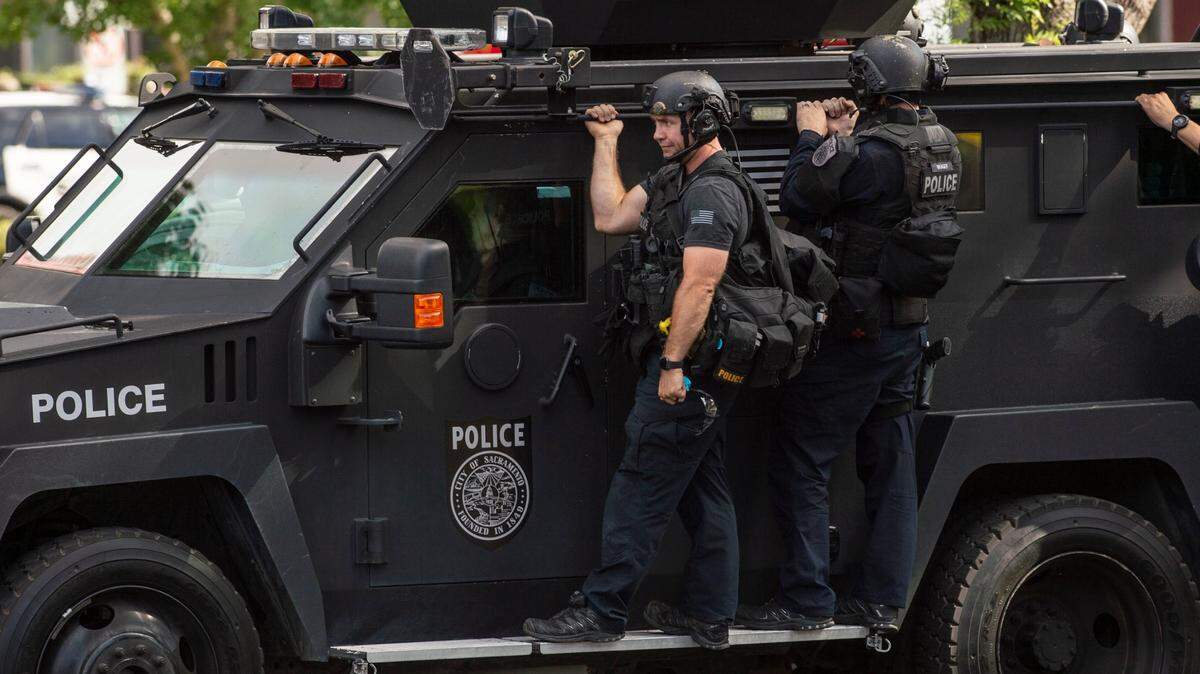
Sacramento PD owns both a BearCat, an armored rescue and response vehicle, and a Peacekeeper Protected Response Vehicle. The Sacramento Sheriff’s Office owns both a BearCat and a Rook, which looks like a lethal bulldozer.
The West Sacramento Police Department has an armored vehicle; Police in Elk Grove, Lodi, Folsom and the El Dorado County Sheriff’s Office all have BearCats. The Placer County Sheriff’s Office has two tactical rescue vehicles (TRV) and Citrus Heights police own mine-resistant military vehicle.
Citrus Heights’ MRAP was a surplus vehicle from the federal government, and both Elk Grove and Lodi’s BearCats were purchased using Homeland Security grants. Placer County Sheriff’s Office own TRV was purchased in 2016 for $385,000 using county funds approved by the county’s Board of Supervisors, and PCSO’s second TRV, a regional asset used by the Roseville and Rocklin Police Departments, was purchased for $325,000 using a Homeland Security Grant.
The frequency with which these vehicles are used is astounding.
While Woodland PD deploys its MRAP between three to six times a year, Sacramento deploys its BearCat approximately 120 times a year. Placer County has deployed its tactical vehicle 100 times since 2016 and its regional asset TRV 300 times since 2006.
Placer County sheriff spokesperson Angela Musallam said the TRV has been deployed in situations including attempted murders with firearms, a hostage situation, attempted murders of peace officers and two separate murders.
The optics of police using and relying on military vehicles are problematic. At a time when relations between police and the public are especially strained, police reform and trust building must start with demilitarization.
Law enforcement agencies must lessen their reliance on military equipment and halt the acquisition of additional equipment.
“Militarizing the police force has become normal, [and] the more normal it becomes, the more equipment they add on,” said Caity Maple, a Sacramento activist who supports demilitarization and a candidate for Sacramento City Council to represent District 5.
These armored vehicles are also relics of an era characterized by war.
The militarization of police began in the 1960s when Los Angeles Police Chief William Parker, a World War II veteran, countered community policing strategies with the idea of a militarized department.
“In the Watts riots in 1965, Parker ... described policing rioters as akin to ‘fighting the Viet Cong,’
as if city residents angry over racial injustices were a bunch of communist guerillas,” wrote Bloomberg columnist Stephen Mihm.
After the creation of a federal agency to oversee the transfer of surplus military equipment to police forces in 1968, police militarization subsequently accelerated during President Richard Nixon’s War on Drugs.
In 1996, President Bill Clinton established the 1033 program — the same program that supplied Davis its MRAP in 2014. The program “requires that law enforcement agencies make use of such equipment within a year of acquisition, effectively mandating that police put it into practice in the public space,” according to The New York Review.
In the 2000s, during the Afghan and Iraq Wars, police departments received even more — and more lethal — equipment. Most recently, restrictions on the 1033 program implemented under President Barack Obama were rescinded by President Donald Trump.
Demands to demilitarize the police have re-emerged following the police killing of George Floyd. According to research from 2017, the recall of “military equipment should result in less violent behavior and subsequently, fewer killings” by law enforcement. “Taken together with work that shows militarization actually leads to more violence against police ... the present study suggests demilitarization may secure overall community safety.”
Sacramento area law enforcement must return to the pre-militarization ideals of community policing.