
How California Democrats learned to stop worrying about COVID and join the trucker convoy
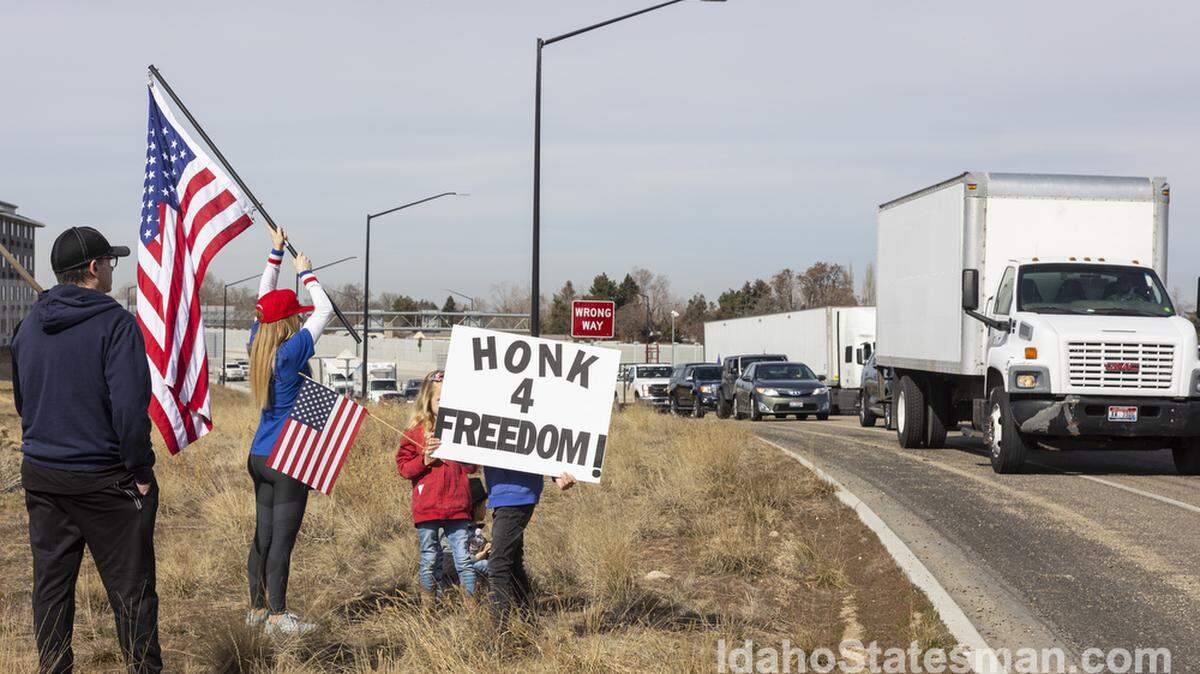
A convoy of truck drivers opposed to public health mandates recently left the Washington Beltway for a destination with even less use for a premeditated traffic jam, California. Around the same time, state Assemblywoman Buffy Wicks announced that her bill to require vaccination against COVID in workplaces had become so much legislative roadkill.
A super-Democratic Legislature doesn’t typically rush to occupy the same lane as drive-by pandemic deniers, so Wicks clarified that it wasn’t the “trucker gang” that forced her to shelve her measure. Rather, the Bay Area Democrat cited the resistance of labor groups representing police, firefighters and other uniformed forces. A host of these “public safety unions,” as she called them, had registered their objections to, well, public safety.
Not to mention their own: COVID killed over 300 active-duty American law enforcement officers nationwide last year, which for the second consecutive year was far more than all other causes combined, according to the National Law Enforcement Memorial and Museum. That made 2021 the deadliest year for U.S. police agencies in nearly a century.
Likewise, according to a recent report by the U.S. Fire Administration, COVID killed more firefighters in the line of duty in 2020 than fires did. And yet the California Professional Firefighters union fumed that Assembly Bill 1993 would set a “dangerous ... precedent,” which is the precise opposite of what it would do.
Meanwhile, the politically generous union representing the state’s prison guards is so committed to resisting vaccination that it appealed a federal court order requiring members to get their shots despite the obvious repercussions for them and the people in their charge, hundreds of whom have died of COVID. More remarkably, Gov. Gavin Newsom’s administration intervened on the guards’ side, prompting one federal appellate judge to recently wonder whether the administration had granted the union “veto power” over public health policy as well as prisoners’ constitutional right not to be extrajudicially sentenced to death.
The law enforcement unions weren’t alone in fighting Wicks’ bill. Several trade unions joined them, making curiously common cause with a collection of agricultural interests, business groups and conspiracy theorists. Union officials, after all, are just politicians writ small, more likely to be pulled by their constituents than to push them.
The assemblywoman likely had little choice but to desist or fight a losing battle given the political realities of the Legislature, where the much-vaunted science is one thing but the well-funded unions are another.
Wicks’ measure was not the first of its kind to succumb nor likely the last. The U.S. Supreme Court struck down a parallel federal mandate affecting large employers in a nonsensical ruling that simultaneously upheld a mandate for health care workers. And Wicks dropped another proposal to require vaccination to enter high-risk indoor spaces such as bars and restaurants last year, foreshadowing more recent retreats by some of the local governments and private businesses that took such precautions in the state’s largest cities.
Last week, a hearing on state Sen. Richard Pan’s bill to deny funding to sheriff’s departments that defy COVID orders — speaking of counterintuitive positions for agencies nominally dedicated to public safety — was postponed. Pan, D-Sacramento, no doubt faces more resistance if he presses on with that bill and another to close the big-rig-size loopholes in Newsom’s school vaccination mandate.
In a senseless world, sensible measures are at least bold and perhaps impossible. Yes, as Wicks noted, the virus has “receded for the moment.” But as the phrase suggests, such moments have passed before and, judging by signs of a resurgent viral subvariant, are likely to do so again.
The impulse to return to normal is understandably strong, but that’s part of what makes the resistance to vaccination even among emergency workforces counterproductive as well as self-destructive. Widespread protection could have sped our return to something much closer to normal with far less suffering. But too many Americans insist on a conception of normal that is so non-negotiable as to brook not even a deviation as minor as a shot in the arm — a minuscule concession to general well-being and particularly the most vulnerable among us — and too few of our leaders are willing to challenge them.
The truckers, expected to arrive any day now, say they’re coming to stop California’s next COVID mandates. When they get here, they will find no such thing. We’re all joining a convoy on a collision course with our own good.