
Across from a Sacramento school, bullets, sad parents and angry homeless people
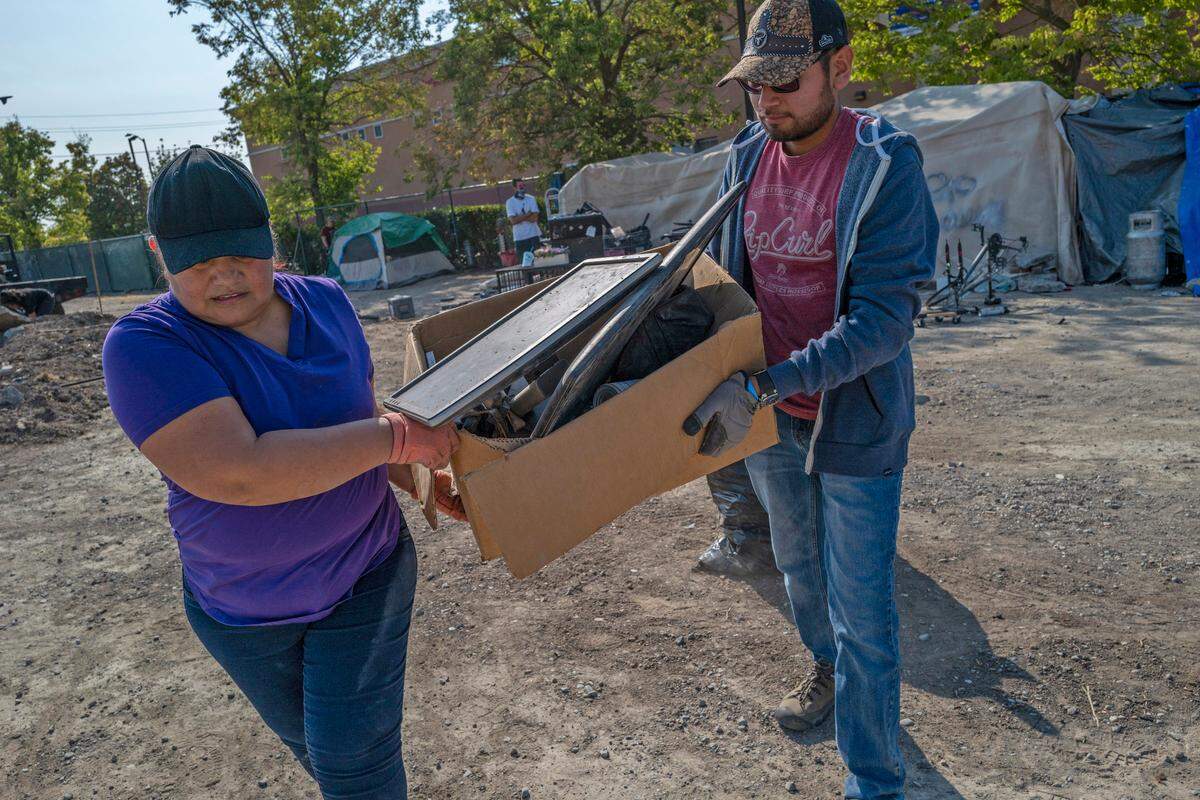
It’s Friday morning, so Leticia Huerta and her family are as usual out picking up trash on the lot right across from their South Natomas neighborhood school, Garden Valley Elementary, where some homeless people are living in tents.
She is “very sad” about this juxtaposition, and who wouldn’t be? This morning, her volunteer crew has run across not just the usual hypodermic needles and trash, but live ammo — seven unspent bullets — and two heavy containers marked “radioactive.”
The situation, Leticia says, “isn’t fair for the kids, for the parents, for the teachers” at the school once attended by her 20-year-old son Raul Jr., now a junior at UC Davis. Raul is here helping, too, and describes himself as a “proud alum.” Because this truly is a place in which the Huertas, who live just around the corner, take great pride.
“People say, ‘Oh, you don’t feel empathy for the homeless,’” says Leticia, “and no, we do, because anybody can be a homeless. They has rights like everybody, but what about the rights of the students to be secure? This school is No. 1 in attendance. The principal went to the houses — the mobile homes right over there — during the pandemic to see what everyone needs. We’re a poor area, and some parents don’t speak English, but that doesn’t mean they don’t have rights. I love this school. This is the second house of your kids,” and needs to be treated as such.
Stories with clear villains and heroes are satisfying, but this is not one of those stories. Almost no honest depiction of homelessness is.
Leticia calls after an abuela hurrying her two 3-year-old grandchildren past the tents and across the field. In Spanish, she asks the woman how often she has to do that. “Diario,” the woman answers. Every day.
I’m a mom, too, and would I have wanted my kids to see people lying unconscious on the sidewalk in front of their “second house” as they waited for the bus, or played outside during recess? Nobody would, just like nobody hopes to grow up to become one of the folks living in those tents.
Homeless people ‘try to keep to ourselves’
The tent-dwellers are upset this morning, too, because someone has told them that the city’s going to be moving them again and confiscating all their stuff. That’s not the case, according to the city outreach workers I’m here with, answering a series of 311 “customer service” calls from the Huertas’ neighborhood group, the South Natomas United Association.
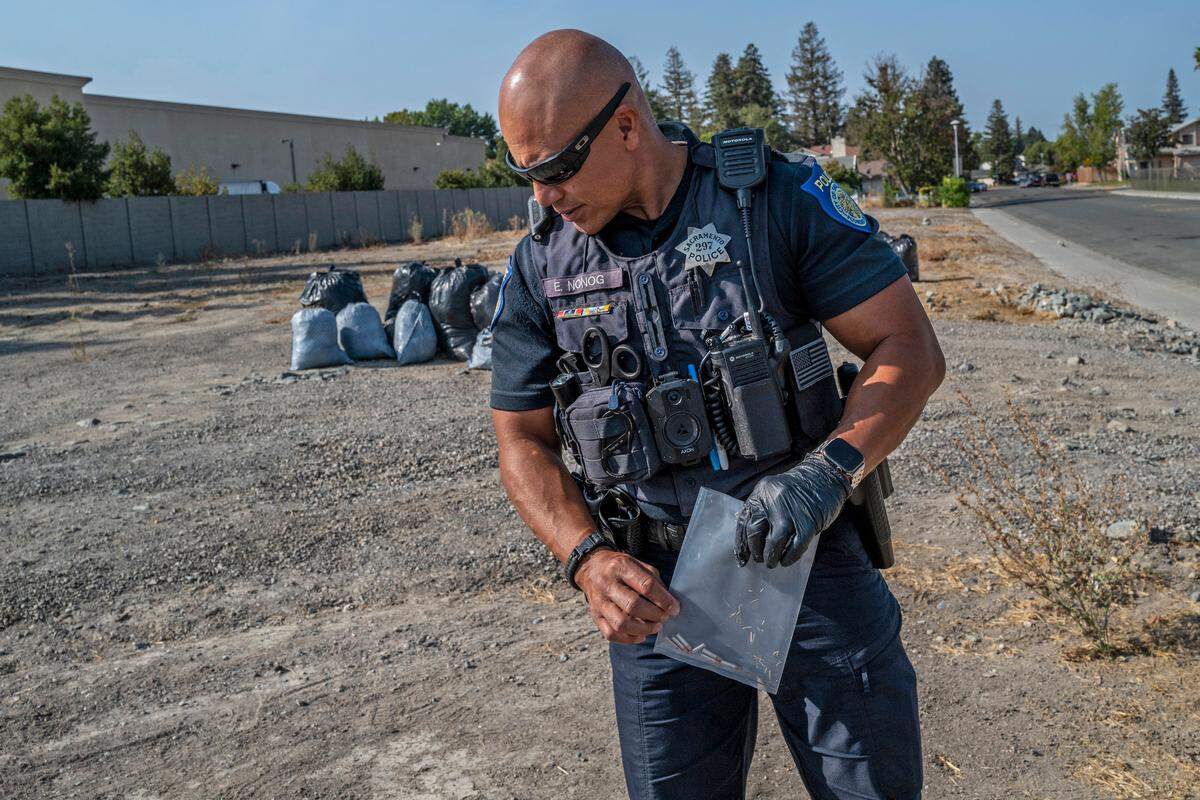
But when the police arrive to pick up the bullets, and some firefighters show up, too, to collect the containers marked “radioactive,” which turned out not to be dangerous, one man sticks his head out of the tent and yells, “I told you guys! Here come the cops!”
Becky Brown, who is 41, climbs out of the tent looking like she’s going to cry. “We try to keep it clean,” she tells city outreach worker Chris Bell. “We try to keep to ourselves.”
She and the others living in a handful of tents up against a fence with holes in it on the far end of this otherwise empty, dusty field aren’t the bad guys in this scenario, either. “People make fun of us,” but “we don’t bother anybody at the school.”
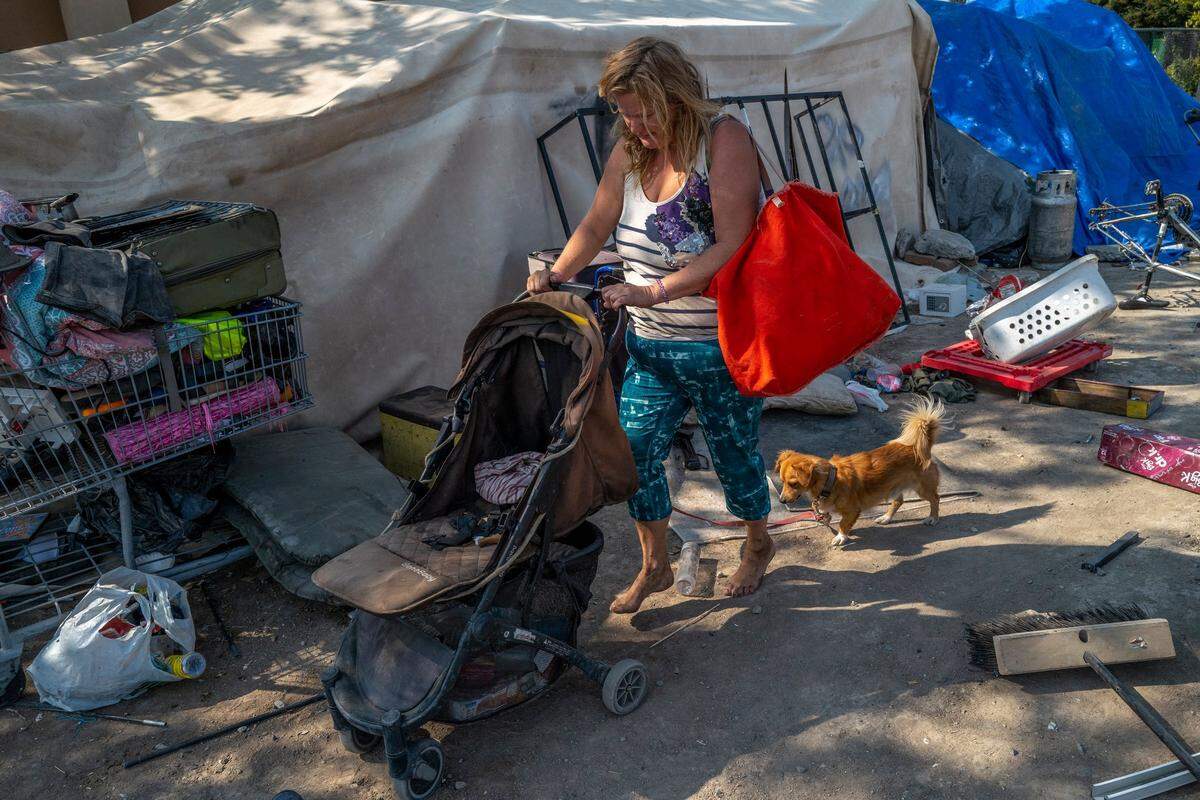
How long has Becky been homeless? “Forever,” she says. Forever started nine years ago, when she and her partner “kind of had a falling out. You can’t depend on people to take care of you.” She gets food stamps, but her only source of income is recycling, which is how she supports herself and her dog, “Little S--t,” whom she pushes around in a baby stroller.
When I ask about family, she says she does have a sister in the area, but “I made some choices that it’s not right for me to be next to my nieces and nephews.” More than anything, “I really want a job, but I’m scared because I have nothing to put on there” when asked to fill out an application.
Here is her entire employment history: She once worked three days at a Taco Bell, in a job her cousin got for her, before being fired.
When the city outreach worker suggests that maybe he could sit down with her and talk about how to build a résumé and figure out a plan, that scares her, too: “I have no schooling! I have nothing!” Well, nothing except “bad anxiety. I feel worthless.”
Even with jobs so plentiful, you can’t necessarily get and hold one just because you want to, though those of us who’ve been doing it since childhood can’t always see that. Outreach workers such as Chris Bell are moving people out of homelessness, but it takes time and patience. “Let’s continue talking,” he tells Becky, and takes her contact information so that “we can get her in the door to have that conversation. That will be my goal.”
‘I’m alive because of garbage’
Another homeless woman who calls herself Lilith Whyte — “That’s the name I’ll give you” — asks Chris angrily whether all constitutional rights have been suspended, or only those of homeless people.
How would you like to come home one day, she asks, and with no warning, find that everything’s gone? That you have to start all over again, and you don’t even know where your family is? If that continues to happen, she says, “It’s going to cause a civil war. They’re going to kill us; that’s how it feels.”
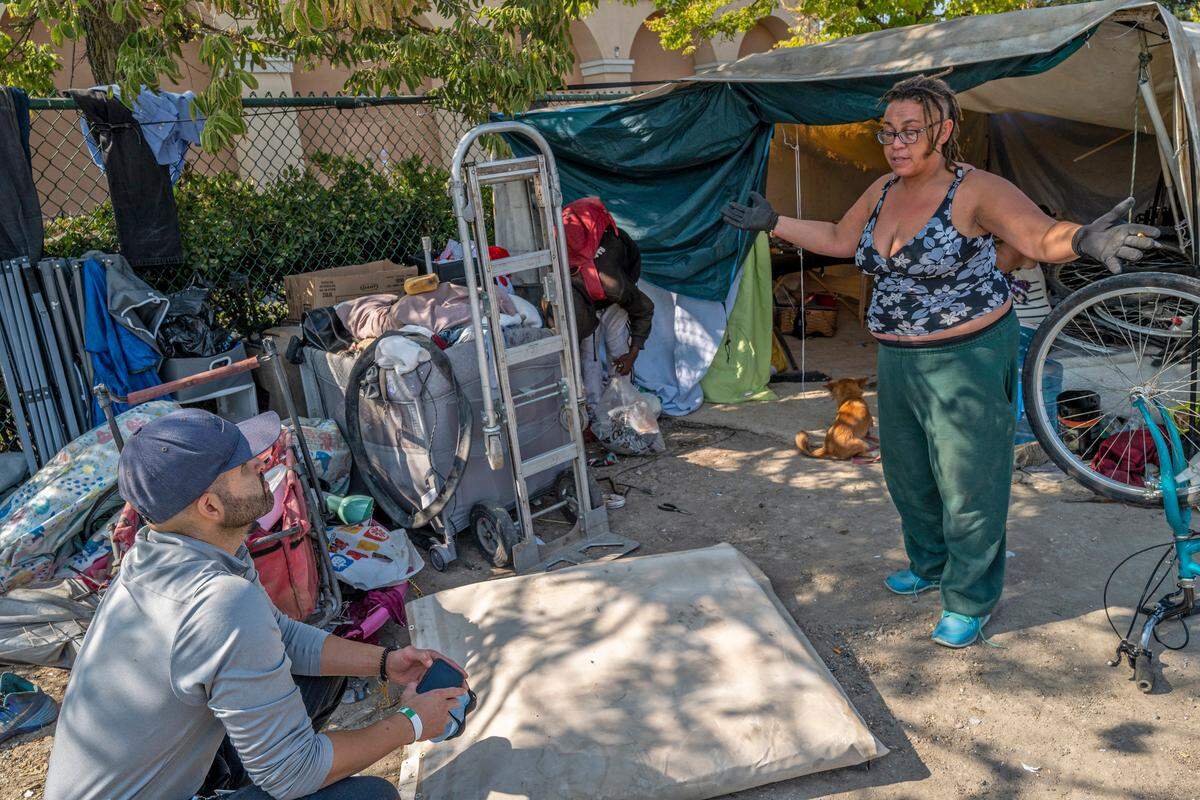
She was employed as the manager of a Denny’s, and was sober and living with her kids before she became homeless — originally, because of an eviction, but that’s not why Lilith is still out here, she says. “This is my family! That’s why we’re out here, because we have a chemical imbalance.”
She, too, complains about some homeless people who aren’t part of her group. “We’ve had homeless people running through our s--t. There are crazy people out here — half-naked bitches.”
But Lilith also asks for the compassion that even she doesn’t always feel: “I fell totally to the bottom when I had to eat out of the trash, but I’m alive because of garbage, and I’ll never knock a homeless person again.”
What she describes as what she wants to see happen — “Just put us somewhere we can go that’s not going to be like this. There’s not even a porta-potty here for me” — sounds a lot like the kind of central intake campus that local officials have been trying to make happen.
Unfortunately, they haven’t succeeded yet, because of neighborhood opposition.
That is what has to happen as an interim measure, mostly because of policy decisions on housing and mental health that were made years ago and, unless someone locates the “affordable housing and services staffed by people who don’t now exist” fairy dust, will realistically take years to correct. (Enforcement is also a mirage, unless you think America should go back to warehousing even larger numbers of sick and poor people than we do now.)
But meanwhile, it’s wrong to keep putting more homeless services in low-income neighborhoods like this one without ever asking areas with more political clout to share the burden.
They’re building a hospice for homeless people down the street, which strikes the Huertas and others as a threat only because dying people need morphine, and that morphine, they fear, might attract armed robberies. Already, two nearby motels house homeless folks. There are plans to put a “safe parking” area for homeless people living in their vehicles not far away.
“Where’s the shared commitment?” asks Raul Huerta Sr. “It’s not a question of compassion, but of equality for our kids.”
This story was originally published September 19, 2022 at 9:53 AM.