
California’s gun control laws are worth nothing if they can’t protect victims | Opinion
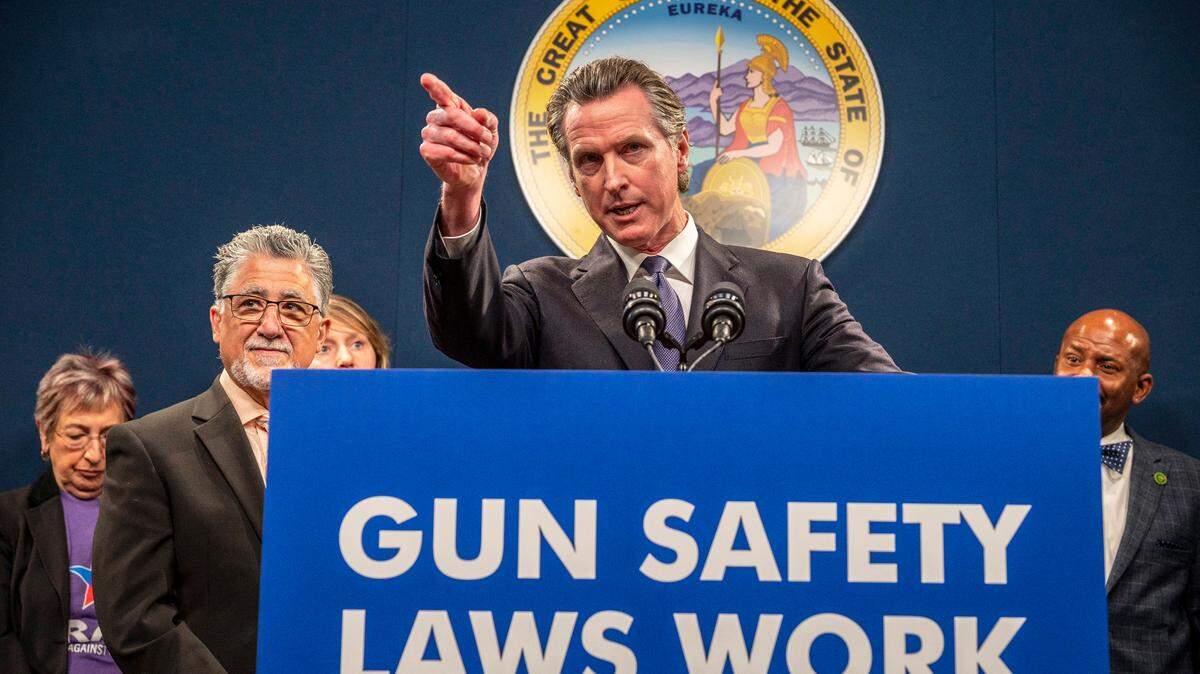
Despite California’s reputation for passing some of the nation’s strongest gun control laws, victims of domestic abuse suffer daily from loopholes in state regulations that too often lead to devastating and deadly outcomes.
In 2020, Christy Camara lost her 10-year-old son to a murder-suicide committed by the boy’s father in the small town of Hanford, south of Fresno. Under the temporary restraining order she was granted by a judge just weeks before, the boy’s father should have never been able to obtain a gun.
Camara is now suing the California Department of Justice, who she says is withholding vital records that would detail the breakdown in orders that allowed her ex-husband to illegally purchase and then use a handgun to kill himself and their son, Wyland.
The Department of Justice refuses to release information that would detail where those court orders broke down. This is an outrageous abuse of power by the Justice Department that has no sensible reason other than to protect the personal privacy of a murderer who took the life of a child alongside his own.
These court orders should have stopped her ex-husband from ever having or buying a gun, but they were either never entered into state law enforcement databases or were ignored entirely.
There’s an overwhelming amount of research that shows the presence of a firearm in a domestic violence situation only increases the likelihood of death. California cannot pride itself on gun control laws and common sense firearm legislation if those systems and laws fail to protect victims in their most dire moments of need. These safeguards must not only be put in place, they must work every time, without fail. Even one delayed or ignored order can result in deadly consequences.
A judge’s order is a paper-thin wall of protection against a bullet. In a study of women in 67 California domestic violence shelters, nearly one-third of study participants reported their abusive partners using handguns to harm, threaten or scare them, according to the National Coalition Against Domestic Violence.
Furthermore, nearly 40% reported that their abuser owned a firearm during the relationship — a number that’s almost twice the rate of gun ownership in California — and 64% reported a gun had been used against them.
Even one death is one too many, but there are at least 50 domestic violence-related homicides each year in which the killer used a firearm, according to the Justice Department.
Recently, CalMatters detailed a backlog of cases in the state’s Armed and Prohibited Persons System, a database of gun owners who cannot own or purchase firearms due to court orders. At the start of 2021, CalMatters reported a high of nearly 24,000 people in the system, including nearly 4,600 because of a restraining order. State Justice Department agents must visit each of these people, all of whom have been ordered to surrender their firearms. The backlog only worsened during the pandemic, when several state Justice Department agents were pulled from field enforcement. Several administrations have promised to fix the problems inherent in the system, but each has failed.
Camara, who was recently profiled by the LA Times, is now suing the Justice Department to force them to comply with the California Public Records Act and disclose the records detailing the background check that allowed her ex-husband to purchase a gun and murder their son.
California’s gun control laws can only be an example to the rest of the nation if they actually work. Not only must we pass the laws, we must also implement them.
If the system did work, then Wyland would still be alive — along with hundreds of other domestic violence victims whom California and the Justice Department have already failed.
BEHIND THE STORY
MOREWhat are editorials, and who writes them?
Editorials represent the collective opinion of The Sacramento Bee Editorial Board.
They do not reflect the individual opinions of board members or the views of Bee reporters in the news section. Bee reporters do not participate in editorial board deliberations or weigh in on board decisions. The same rules apply to our sister publications, The Modesto Bee, Fresno Bee, Merced Sun-Star and San Luis Obispo Tribune.
In Sacramento, our board includes Bee Executive Editor Colleen McCain Nelson, McClatchy California Opinion Editor Marcos Breton, opinion writers Robin Epley, Tom Philp, LeBron Antonio Hill and op-ed editor Hannah Holzer.
In Fresno and Merced, the board includes Central Valley Executive Editor Don Blount, Senior Editor Christopher Kirkpatrick, Opinion Editor Juan Esparza Loera, and opinion writer Tad Weber.
In Modesto, the board includes Senior Editor Carlos Virgen and in San Luis Obispo, it includes Opinion Editor Stephanie Finucane.
We base our opinions on reporting by our colleagues in the news section, and our own reporting and interviews. Our members attend public meetings, call people and follow-up on story ideas from readers just as news reporters do. Unlike objective reporters, we share our judgments and state clearly what we think should happen based on our knowledge.
Read more by clicking the arrow in the upper right.
Tell us what you think
You may or may not agree with our perspective. We believe disagreement is healthy and necessary for a functioning democracy. If you would like to share your own views on events important to the Sacramento region, you may write a letter to the editor (150 words or less) using this form, or email an op-ed (650-750 words) to opinion@sacbee.com. Due to a high volume of submissions, we are not able to publish everything we receive.
Support The Sacramento Bee
These conversations are important for our community. Keep the conversation going by supporting The Sacramento Bee. Subscribe here.