California’s death penalty is unjust — even for the cop-killer who shot Tara O’Sullivan | Opinion
There is no doubt that Adel Sambrano Ramos is guilty. But that doesn’t mean we need to try so hard to kill him.
Ramos murdered Sacramento Police Officer Tara O’Sullivan on June 19, 2019, in the first violent act of what ultimately became an eight-hour-long shootout. The day would leave the 26-year-old rookie officer — just six months on the force — lying in a backyard with mortal wounds for 44 minutes as Ramos hurled both bullets and insults at officers.
When police finally reached O’Sullivan and sped her to a nearby hospital, it was too late. The young officer succumbed to her injuries shortly after.
Ramos pleaded guilty to 13 felony counts, including murder with special circumstances for O’Sullivan’s slaying and the attempted murder of another officer.
The Sacramento County District Attorney’s Office sought the death penalty, first spearheaded by Anne Marie Schubert and a continued policy under Thien Ho, arguing that the sentence would bring closure for the family and the police department.
The defendant’s lawyers argued that Ramos’ mental illness and his violent childhood should be mitigating factors to his sentencing; Ramos’ brother testified that, as a young boy, Ramos witnessed the murder of his father in the Philippines.
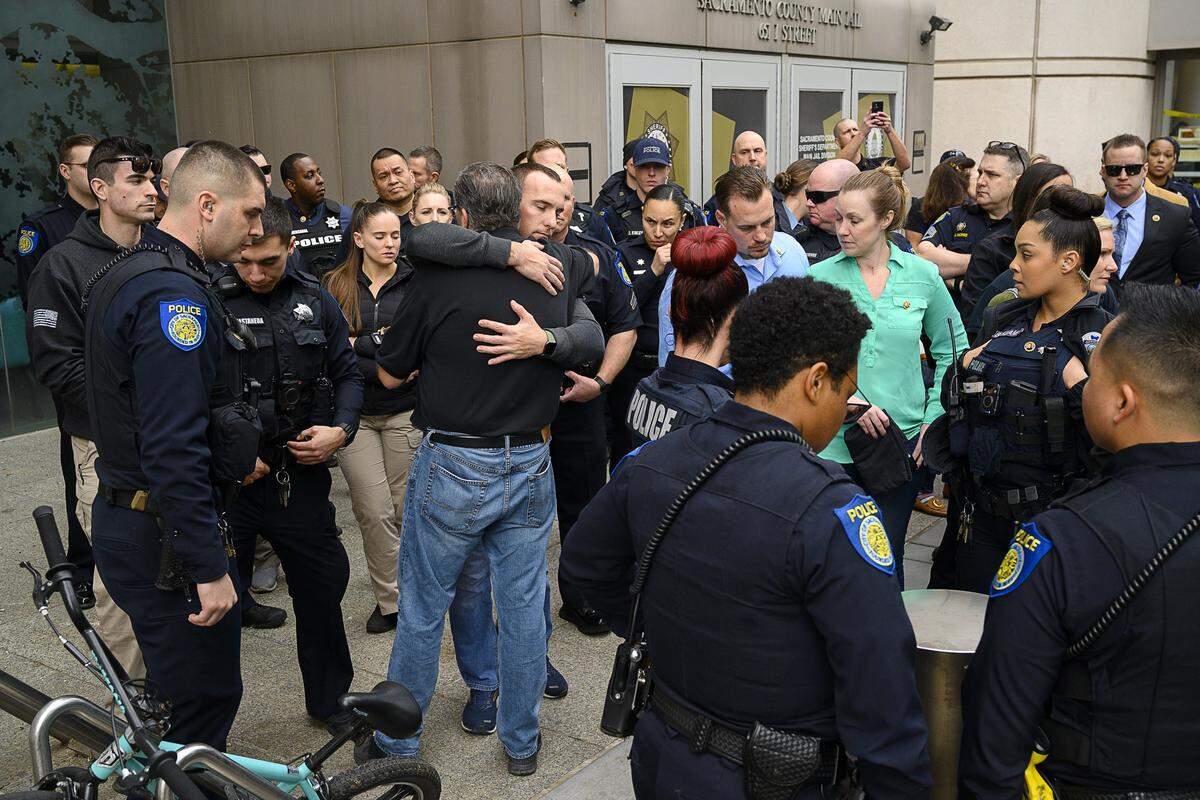
On Nov. 15, after the jury deadlocked at 11-1, Ramos’ sentencing ended in a mistrial. Afterward, some of the jurors cried and hugged O’Sullivan’s family and police officers.
“I’m sorry we failed you,” one male juror cried to O’Sullivan’s family in the hallway of the courtroom after proceedings finished. “We tried so hard.”
Yet the jury did not fail. They did what they were supposed to do. Just because it’s not the retributive outcome many had hoped for doesn’t mean it was wrong.

California and the Death Penalty
Why do we believe that murdering murderers is a correct and just punishment? We don’t similarly burn down the homes of arsonists, or rob thieves. So why do we kill killers?
It’s a question many nations have historically struggled to answer. More than 70% of all countries have abolished the death penalty, most recently Kazakhstan and Papua New Guinea. For much of the world, death is neither a just nor necessary retribution for any crime, even the crime of murder. The U.S. is one of the few so-called “developed nations” that has continued the practice.
The lone juror — Juror 8 — who held out in this trial should be praised for her courage, not blamed by her peers for their “failure.” She received pressure, no doubt, from both those on jury and the presence of so many Sacramento police officers in the courtroom. I think she was incredibly brave to stand alone. I would hope to have the same courage in that situation.
California must end the charade of sentencing killers to death purely for the performance of the sentencing process, even though the state has not executed a death row inmate for nearly 20 years. It is a costly and wasteful process that serves only to traumatize everyone involved, and brings no justice or closure.
There’s a reason why, in California, a death sentence must be a unanimous decision. However, unlike other states that still impose capital punishment, in the case of a mistrial like Ramos’, California courts allow prosecutors to retry the case with another jury — spending even more money in prosecution and ultimately re-traumatizing witnesses, the family of both parties and a whole new set of jurors.
Sacramento Deputy District Attorney Jeffrey Hightower has until Dec. 20 to decide whether or not to pursue a second sentencing trial.
He should not.
The facts of death row
More than 600 inmates are awaiting the death sentence in California; the most of any state. Yet there has not been an execution here since 2006. After Gov. Gavin Newsom placed a moratorium on capital punishment in 2019, the death sentence has become purely ceremonial. (Though a future governor could overturn Newsom’s executive order and reinstate the process.)
It is also “hideously expensive,” said Mike Farrell, president of Death Penalty Focus, a capital punishment abolitionist group based in California. According to data compiled by Death Penalty Focus, Sacramento County alone has spent nearly $7.7 million pursuing death penalty convictions (and funding the subsequent appeals) since 2000, while the state spends a total of $72 million each year.
Since reinstating the death penalty in 1978, the state of California has spent roughly $4 billion to carry out barely more than a dozen executions, according to the group.
“At every stage of legal proceedings, a death penalty case is vastly more expensive to prosecute than a standard murder case,” wrote Death Penalty Focus on its website. “Death penalty trials are actually two trials — one to determine whether the person is guilty of capital murder, and the second to determine whether the sentence of death is appropriate for the defendant and the crime. Post-conviction proceedings take years.”
Capital punishment is also often a racist policy, and some have even said the death penalty is the successor of lynching. Black prisoners make up 34% of California’s death row, yet they are only 6% of the state population. Latinos account for 26% of prisoners on death row but are 39% of the general population. White prisoners make up the smallest percentage on death row (32%) and are 35% of California’s general population.
Perhaps most importantly, if even one innocent person is executed thanks to a death penalty sentence, then we have erred as a society. We have also wronged any innocent person who sits awaiting a natural death in prison, as our judicial system drags on and many are denied the legal representation they are entitled to.
‘Hideously painful, expensive process’
“Given that the jury has obviously concluded its deliberations, why does California law, instead of accepting the hard-fought decision of the jury, insist on giving the prosecutor the chance to call for another trial?” Farrell said.
“(Hightower is) putting another group of citizens through this same hideously painful, expensive process, rather than accepting the decision of the people to whom he made his case.”
Given that Ramos, now 51, is likely to spend his life waiting for appeals on death row, what would another trial accomplish? To “get it right” this time? To sentence a man to death even though he will likely spend the rest of his days in prison anyway?
After the mistrial was declared, Deputy DA Hightower addressed some of the crying jurors in the hallway.
He said their duty was “above and beyond what any human should be asked.” He told them they had not failed.
Hightower was right on both counts. The jury did not fail, they simply did not come to a consensus, and our laws state that’s not enough to put someone to death. We should not ask our fellow citizens to be responsible for taking the life of another.
Officer O’Sullivan died in the line of duty, and she will be mourned. She will be mourned the same way as every young person who dies before their natural time. But no punishment for Ramos — including his own death — will change what happened that day in June.
Ramos must be removed from society and rehabilitated to the best of the state’s ability. These are the facts of life and death in an advanced society. This is what our penal system is based on. It’s also based on trusting a jury’s decision.
Death for death is not justice; it is vengeance. And that is not ours to take.
This story was originally published December 2, 2024 at 5:00 AM.