Why is Sacramento spending millions on a divisive program other cities reject? | Opinion
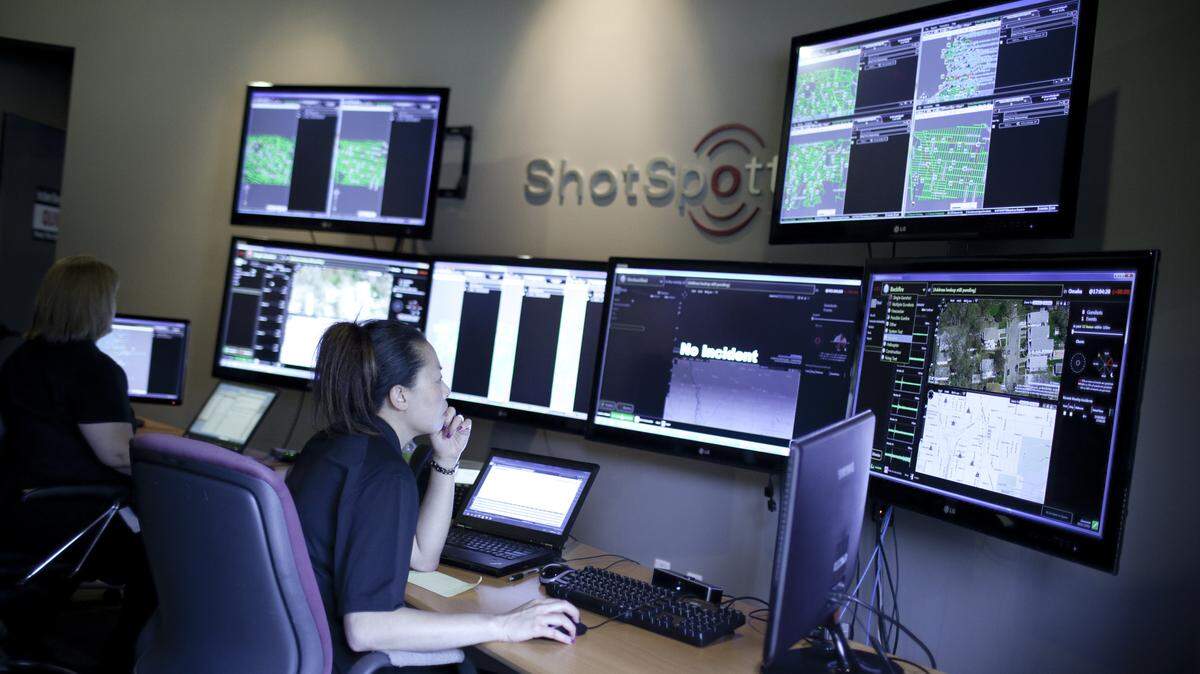
Last week, the city of Sacramento spent $2.6 million to retain the services of controversial AI technology that tracks the location of gunfire, an expense that other cities across the nation have rejected.
“We believe that ShotSpotter is a crucial piece of (technology)… and we’re seeing a positive result from the use of these dollars,” said Zachary Bales, deputy chief of the Sacramento Police Department, at the city council meeting where the contract was approved.
Produced by a company called SoundThinking, ShotSpotter claims to be able to pinpoint the location of urban gunfire by using sensors that can determine the acoustic signature of shots fired with 97% accuracy.
In a recent interview with The Bee Editorial board, SoundThinking CEO Ralph Clark said his company has contracts with cities across the nation.
“Why is responding to criminal gunfire more important? Well, because there might be a victim,” Clark said.
But some of the harshest critics of ShotSpotter say the technology can also create victims: Black and brown people, who have been swept up by the police chasing alerts.
In 2022, an investigation into the company by the Associated Press found that ShotSpotter technology can miss live gunfire occurring right under its microphones, “or misclassify the sounds of fireworks or cars backfiring as gunshots.” A 2023 study from Northeastern University found ShotSpotter did not reduce crime, though it did help police decrease response times.
More recently, a lawsuit against ShotSpotter and the city of Chicago was settled with the help of the MacArthur Justice Center, a public interest law firm that works on social justice cases across the country. In the settlement agreement, Chicago agreed that a ShotSpotter alert does not give its police justification to stop or pat down any person who happens to be near the location of an alert.
Chicago canceled its contract with ShotSpotter last year and stopped using the system completely by last September.
Clark disparaged the Justice Center’s lawsuit in his interview with The Bee’s editorial board, calling their case “completely fictional” and dismissing the group for having “a political agenda.” He claimed that “their data only comes from the Office of the Inspector General report” and that they “weaponized the OIG report (and) distorted those numbers.”
“ShotSpotter alerts were associated with thousands of stop and frisks that rarely turned up evidence of gun crime,” said Jonathan Manes, senior counsel at the MacArthur Justice Center, which has offices in Chicago and several other cities. “Furthermore, officers in neighborhoods where ShotSpotter is present were using a supposed history of ShotSpotter alerts as part of the reason to stop and frisk people on the streets.”
Manes also said that Clark’s much-hyped “97% accuracy rate” was achieved by subtracting the number of submitted false alerts from the total number of alerts nationwide.
“The trouble with that metric is that ShotSpotter can just trigger more alerts in order to drown out the missed gunshots,” Manes said. “What Ralph Clark says in his interview is that if there were a lot of false alerts, that would be a problem, customers would complain. But what actually happens is that police show up and most of the time they find nothing. They’re very used to that, because the most common outcome of a ShotSpotter alert is finding no evidence of gunfire or gunshots.”
In reviewing its contract with SoundThinking and ShotSpotter, Sacramento city councilmembers had the opportunity to learn from other cities like Chicago, Baton Rouge, Atlanta, Seattle and Houston — which have all rejected the technology as unreliable.
“You can’t just point to one item as the reason why crime has been down,” said councilmember Mai Vang, who was the sole nay vote on renewing the contract last week. “We should be looking at methods that are actually about preventing gun violence when it happens.”
For the past two years, the Sacramento Community Police Review Commission has recommended ending its contract with ShotSpotter. Instead, our elected officials bowed to pressure yet again from the Sacramento Police Department, ostensibly in pursuit of their ever-elusive promise of public safety.
“There’s growing evidence that ShotSpotter is not worth the cost, if what we’re trying to do is reduce gun violence in our cities. ShotSpotter isn’t an effective solution, and there are better ways to spend that money,” Manes said.
“I’d encourage people in Sacramento to talk to independent academic researchers who study this, rather than listening to a publicly traded, for-profit company whose obligation is to maximize profits.”