
The legacy of my father, a Hiroshima atomic bomb survivor | Opinion
Today marks the 80th anniversary of the atomic bombing of Hiroshima, when 70,000 people were killed instantly. By the end of 1945, the final death toll reached 140,000.
Not long ago, while sorting through my father’s files, I discovered a 1985 Washington Post editorial dated Aug. 6. The faded and brittle editorial, “The Passage of Four Decades,” addressed the world’s apathy toward the state of nuclear weapons. The editorial must have struck a deep chord in my father, Hisao Matsumoto, an American of Japanese ancestry. He was a resilient, intelligent, accomplished man who walked with quiet dignity.
He was also a hibakusha — a Hiroshima atomic bomb survivor.
Now, 40 years after that publication and 80 years since the horror of Hiroshima, I go a step further and ask: If not now, when will we be willing to rise above apathy and eliminate weapons of mass destruction?
Hisao was raised in militaristic Japan believing he was Japanese, but he was an American, born in Los Angeles. His family moved to Hiroshima when he was an infant. Conscripted by the Japanese miliary at age 15, he was forced to abandon his education to work in a factory making rifles to be used against the enemy. He, an American, was the enemy. The irony.
At age 19, Hisao returned to the United States to finish school at Sacramento High School. He then enlisted in the U.S. Air Force and served during the Korean conflict. Later, he graduated from UC Berkeley and enjoyed a 36-year career at the Library of Congress, retiring as Head of the Asian Division.
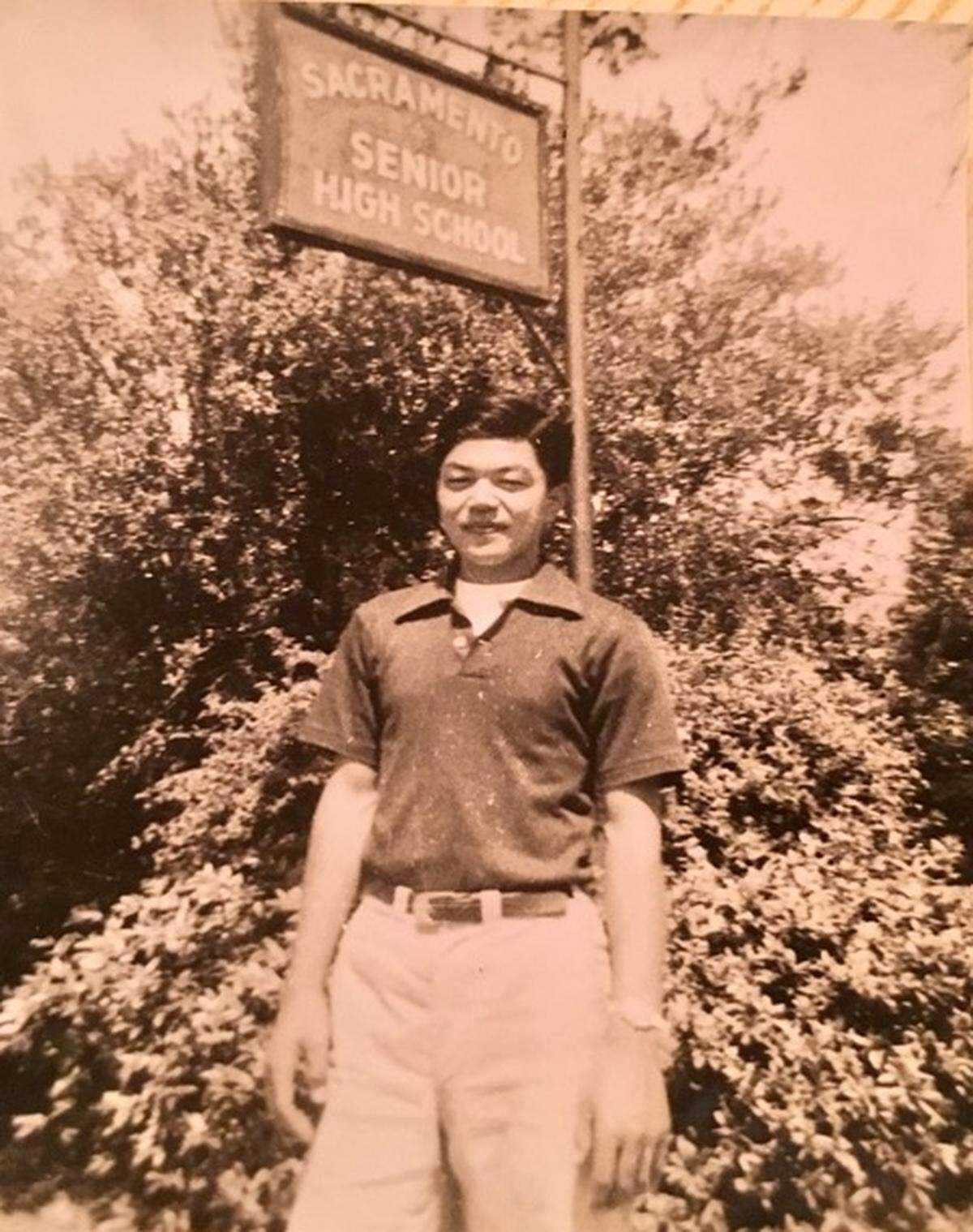
My father didn’t speak often of the Hiroshima bombing. Many survivors don’t. I now understand he didn’t want to burden my siblings and me with his trauma. He loved America and wanted to enjoy the American Dream. He also wanted that for his children.
Occasionally, my father would share wartime recollections with my wife, Constance. Those painful memories of that fateful August 1945 morning of searing light and heat, instant death and humans floating in the river made their way into “Of White Ashes,” the historical novel Constance and I co-authored to honor my parents.
My mother, Reiko, was incarcerated in two of America’s camps during World War II. Hisao and Reiko exemplify the spirit of gaman — the Japanese word for moving through hardship with grace and dignity.
Theoretically, deterrence keeps us safe. Yet the risk of nuclear catastrophe through mistake, malfunction or madness is real. Deterrence is a paradoxical philosophy of fear. By threatening annihilation, we prevent it.
Arguably, for 80 years, deterrence has worked, but fear remains. Humans are fallible hostages of our own creation. Today’s nuclear weapons are far more powerful than those dropped on Hiroshima and Nagasaki. In January, the Bulletin of Atomic Scientists advanced the Doomsday Clock another second to 89 seconds to midnight — when humanity will destroy itself.
The world continues to live quietly with weapons of mass destruction resting in silos, in a state of permanent readiness. My father never saw the world disarm. But that 1985 editorial resonated with him. He held hope in the possibility of nuclear disarmament. I hold the same hope. Someday, somehow, we will move thoughtfully and responsibly to eliminate nuclear weapons.
Last year, the Nobel Peace Prize was awarded to Nihon Hidankyo, the group of Japanese atomic bomb survivors who have committed their lives to sharing painful memories and advocating for nuclear disarmament. I wish my father had lived to know that hibakusha, like him, awakened the world. Their voices matter. May this current generation keep Nihon Hidankyo’s vision alive.
My father didn’t dwell in fear or anger, but I suspect the trauma of his memories were buried deep inside. He saved that article because it reminded him of what mattered. I keep it with me because it reminds me of how decades quietly slip by with so little change in our thinking about nuclear disarmament.
Our past can’t be changed, but it doesn’t have to bind us. The future remains unwritten. We have the power to shape a better and safer future.
Kent Matsumoto, a practicing attorney, is a third-generation Japanese American. “Of White Ashes” (Loyola University MD 2023) is his debut novel.