
The Trump administration just upended the livelihoods of Sikh truckers | Opinion
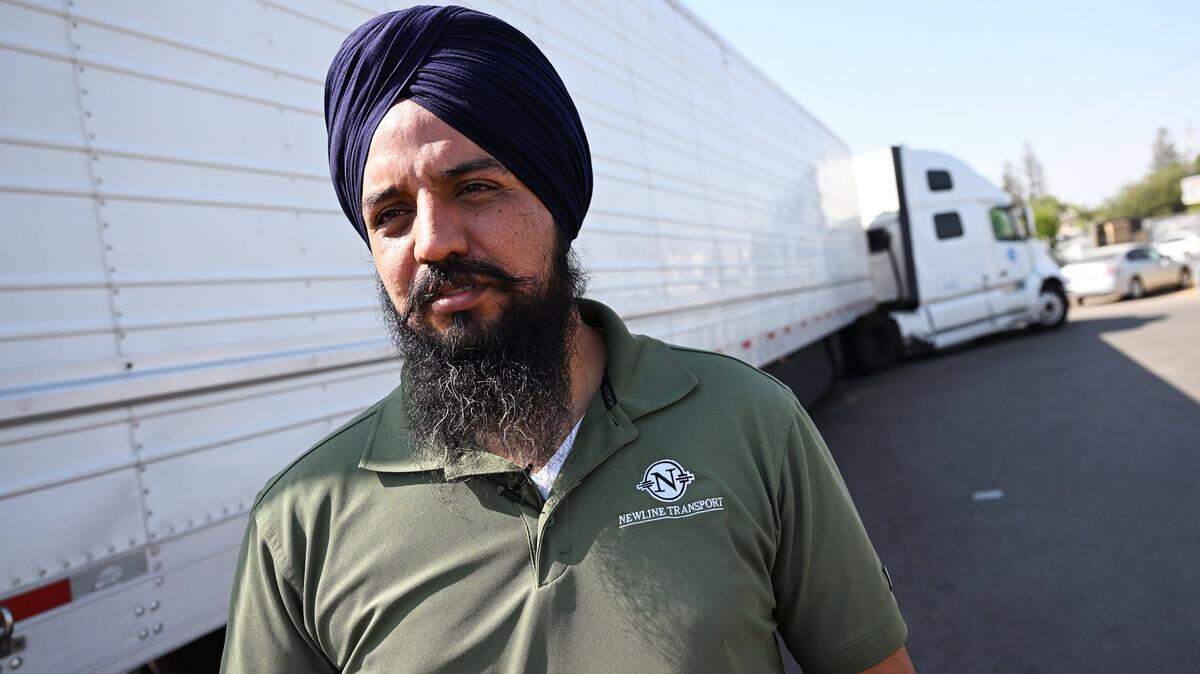
U.S. Transportation Secretary Sean Duffy recently announced sweeping changes to significantly restrict the issuance of commercial driver’s licenses to immigrant workers with temporary work authorization.
The rule changes the federal minimum eligibility requirements — immigrants with pending asylum cases, for example, can no longer receive a commercial driver’s license with a work permit alone.
Duffy’s comments took particular aim at California, whose policies have been under strict scrutiny after a California trucker was involved in an accident in Florida, killing three. The driver was a Sikh, whose religious attire — such as his turban — drew bigoted and racist comments from across the country. It’s estimated that 150,000 Sikhs work in the trucking industry, with an overwhelming majority of them being from California. The Florida turnpike crash was a turning point for Sikh truckers. Sikhs remain at the center of this issue, with many reporting harassment and racial abuse while driving across the country. The mistake of one man in Florida is being used to target the entire Sikh trucking community.
Historically, Sikhs have disproportionately been victims of hate crimes due to their outward religious symbols, such as their turbans and long beards. Many chose the trucking profession as it allowed them to maintain their religious preferences and also earn a living. For these hardworking immigrants, this was the American dream.
But now, asylum seekers from Sikh, Mexican and other communities with pending asylum cases will no longer be able to work as truckers. Those with an existing commercial driver’s license are no longer eligible for renewal. And with obsolete licenses, the livelihoods of thousands of workers have been upended.
The immigrants being affected by this policy change had lawfully issued employment authorization documents. In other words, these individuals followed proper procedure, bringing their asylum cases to the immigration courts and diligently showing up for every hearing and court date.
In many ways, the catalyst behind these new trucking policies stemmed from a xenaphobic “other-ing” of a community of truck drivers. To justify these policies, it was necessary to create and justify the idea that immigrant drivers were making American roads unsafe. The data, however, tells a different story.
California has a fatal crash rate for commercial drivers that is almost 40% lower than the national average. According to data from the Federal Motor Carrier Safety Administration, which releases reports on state-level commercial motor vehicle fatal crashes, the 10 states with the highest commercial fatal crash rate are all Republican states. The 10 states with the highest crash rates are Wyoming, New Mexico, North Dakota, West Virginia, Oklahoma, Idaho, Kansas, Montana, Nebraska and Mississippi. The FSMCA data is expansive, assessed through fatal crashes per 100 million total vehicle miles traveled.
The data is clear that this policy is not a result of a focus on road safety, but instead an immigration incitement issue.
Why target immigrant drivers, who work dangerous hours to support and contribute to the American economy? Perhaps this hypocrisy has more to do with playing politics with California than ensuring road safety across our nation. California has been a thorn in the side for the Trump administration, who perceive Gov. Gavin Newsom’s state as defying federal authority.
The abruptness of the policy is a problem in itself. Unlike many new rules which phase out certain policies, this overnight change allows no time for truckers to assess their options.
So what can we do? To start, tighter safety regulations are needed across the country. Tougher tests, increased language requirements and stricter policies are important to curbing road risks. However, the wholesale ban of immigrants with temporary immigration status turns the focus on eligibility instead of implementing tougher policies for road safety.
We can raise the bar for road safety, but should do so in a way that gives immigrants a chance to meet those standards. No one wants safer roads more than truckers, who spend their entire lives on them. However, reacting to a tragedy in Florida in this way isn’t wise policy-making — it’s politics.
Karam Singh is the co-founder of the California Sikh Youth Alliance, a grassroots Sikh advocacy organization. A graduate of UC Berkeley, Singh works as a regulatory finance analyst in Sacramento.