
California’s fires have changed, but its policies haven’t | Opinion
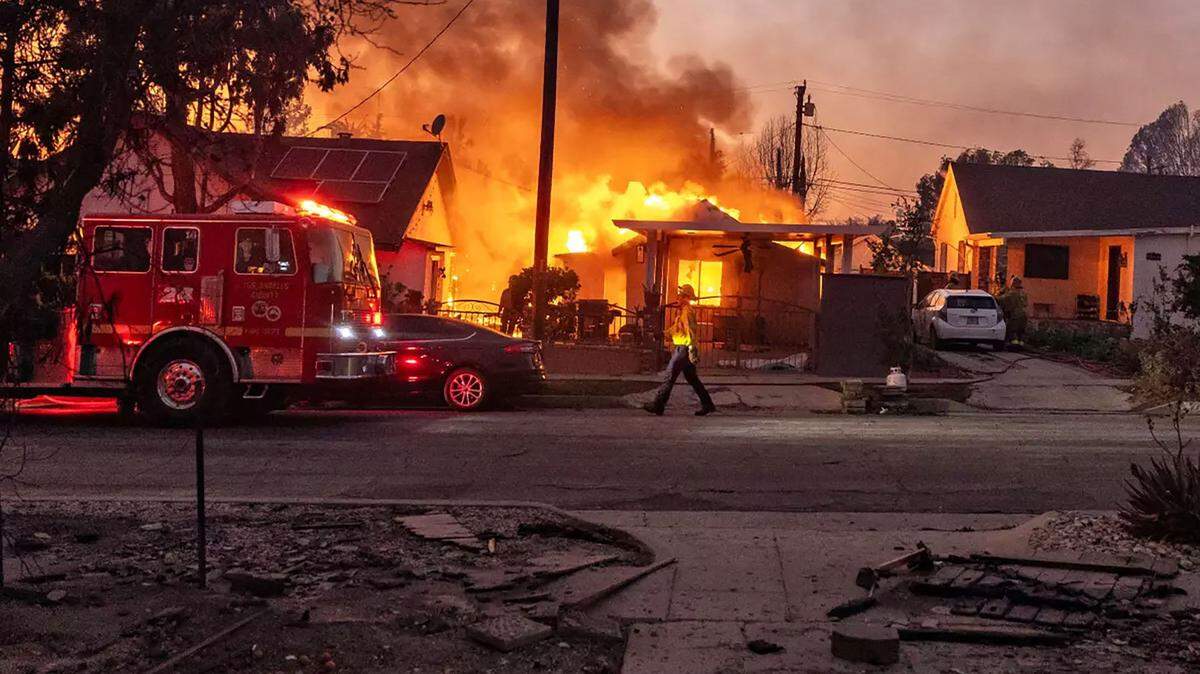
In the aftermath of the devastating Los Angeles fires, a public health crisis has emerged — one that the state has insufficient tools to address. Assembly Bill 1642, authored by Assemblymember John Harabedian, D-Pasadena, and now heading to the Appropriations Committee, is an attempt to build those tools and shield Californians from the severe, long-term health damage that future fires can cause.
Historically, fire danger in California has meant wildfires (the burning of forests). The smoke was toxic, the destruction devastating, but the fire fuel was largely organic, and the resulting contamination something our public health system had tools to address.
Fires in the wildland-urban interface, also known as WUI, are reshaping California and are fundamentally different — like the Eaton Fire, which tore through Altadena in January 2025. They do not burn forests, but neighborhoods. Their fire fuel is the accumulated material of modern life. Their smoke and ash carry a toxic mixture of heavy metals and combustion byproducts.
One month after the Eaton Fire, my research group at the California Institute of Technology visited 52 standing homes across the impact area, collecting samples both indoors and outdoors. Lead was present at levels well above the limits set by the Environmental Protection Agency. We found lead up to seven miles downwind of the fire zone — the furthest we tested. Even after cleaning, roughly 10% of indoor surfaces still tested above federal limits. Data gathered by Eaton Fire Residents United shows an even grimmer picture for homes closer to the burn area: 100% of tested homes were positive for lead pre-remediation, and 6 in 10 remediated homes remain uninhabitable due to lead and/or asbestos levels.
AB 1642 contains three provisions that go to the heart of what has failed Eaton Fire survivors.
The first is mandatory testing. There is currently no legal requirement for anyone to test for heavy metals after a WUI fire. Homeowners who suspect contamination — even homeowners who, like me, have measured it themselves — must fight their insurers just to determine whether they can safely return home.
The second is independent, science-based limit-setting. AB 1642 directs the Department of Toxic Substances Control and the Office of Environmental Health Hazard Assessment (California’s expert public health and toxicology agencies) to determine what levels of contamination are safe to live with. Those thresholds will be grounded in scientific evidence, not in what is convenient or cost-effective for an insurer to remediate.
Finally, AB 1642 states that if a home contains fire debris from the WUI, contamination is presumed to result from the fire. Families will no longer bear the undue burden of proving that the pervasive presence of toxic chemicals in their homes is due to the fire. Right now, thousands of Eaton Fire survivors, like me, are fighting to convince their insurance to pay to remediate homes that are still unsafe.
Days after the fire, wearing a Tyvek suit and respirator, I re-entered my standing home, collected samples and brought them to my lab. The results were unambiguous with lead above federal limits in most rooms. Elevated cadmium, chromium and arsenic was throughout.
There is no safe blood lead level in children, and even low-level exposure impacts their developing brain. Arsenic is a potent carcinogen. Cadmium damages kidneys, lungs and bones. A medical toxicologist recommended the home be gutted or demolished, and the remediation company agreed, but my insurance company did not. Without a state standard, insurance companies don’t have to test for toxic contaminants. As a result, my family — like thousands of others — remains displaced. We won’t move back until we know it is safe.
Under current policies, this will be the story of the survivors of every future fire in California’s WUI. But AB 1642 would prioritize residents’ safety and force insurance companies to restore damaged homes to their pre-fire conditions.
François Tissot is a professor of geochemistry at the California Institute of Technology and an Eaton Fire survivor. His research group’s data on heavy metal contamination from the Eaton Fire is available online.