
Heart attack, not drugs, killed Kentucky Derby winner Medina Spirit but report not definitive
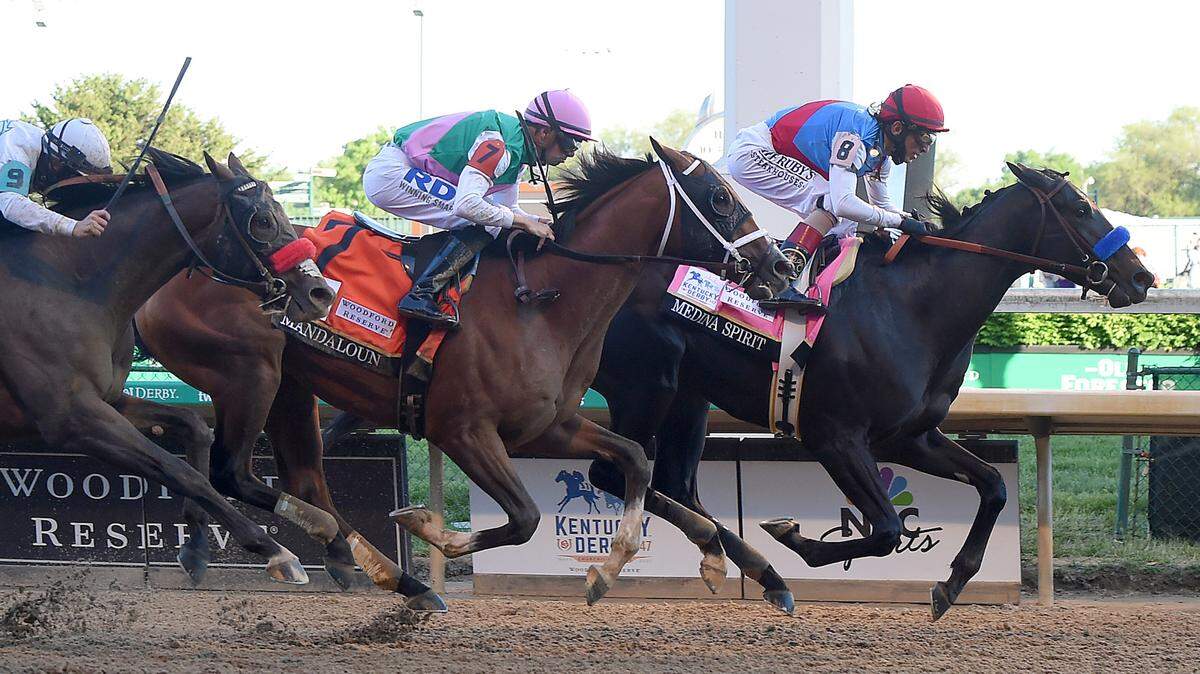
A heart attack could have killed Medina Spirit but a necropsy performed on last year’s Kentucky Derby winner was inconclusive, the California Horse Racing Board said.
“A definitive cause of death was not established despite extensive testing,” the board said in a statement Friday.
The board said the thoroughbred did have swollen lungs, foam in his windpipe and an enlarged spleen, all common signs “compatible with, but not specific for a cardiac cause of death.”
The necropsy by the UC Davis School of Veterinary Medicine did find furosemide, a diuretic commonly known by the brand name Lasix, that can be used to enhance performance in the horse’s system, but made no connection between the drug and the horse’s death.
Median Spirit died December 6 after collapsing during a workout at Santa Anita Park in Arcadia.
The necropsy’s report came amid a focus on Jeff Blea, UC Davis’ equine director, who had overseen the medical safety of racehorses in California, and was in charge of the investigation into the horse’s death.
The California Veterinary Board suspended his license in December saying that he had injected horses with performance enhancing drugs including Lasix in his job as a racetrack physician between January and March 2021.
Doping scandals have plagued the horse racing industry for years. The vet board said Blea could not be trusted to do an honest examination in his role overseeing the cause of Medina Spirit’s death.
Blea was jointly appointed to the UC Davis veterinarian school and the California Horse Racing Commission, which removed him from overseeing the investigation.
“Any necropsy and investigation results identifying any racehorse’s cause of death as drug-related would be detrimental to Respondent Blea, his career, and his livelihood,” the vet board wrote in its initial complaint against Blea in December.
A full hearing into the board’s request to permanently bar Blea from practicing veterinary medicine is expected in the next several months.
Blea’s attorney, George Wallace, has said the horse-doping charges against his client are without merit. The vet board said Blea injected performance enhancing drugs into horses even though the doctor had never diagnosed the animal’s condition.
The horse racing board is supporting Blea, despite initially removing him from the Medina Spirit investigation.
Medina Spirit, who won the Kentucky Derby by a half-length, had failed a post-race drug screening the day after May 1 race.
The horse was found to have the steroid betamethasone in his bloodstream the day after the race. The corticosteroid decreases inflammation and can be controversial because some veterinarians feel it can mask injuries that would otherwise prevent a horse from racing.
The Kentucky Derby prohibits the drug on race day and suspended the horse’s trainer Bob Baffert for two years following the discovery.
Baffert said at the time that the drug test results were “disturbing” and “the biggest gut punch in racing for something I didn’t do.”
Baffert’s horses have a history of failed drug tests including five in the one-year period predating the 2021 Kentucky derby.
The three-year-old colt was owned by Saudi Arabian businessman Amr Zedan.
Kentucky Derby officials are expected to determine Monday whether Medina Spirit’s first-place finish should be allowed to stand along with the $1.8 million in prize money awarded to Zedan.
This story was originally published February 11, 2022 at 11:22 AM.