
A California bus crash killed 11. Was the driver’s prison sentence a ‘miscarriage of justice’?
The Gambler’s Special was loaded with 40 passengers and headed north on the outskirts of Colusa.
Soon, 11 of them would be dead.
It was 6:10 p.m. on Oct. 5, 2008, on a narrow two-lane road north of Sacramento. The sun slumped toward the horizon to the left. Some passengers dozed. Others took stock of the pancake-flat rice fields just off Interstate 5.
Quinton Watts was at the wheel. It was his first weekend driving that route to Colusa Casino Resort. The bus company’s owner — Watts’ stepfather — sat behind the driver’s seat and gave instructions.
The passengers, most of them in their 60s or 70s, were of Hmong and lu Mien descent. They were from Sacramento and the surrounding region, and looking forward to an evening of gambling. Watts would get them there in about 10 minutes.
Then, almost casually, the huge bus drifted over the dashed yellow line on Lone Star Road. Thirteen tons of steel and glass. The ditch came closer.
“Are his eyes closed?!” one passenger wondered.
Screams. Prayers. Wailing.
And then, for a moment, a reprieve. The bus angled back toward its lane. Daniel Cobb, the owner of the Cobb’s Coaches bus, stood up and grabbed the wheel from Watts.
He shouted at Watts as the bus charged forward.
“Why isn’t the driver hitting the brakes?”
The bus lurched left again and crossed the dashed line a third time. Nearly half a mile after it first started to drift, the bus launched off the road.
It smashed into a drainage ditch, spun 180 degrees, and crumpled in a patch of tules next to the rice field.
The impact threw passengers out windows, lodged them in the mud and killed seven people almost instantly, including Cobb. Four more would die from injuries. Another 23 people were seriously injured.
It remains one of the worst bus crashes in California history.
When the bus hit the ditch, Watts catapulted through the windshield. As terrorized survivors scrambled to escape, the 52-year-old stood dazed outside the heap of mangled metal, a void carved in his memory, and bone showing on his left arm.
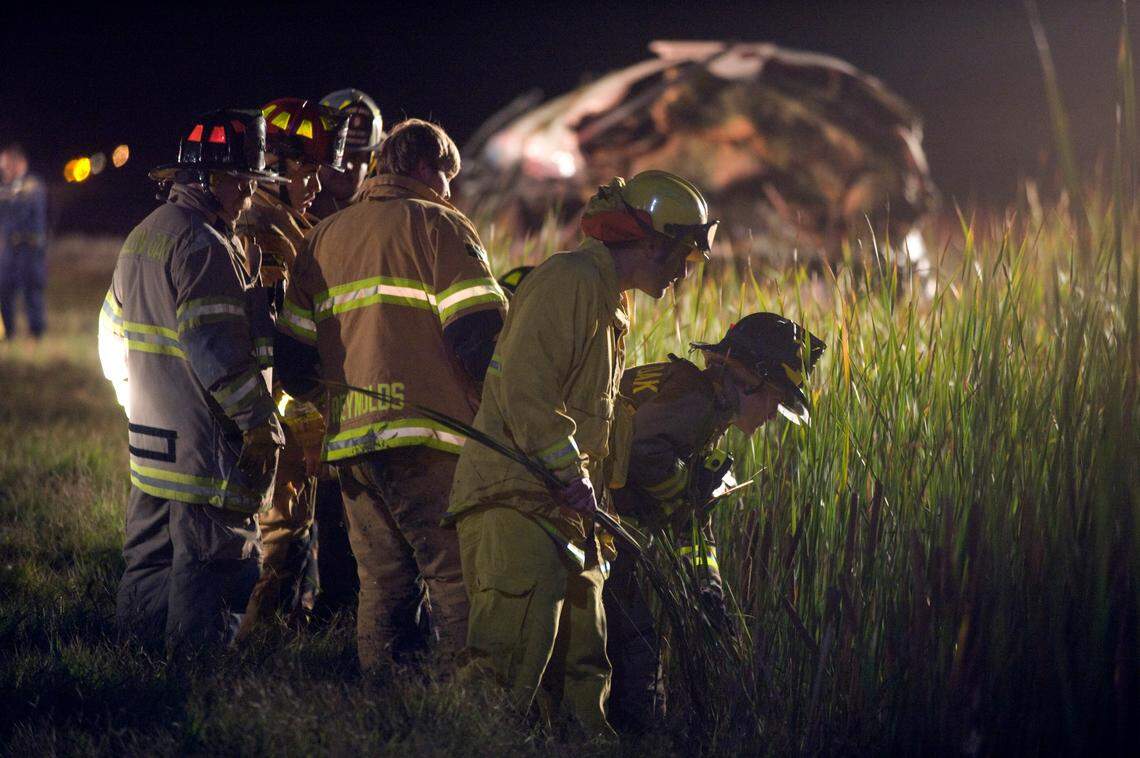
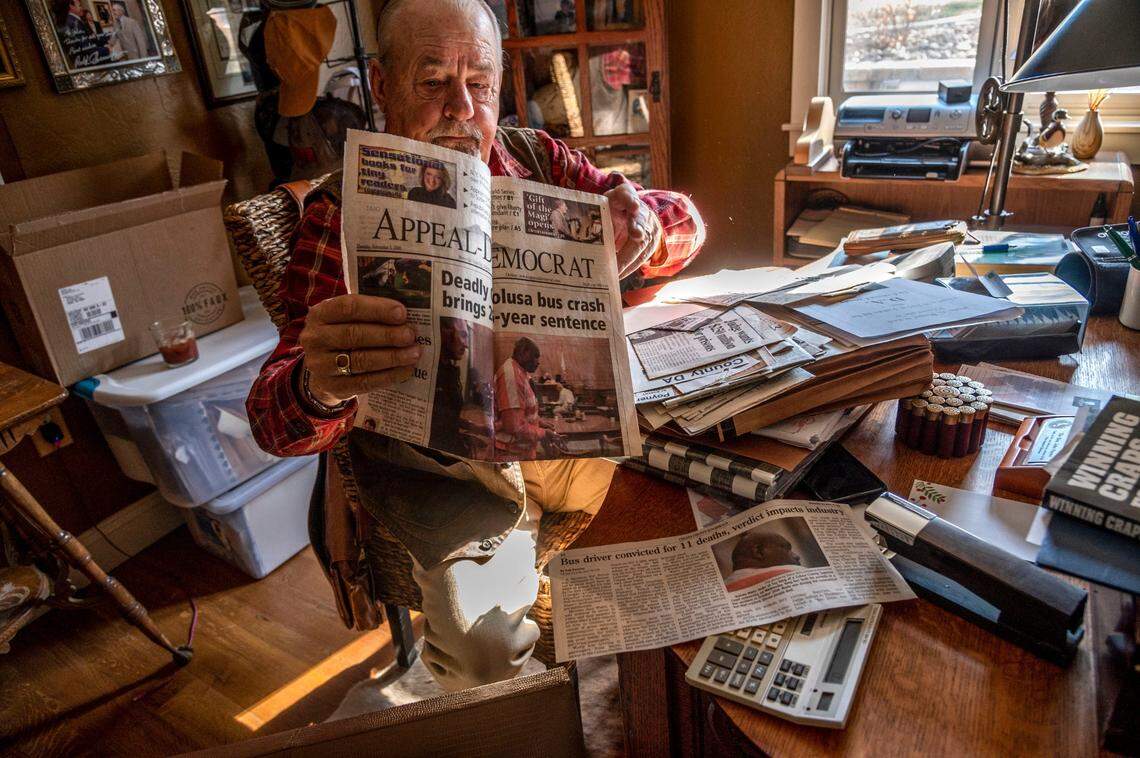
News of the crash topped newspaper front pages and garnered international attention. In the months that followed, with an investigation ongoing, lawmakers passed legislation on charter bus company licensing.
Jurors found Watts guilty of 11 counts of felony vehicular manslaughter with “gross negligence” in the crash. They also found him guilty of 21 counts of causing great bodily injury, a sentencing enhancement. The judge sent Watts to prison for 26 years and four months. Nine of those years are for the great bodily injury enhancements.
He’s not eligible for parole until 2027.
The official story of the crash was written like many open-and-shut cases.
But there is another story — one that offers a clear portrait of Watts as a victim rather than a criminal, according to a Sacramento Bee review of thousands of pages of trial transcripts, police reports, dozens of interviews and Watts’ medical records during more than a decade behind bars.
Prosecutors relied on dubious scientific claims about sleep deprivation and diabetes as they rushed the case through the justice system. State investigators initially claimed Watts might have been drunk — a false allegation that remains etched in the minds of those who remember the wreck. Authorities later theorized that Watts, who is Black, fell asleep while driving.
There were no Black jurors to hear the case against Watts in the rural Colusa County courthouse. A judge dismissed one potential juror who was Black for showing bias against Watts. Prosecutors dismissed another after questioning the person intently about their race and ability to judge Watts fairly.
Critically, Watts had been medically cleared to drive commercial vehicles, even though he suffers from a seizure disorder. Watts thought he could drive. But jurors were not told about that seizure diagnosis, evidence that could have explained the crash as something less than gross negligence. (The California Medical Board would later reprimand the physician’s assistant who had cleared Watts.)
The prosecution’s argument that Watts fell asleep was based on conflicting witness statements and Watts’ own contradicting explanations as he struggled to explain the lapse in memory. They leaned on statements from an interview that a medicated Watts had given at the hospital only hours after he was taken out of a coma and recoverin∂g from his injuries.
His prickly public defender — later described by Watts’ appellate attorney as “ineffective” — took pride in boiling the case down to a simple question about negligence that could get jurors back to their day jobs by the end of the week. He called just one witness: the paramedic who treated Watts.
Years later, with Watts in prison, the 3rd District Court of Appeal concluded the superior court judge had erred when he failed to give the jury specific instructions about unconsciousness as a defense. They said prosecutors committed misconduct when they aroused the passions of the jury during an inflammatory closing statement.
The appellate court, however, found the missteps weren’t enough to overturn Watts’ conviction. It was closed in 2009 and would stay that way. Watts was out of options.
For years, Watts has tried to prove his innocence from behind bars. He has sued the medical staff who had cleared him to drive. He appealed to higher courts in hopes of having his sentence reconsidered, as California’s rules about prison sentences have changed.
Watts, now 64, has been in prison for the past 11 years. He takes medication for seizures, cholesterol and high blood pressure between shifts at his custodial job in the medical ward at a Vacaville prison. Recently, he said he’s been cleaning up after inmates suspected of having COVID-19. He earns 55 cents an hour.
“I’m not asking for a lot,” Watts said in an August interview, among some three-dozen since June. “I just want justice.”
This month, John Poyner, Colusa County’s former district attorney who prosecuted Watts, told The Bee that he didn’t know about the seizure disorder. He said it was time for Watts to be released from prison.
“He did not do this on purpose,” Poyner said. “This was not an intentional act in the end. He’s paid his price.”
‘I just kept self-destructing, going down the wrong path’
Watts’ life up until that moment in October was filled with good intentions and bad decisions.
He was born in French Camp on the outskirts of Stockton and raised by an extended family. He never knew his biological parents.
Watts earned his GED at age 19, attended trade school and in the early 1980s took a job repairing IBM Selectric typewriters in the Bay Area. He returned to Stockton in the mid-1990s and attended school to become a truck driver.
From vegetables to chemicals, Watts hauled all manner of goods up and down freeways bisecting sprawling fields across the Central Valley.
With his commercial driver’s license, Watts logged hundreds of miles daily and enjoyed the steady money, the open road, and the stability of full-time work.
Over time, he started using marijuana and cocaine. Stockton police officers in 1997 arrested him for marijuana possession while he slept in a downtown park. About that time, they caught him with stolen credit cards. He also tried to pass a bad check for $100 at Burger King, court records show.
Prosecutors combined the cases against him and a judge sentenced him to two years in prison.
“I just kept self-destructing, going down the wrong path, taking the wrong turns,” he said in an interview from prison.
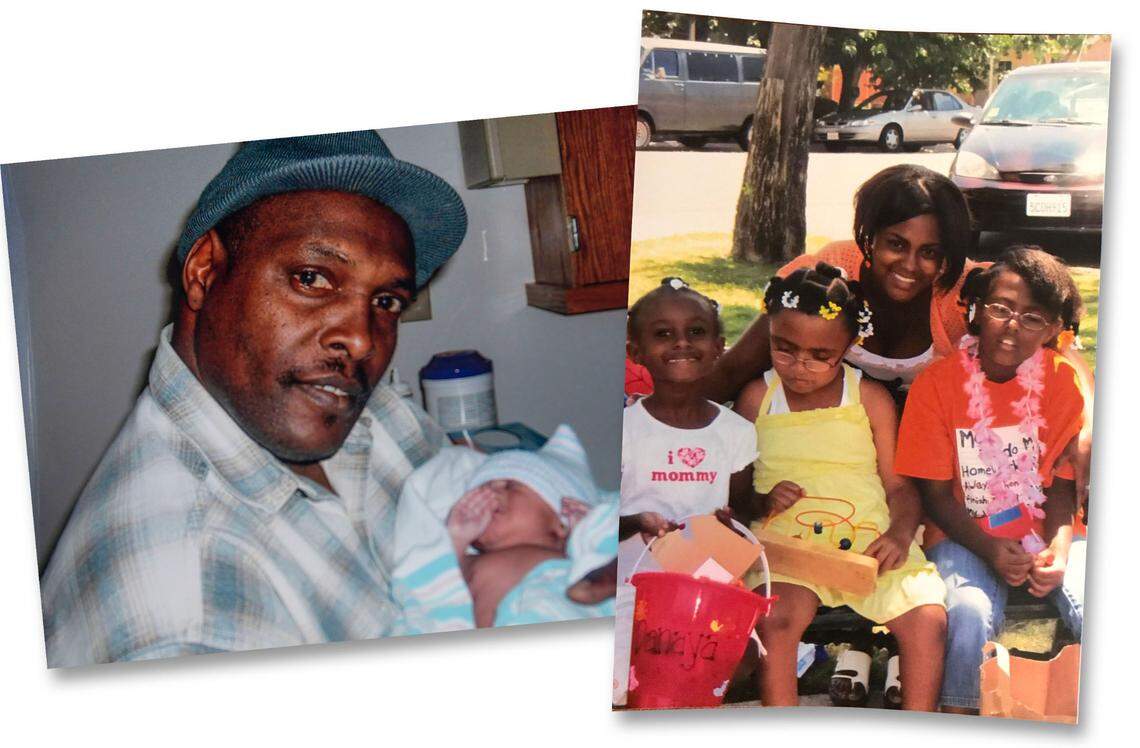
He picked up truck driving again after he got out of prison and worked for companies that sold steel, chemicals and produce. Around that time, he found stability when his niece introduced him to her friend, Colene Robinson. Watts is 22 years older than Robinson, but the two started seeing each other and got married in 2002. Soon they had three daughters.
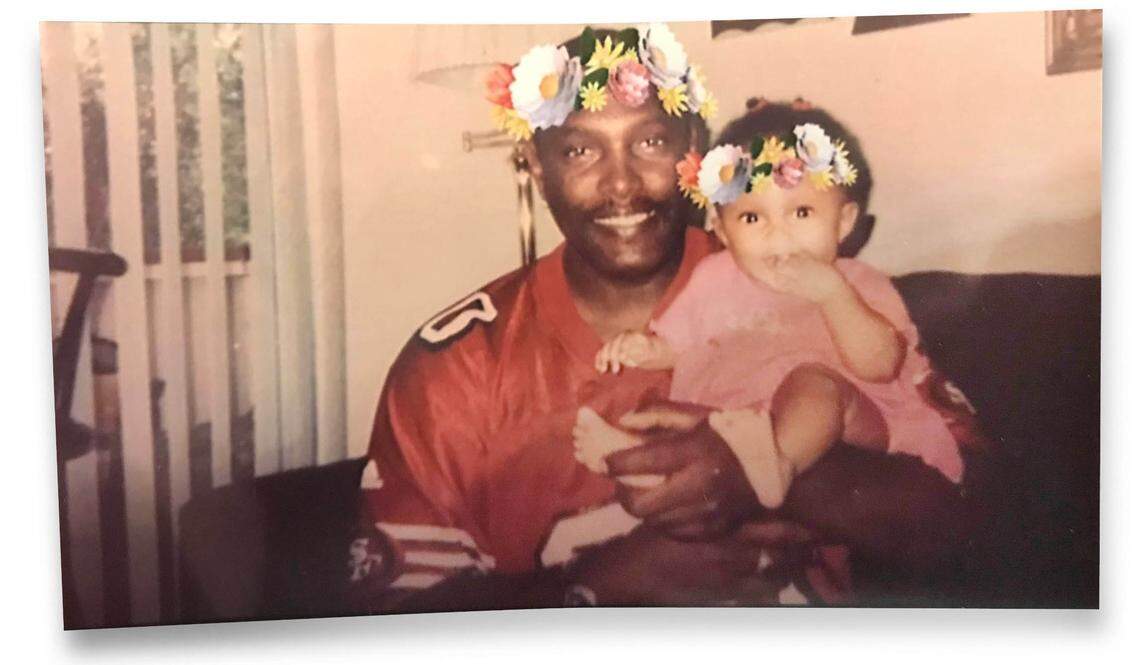
Daisha Watts, 19, still holds onto a photo from a family trip to Chuck E. Cheese in Reno.
“He was always with us, always playing with us,” she said. “If I’d get mad at my mom sometimes, I’d go tell on her to my dad. I love my dad. I’m a daddy’s girl.”
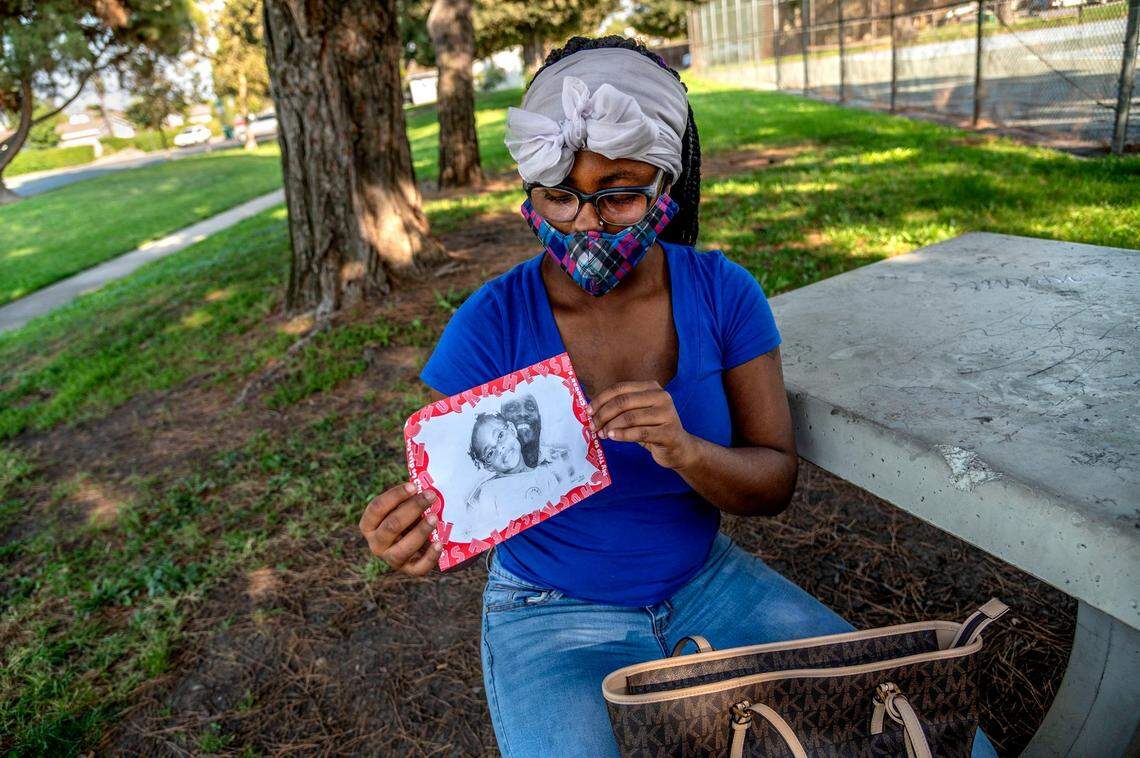
At the prison in Vacaville, Watts has pinned those family photos above his bed and under his bunkmate’s mattress.
His life took a sharp turn in the autumn of 2006.
Watts and Robinson divorced about a year earlier but remained close. Robinson said she remembers her ex-husband at a backyard get-together in South Stockton on Sept. 22, 2006, celebrating his completion of a job-training program. Then he heard shouting. According to police reports, a boy violently shoved a girl to the ground, and Watts said he intervened. Watts said he told the boy that was a “bitch-assed move,” and the boy ran to a nearby home.
Moments later, about 9:30 p.m., a man came out of the house and began swinging at Watts. The man knocked Watts to the ground and, according to witnesses, punched and kicked him in the chest and head before fleeing the scene.
Stockton police officers responded, and Watts was hospitalized for two days with head trauma and a busted ankle.
He developed unusual sleeping patterns and began having blackouts. He would say he was going to take a shower and then seem to forget what he was doing. He would make strange, out-of-place comments as if he were one of their kids, Robinson said.
“I think being stomped in the head did something to him as well, on top of his health issues,” Robinson said.
For a while, she thought the strange behavior was related to his blood-sugar levels being out of whack following his Type 1 insulin-dependent diabetes diagnosis years earlier. But she noticed he would start to get a “lost” look in his eyes. Next came the seizures.
She called the ambulance several times, she said, including once when her brother had to help him as he shook on the ground.
“He always came out of it. But he came out of it delirious,” she said.
•••
In January 2007, roughly three months after the fight, Watts went to three separate clinicians to diagnose his uncharacteristic behavior. Almost a year had passed since he had driven a truck, records show. He wanted to know what was wrong with him.
“Possible post-ictal,” a doctor wrote on Jan. 15, referencing the technical term for the confusion that follows an epileptic seizure. “Started sleeping uncharacteristic, forgetful, inappropriate answers.”
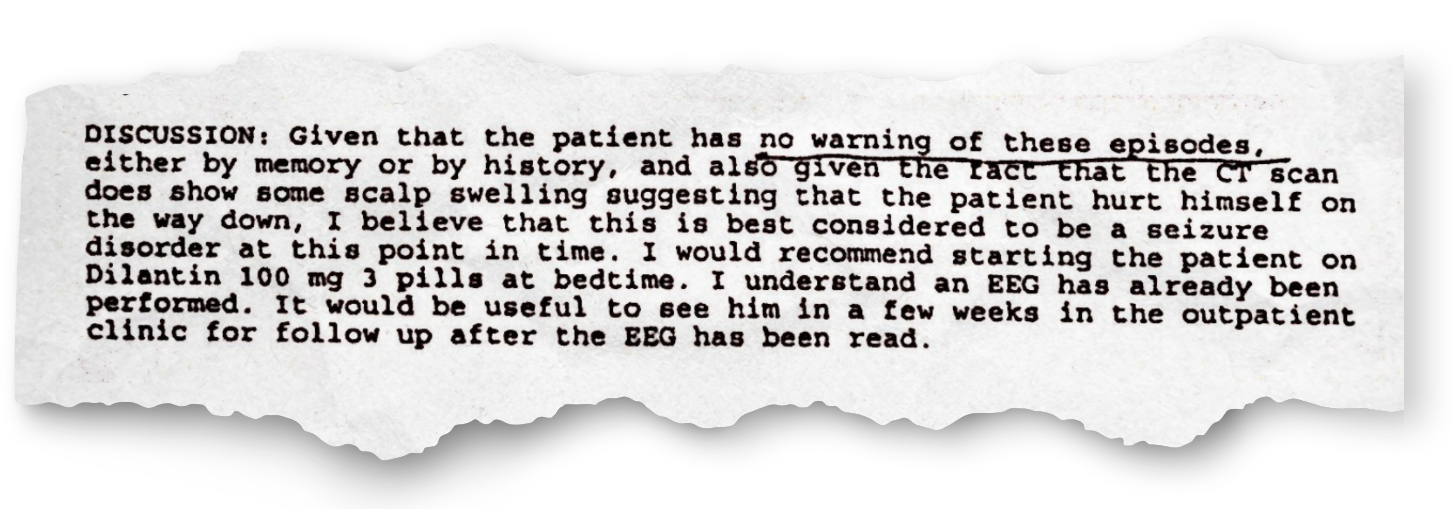
Two days later, in a follow-up appointment, medical staff diagnosed him with an unspecified seizure disorder. Doctors reviewing an MRI scan soon found a possible explanation: Swelling near his skull. “This may be the trigger site for his seizures,” they wrote.
Two more appointments in March corroborated the seizure diagnosis. He was prescribed medications for his high blood pressure and insulin-dependent diabetes. Physicians didn’t give him anything for seizures, according to medical records.
Watts’ mood swings were unlike anything he or his family had ever seen. He was irrational.
Then he bought the illegal gun.
He said he wanted to get revenge on the man who had beaten him and robbed him of the decent life he had worked to build.
But with his temper flaring and mood swings from a strange new problem in his head, Watts said he snapped one night. He pointed the gun at Robinson. The police came, and he was charged with being a felon in possession of a firearm. Watts returned to prison for a six-month sentence.
When he got out at the end of 2007, he was determined to take control of his life. He applied for jobs but managers repeatedly turned him away because of his felony record, he said.
Watts decided to return to the road.
“As long as I was able to drive truck, that’s what I wanted to go do. Drive truck,” Watts said. “As far as knowing there was something wrong with me to not be able to drive a truck, I didn’t know that. Otherwise, I would never have been driving anything because I have babies.
“I wouldn’t even have been driving my car.”
Medical staff are legally required to notify the California Department of Motor Vehicles when drivers are known to have a disorder that causes them to lose consciousness. No such report appears to have been made in early 2007 after Watts began experiencing blackouts. His license remained in good standing.
Before he could return to driving for work, a medical professional needed to sign off on a DMV report that would clear him for his commercial license. So in early March 2008, he met with David Anslinger, a physician’s assistant, at a Stockton clinic.
Anslinger had been treating Watts for several years and had documented his seizure disorder a year prior. In the paperwork, Anslinger noted Watts had been drug and alcohol-free for a year. He diagnosed diabetes and “a history of seizure disorder.”
Anslinger ordered a follow-up with a neurologist before issuing any final paperwork.
At the follow-up, Anslinger noted Watts had a blood pressure of 150/90 and that he was taking medication for high blood pressure as well as insulin for diabetes. Anslinger told Watts to increase his insulin dosage, meet with a nutritionist and follow-up in a month. Anslinger marked “no” on the section about whether Watts had a history of seizures. Then he medically cleared him for his commercial license.
Watts said he didn’t know about the seizures marked on his earlier paperwork. He said he didn’t know fully what was happening with him, but that he trusted Anslinger’s guidance in clearing him to drive.
The state medical board in 2014 put Anslinger on probation for two years for his failure to properly document Watts’ medical problems. The error “represented an extreme departure from the standard of care,” it wrote.
Anslinger told the board that he thought Watts would only be driving a pickup truck, not a bus.
“I was wrong and I feel terrible about it,” he told them.
Anslinger’s attorney, Scott Ginns, said in an interview that the mistake Anslinger made in 2008 has haunted him. “This whole thing ate away at him and continues to live with him,” Ginns said. “We’re all human. We all make mistakes.”
Daniel Cobb, the company’s owner and Watts’ stepfather, ran Cobb’s Coaches out of south Sacramento. The small operation primarily ferried gamblers to and from Thunder Valley Casino Resort just outside of Sacramento and Colusa Casino 90 minutes north of town. Watts’ bus still carried large, faded Greyhound logos on its sides, even though Cobb’s Coaches had purchased the bus two years earlier.
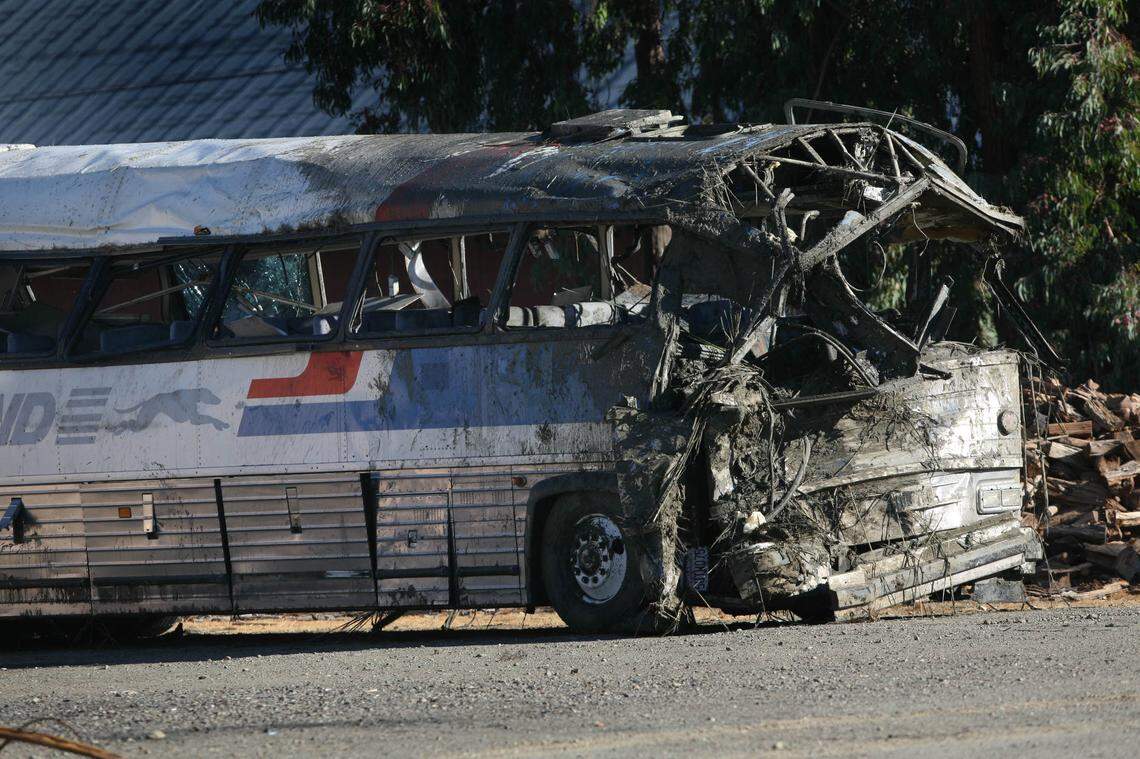
The routes, operated twice or three times a day, primarily serviced passengers from the region’s Southeast Asian community.
Watts gladly accepted the job offer in September 2008. It was his best shot at getting back on his feet, especially having been released from prison less than a year earlier. Cobb could pay up to $700 per week, good money, especially for Watts. The Central Valley economy was on the brink of the housing market crash and he had three kids to feed.
He’d made several trips to Thunder Valley and had driven the bus almost every day. The weekend of the crash was his first time driving to Colusa Casino.
Conflicting witness statements, and memory loss
Watts went to sleep at home in Stockton at about 3:30 a.m. Sunday, Oct. 5, and was back at Cobb’s Coaches by sunrise.
He didn’t drive the first trip of the day. Instead, he studied the route and napped for an hour or two in the back of the bus. He told Cobb he was tired that afternoon. Then he took the wheel for the day’s second trip, about 4 p.m., swinging by bus stops and parking lots to collect passengers across south Sacramento.
He turned onto Interstate 5, headed north for about an hour and eased off the freeway at the Hahn Road exit near Arbuckle, north of Woodland. He made a right turn, crossed some railroad tracks, and then a quick left onto Lone Star Road, a tight two-lane county road with a narrow shoulder.
While driving below the 55 mph speed limit, Watts navigated a short bend in the road as he got closer to Colusa. Then another. And then a third as the bus passed Abel Road.
Less than two minutes after the third bend, the bus lurched, left, right and then left again. Inside the bus, people who’d been sleeping were jarred awake. A half-dozen could see Cobb stand up and try to steady the bus.
Three people saw Watts’ eyes reflected in the mirror and reported to investigators that he appeared to be closing them as if dozing off. One woman told investigators she “saw the bus driver’s eyes turn white” and “roll back.”
Nobody reported seeing his eyes open during the roughly 26 seconds of swerving.
Investigators would later find that the brakes were never engaged. It appeared his foot never came off the gas pedal. One passenger said it seemed like the bus was actually accelerating as the cries grew louder.
“How could I sleep through that? How could anybody sleep through that?” Watts said in an interview for this story. “Nobody can. Nobody can humanly sleep through all that trauma that bus went through before it went through and hit the embankment.”
•••
Merced Corona, an off-duty Colusa County Sheriff’s Office deputy driving home from work, was the only passerby to witness the crash. He saw the oncoming bus swerve into his lane and kick up dust, veer back and swerve back again.
From about 50 yards away, Corona watched the bus barrel off the road, crash into the ditch, flip up into a cartwheel and slam down into the mud.
“I saw several people being ejected from the bus,” Corona said in an interview with crash investigators. “I also saw one person hanging momentarily from the roof or window area and then fall to the ground.”
Corona immediately called for help. He ran toward the wreckage. He saw people inside and outside the bus who were bleeding. He tried to calm them. He saw a woman with her head under field water and two people face-down in the mud. He searched the scene for people who could help and ordered a group of men from a vehicle that had pulled up to help block traffic.
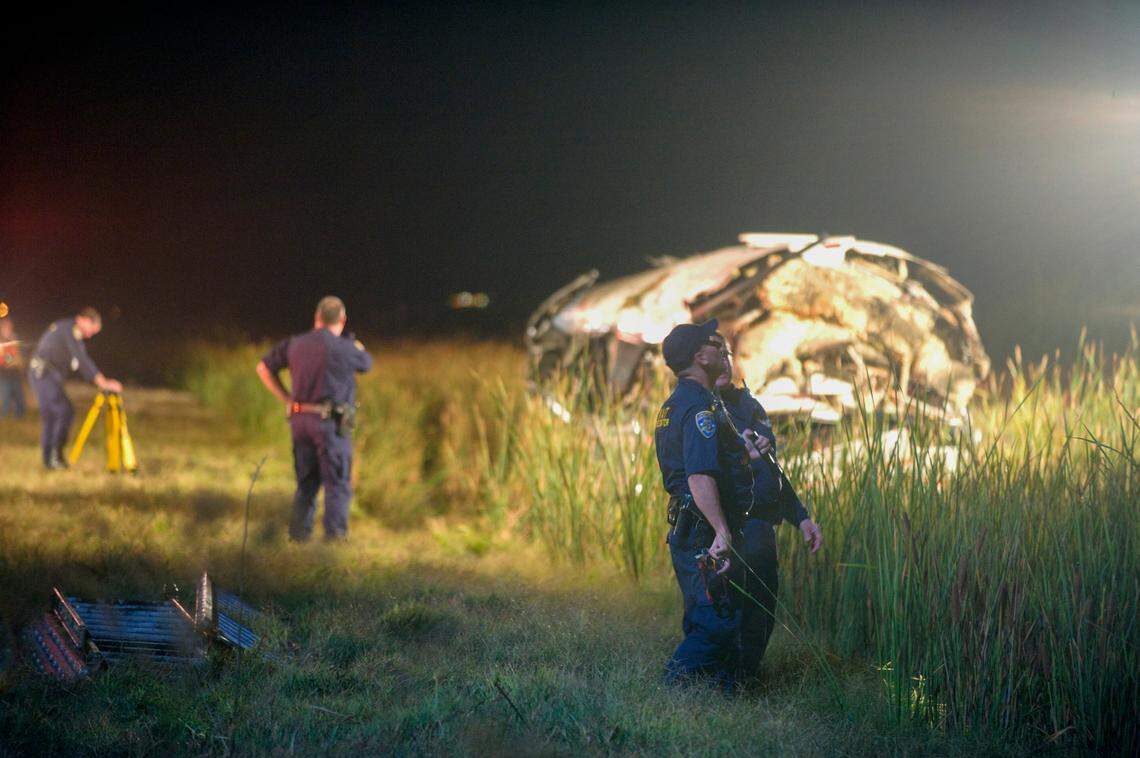
“I managed to pull several subjects closer to the bank, out of the mud and away from the bus,” Corona said.
Corona declined to speak with The Bee for this story. “I am not interested in reliving every moment of that horrible day,” he wrote in an email. His daughter, Natalie, was a police officer in Davis who was killed in an ambush last year. “I just don’t need the extra stress right now.”
At the crash scene, Corona asked Watts what happened and how many had been on the bus. Watts said he didn’t know. He told Corona he wasn’t even sure if he had been driving.
In news coverage, rescuers described the painstaking race to find the victims, at one point using infrared scanners from a helicopter to scan the muddy rice fields. Rescuers said the next day they were “reasonably sure” they’d accounted for everyone.
•••
In a daze immediately after the crash, Watts was able to call his former wife, Robinson, from his cellphone. She remembers the call vividly: “I’ll never forget the words he said. He said, ‘I’m all f----- up.’ “
Seconds later, someone whom she thinks was a rescuer took the phone from Watts and asked her if the man she’d been talking to might have been driving a bus. She said he had. She told them what she knew.
“Within 15 minutes or so, it hit the news,” she said.
Arlen Soghomonians was a paramedic who responded to the crash. He and an intern arrived at the scene just as rescuers were moving Watts’ 6-foot-1, 270-pound body on a backboard. On the way to the hospital, the intern tested Watts’ blood sugar.
The glucose meter brought back a 171 reading. It was elevated, but not particularly worrisome to Soghomonians. Blood sugar levels tend to rise during stressful or traumatic situations.
The crash happened late Sunday but dominated the news Monday.
“10 DIE IN CASINO BUS CRASH,” declared The Bee.
And on the front page Tuesday, the headline would live long in the public’s mind, even after Watts was found to not have any alcohol or drugs in his system: “Driver hired last week is held on DUI.”
Stories about family members searching for loved ones at an array of hospitals filled that day’s pages.
Ma Lor Vang, who was 60 and emigrated from Laos in 1977, used the casino outings as a reprieve from stressful days tending to her husband, who was paralyzed after a stroke. She died in the crash.
As family members searched hospitals spanning Chico to Sacramento, 61-year-old Khou Yang’s loved ones looked through the muddy field for any sign of her. She, too, was dead.
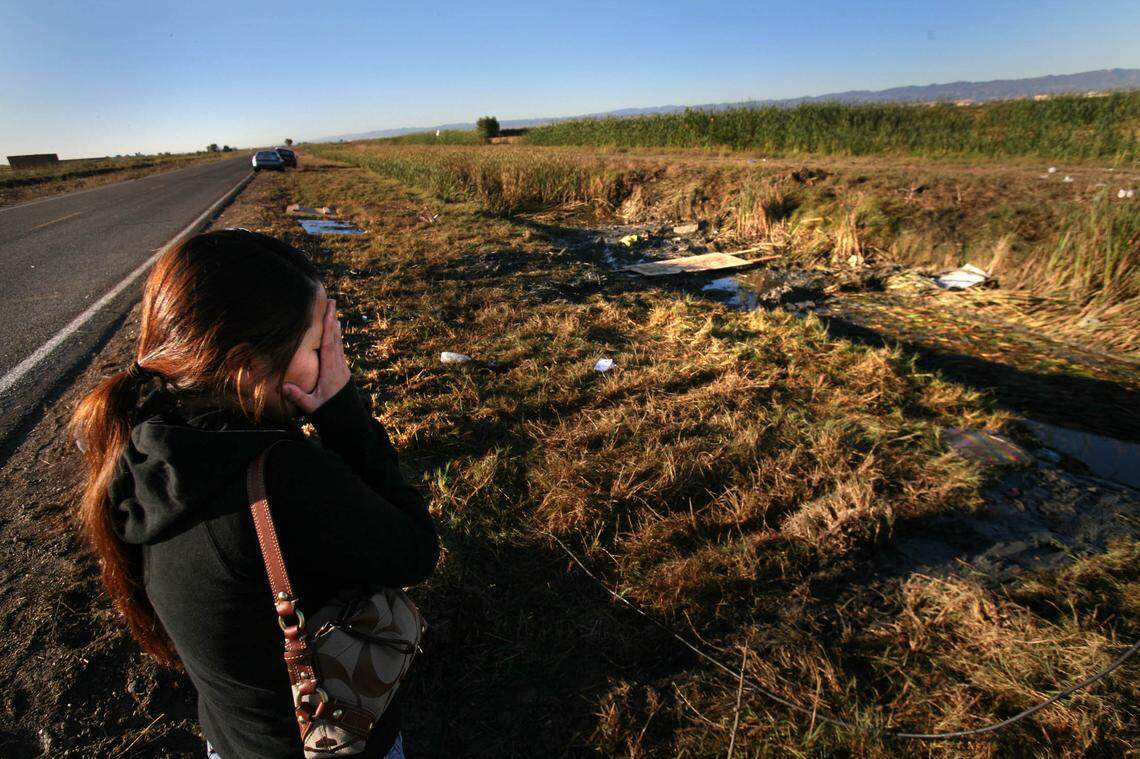
Thomas Vang said his 87-year-old father, Xee Hue Vang, took the casino tours with his wife as a reprieve from the jam-packed house with dozens of family members. At most, they’d spend $40 and enjoy some time together, Thomas Vang told a Bee reporter in the days after he found his father’s body at a Chico funeral home.
‘Answer them truthfully and let God do the rest’
After Watts arrived at Woodland Memorial Hospital, doctors put him in a medically induced coma and intubated him. He underwent surgery to suture gashes on his head and repair his left arm where a 2-inch gash exposed bone.
Robinson visited him early in the week and had to tell him what happened. He was barely lucid, unaware whether it was day or night.
“He knew it was a crash,” Robinson said. “But he didn’t know people died, and he didn’t know his sister’s stepfather (Cobb) died in it.”
California Highway Patrol Officer Simon Hamann walked into Watts’ room on an early Wednesday morning three days after the wreck. It was law enforcement’s first time interviewing Watts, who was still in bed and taking Versed, a powerful sedative, to dull the pain.
Hamann pulled out a voice recorder, asked Watts for permission to record their talk, and started a line of questioning that prosecutors would use to build their case to the jury a year later.
Watts was still foggy on the details about what happened. He said doctors hadn’t told him much about his injuries.
“I’m just laying here. Taking pills. It sure hurts,” Watts said.
They chatted about his injuries and driving history, and then read him his Miranda rights. “You do have the right to remain silent. Do you understand that?”
“Mmm hmm.”
He told them about his criminal history in detail. He told them about the days driving to Thunder Valley Casino without incident, about a pre-trip inspection of the bus.
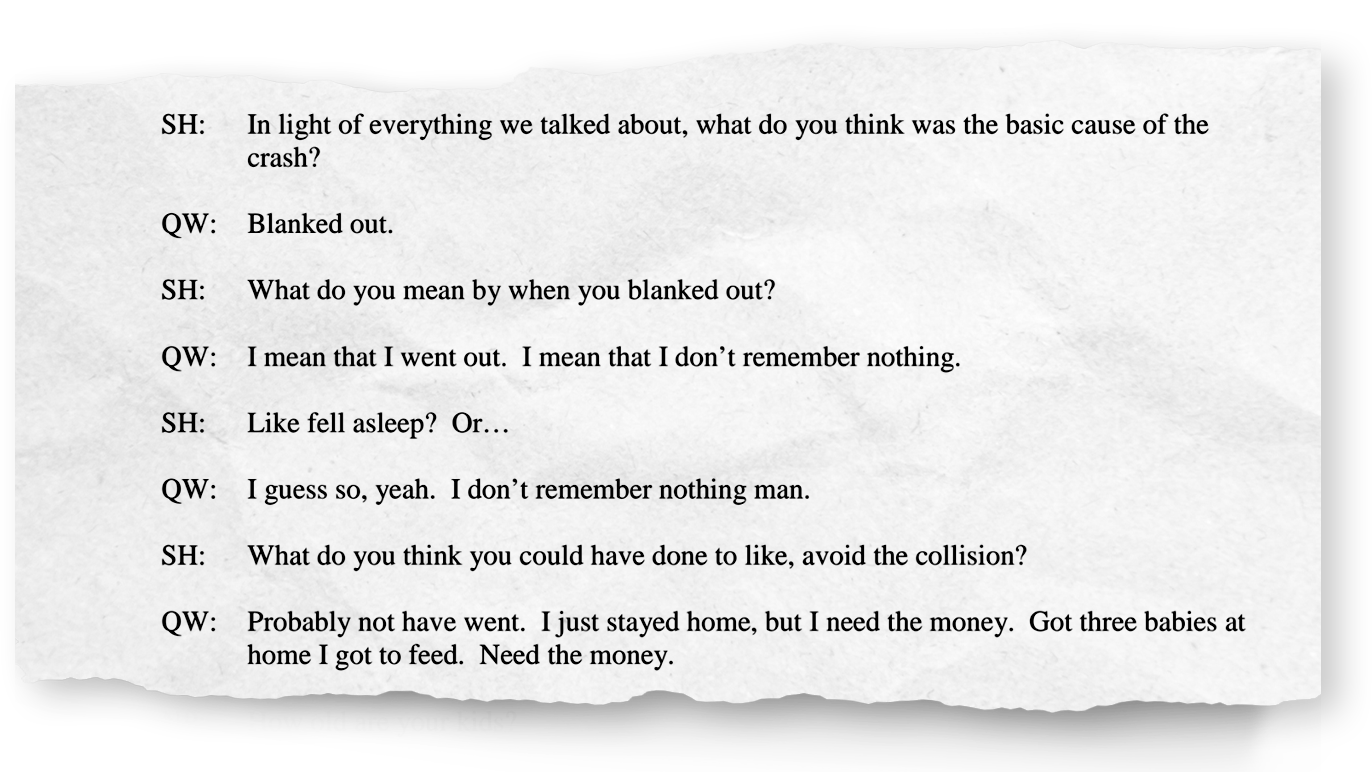
He told them about his sleep schedule and the food he generally ate, and his diabetes. He told them about how, when driving trucks over the years, he’d pull over and rest if he felt tired. He didn’t take driving lightly, he said. Watts said his memory ended when he turned off the freeway and onto Hahn Road.
At one point during their talk, a hospital staffer walked into the room with a message for Watts: “Your wife wants you to call her,” the person said. “Would you call her right away because she’s in tears? She doesn’t think you’re ready to talk to any policemen.”
The officer dialed Robinson and handed the phone to Watts. The officer’s recording captured Watts’ end of the conversation.
“Hello… They talked to me, yeah… It’s fine. I don’t have no drugs in my system.”
“Yeah, yeah. Answer them truthfully and let God do the rest.”
•••
Blood tests came back showing he had no alcohol or drugs in his system at the time of the wreck. On Oct. 14, nine days after the crash, he was discharged from Woodland Memorial Hospital.
As prosecutors built a case against Watts, the California Department of Corrections and Rehabilitation leaned on a technical violation of Watts’ parole from the gun charge a year earlier — that he’d traveled more than 50 miles from his home — as justification for putting him back in prison. It bought them time while crash investigators kept digging.
They caught a break in a follow-up interview with Watts on Dec. 9 at Deuel Vocational Institution near Tracy. He told Hamann and another CHP officer, George Luce, that he’d begun suffering headaches. He told them again the timeline as he remembered it from that day.
“Tired. That’s what I think it was from, basically,” he said, explaining the crash.
“Fatigue?” Luce asked.
“Just being, yeah, hella tired,” Watts replied.
“Is there a possibility that you fell asleep?”
“That’s a possibility. That’s, that’s um, to me that’s what I believe happened.”
The recording stopped a few seconds later.
Prosecutor’s ‘bad mojo’ in front of jury
Watts walked out of prison on Jan. 12, 2009, after state officials determined they couldn’t hold him for a full year on a technical parole violation. CHP investigators and Colusa County prosecutors kept working.
CHP investigators interviewed witnesses and surviving family members of victims for months to know precisely who was seated where on the bus and which rider might have seen what. They even fingerprinted the license plates.
Bit by bit, they stitched together a narrative and, by mid-May, had made enough of a case for the Colusa County District Attorney to charge Watts’ for the deaths of 11 people.
Even when he was in jail awaiting trial, Watts searched for an explanation. Shortly before 3 a.m. one day in July 2009, he awoke from a dream, called out to a Colusa County deputy nearby, and declared that he must have become overwhelmed by exhaust fumes from the engine.
Prosecutors later used the fumes theory as further proof that Watts was a compulsive, remorseless liar. The engine was in the back of the bus and nobody else had complained of fumes.
In a pretrial hearing, he called prosecutors liars and demanded that he represent himself before a judge rebuked him. Watts said in an interview that he doesn’t know if a head injury contributed to his outbursts. He said he acted out because he felt the system was stacked against him.
Rob Parsons covered cops and courts at the local paper, the Colusa Sun-Herald. The tension between Watts and his attorney was clear, Parsons said. They had quiet, animated arguments at the defense table, he said. At one point, Watts told Parsons that prosecutors and his own attorney were railroading him and not allowing him to mount a defense.
The press, Watts said, should report on that.
“The thing that I still remember most vividly was just how terrified Watts was and how alone he seemed to me,” said Parsons, who now works for the Fresno Bee. It was one of the most strained attorney-client relationships he’d seen.
“It was just clear that they were not on the same page at all. And they never got on the same page.”
Mixed in stacks of Watts’ papers near his prison bed is a copy of a story Parsons wrote, dated July 31, 2009. “Bus driver held over for trial,” the headline says. The story was about his preliminary hearing and mentioned the back-and-forth about falling asleep and the seizure from a year earlier — the seizures that never came up at trial. It also described Watts’ frustration with his lawyer.
“Watts tried to dismiss his attorney twice,” Parsons wrote. “Watts told the judge that Smith had threatened him prior to Friday’s proceedings.”
Watts drew lines around that part of the story. He scribbled a star in the upper corner.
•••
Jury selection began Oct. 5, 2009, exactly one year after the crash.
Judge Jeffrey A. Thompson asked the first 18 prospective jurors who had seen media coverage of the case. Every hand went up. The drunken driving allegations, pretrial publicity and TV ads for personal injury attorneys seeking clients to file lawsuits were seemingly everywhere in Colusa County, population 21,000.
Thompson asked how many of the prospective jurors knew someone else on the jury. Nearly every hand went up then, too.
Watts wanted the case to be tried in a different county, but he also didn’t want to wait longer for his case to be heard. There wasn’t enough time for a proper change-of-venue request, said Smith, his attorney. The case went forward.
Watts was a Black man from Stockton — an outsider — on trial in a small county where just 1% of the population was Black. Lawyers maintained that “justice is colorblind” during the jury selection process.
“Justice doesn’t care what color a person’s skin is. OK? Everybody agree with that? Everybody OK with that?” said Creg Datig, a special prosecutor from Riverside County who was assisting as part of a vehicular homicide task force from the state district attorney’s association.
He turned to prospective Juror No. 1, who said, “Yes.”
“You are, I believe, African American, is that correct?” Datig asked.
“As far as I know, yes,” the person replied.
Datig apologized for the awkward phrasing. It was necessary for the sake of the transcripts. “It has to show up in writing somewhere,” he said before continuing to question the only Black person on the jury pool.
“The defendant in this case is African American. Would that cause you any discomfort having to judge an African American person?” Datig asked.
“No,” the person replied. “It’s the offense that we’re doing here, not what he looks like.”
Datig agreed. Then, later that afternoon, he dismissed the prospective juror without explanation.
None of the other prospective jurors was asked such direct questions about their racial biases. By 2 p.m., attorneys had seated the 12-person jury. None of them was Black.
•••
The Watts case would be a career highlight for longtime District Attorney John Poyner, he would recall. Right alongside his cases against bombers, murderers and embezzlers.
That afternoon, on the anniversary of the crash, Poyner began his opening remarks.
Poyner applauded his legal team’s efforts to expedite the case and focus on the question of whether Watts was “grossly negligent” for his role in the crash. Under the law, gross negligence means that someone’s recklessness or deliberate actions caused an event to happen. It differs from regular negligence, such as a careless mistake or momentary lapse in judgment that might contribute to a crash.
.JPG "ACW JOHN POYNER (1).JPG")
CHP investigators explained the mechanics of the crash, the left-right-left swerve, the lack of evidence that anyone had ever tried to stop the bus.
“We were not able to find anything associated with braking,” said Nate Parsons, a CHP investigator, adding that is something they normally find at crash scenes.
Three women who had been on the bus testified that they saw Watts’ eyes begin closing. “It looks like he was sleepy, like he was wanting to sleep,” one witness said.
The prosecutors argued that Watts failed to control his diabetes the day of the crash and fell asleep at the wheel. All told, they argued Watts was guilty of gross negligence, the more serious allegation, because he should have known better than to try to drive with his insulin-dependent diabetes and without enough sleep. It was a compounding crisis that should have been avoided.
However, experts say Watts’ blood sugar level was only slightly elevated and was unlikely to have contributed to his loss of consciousness — a “blackout” that lasted some 26 seconds, according to CHP investigators, as the bus weaved out of control.
•••
By the third day of the trial, Albert Smith mounted Watts’ defense. Colusa County contracts out public defenders for lower-income defendants, and Smith, who joined the California bar in 1975, had a long record of taking cases there. During jury selection, he was upfront about his personality.
“All right,” he turned to prospective Juror No. 6. “I really am something of a curmudgeon. Is that a problem for you?”
It wasn’t, the person said.
“My back hurts. I’m grumpy. I’ve got a mild toothache,” Smith continued.
His quirks, he noted, should not be used in determining his client’s guilt.
Smith needed to convince a jury that it wasn’t conclusively gross negligence because Watts could have suffered a medical emergency or that there wasn’t enough evidence about what exactly happened on the bus.
Investigators knew Watts had a history of seizures, something that came up during interviews, medical records reviews and even his preliminary hearing months before the trial, records show. Smith never brought it up at trial.
Before an extra-long lunch break that day, Smith said he had meetings planned with “several” of his witnesses. But when court resumed, he called only one person to testify: the paramedic who treated Watts.
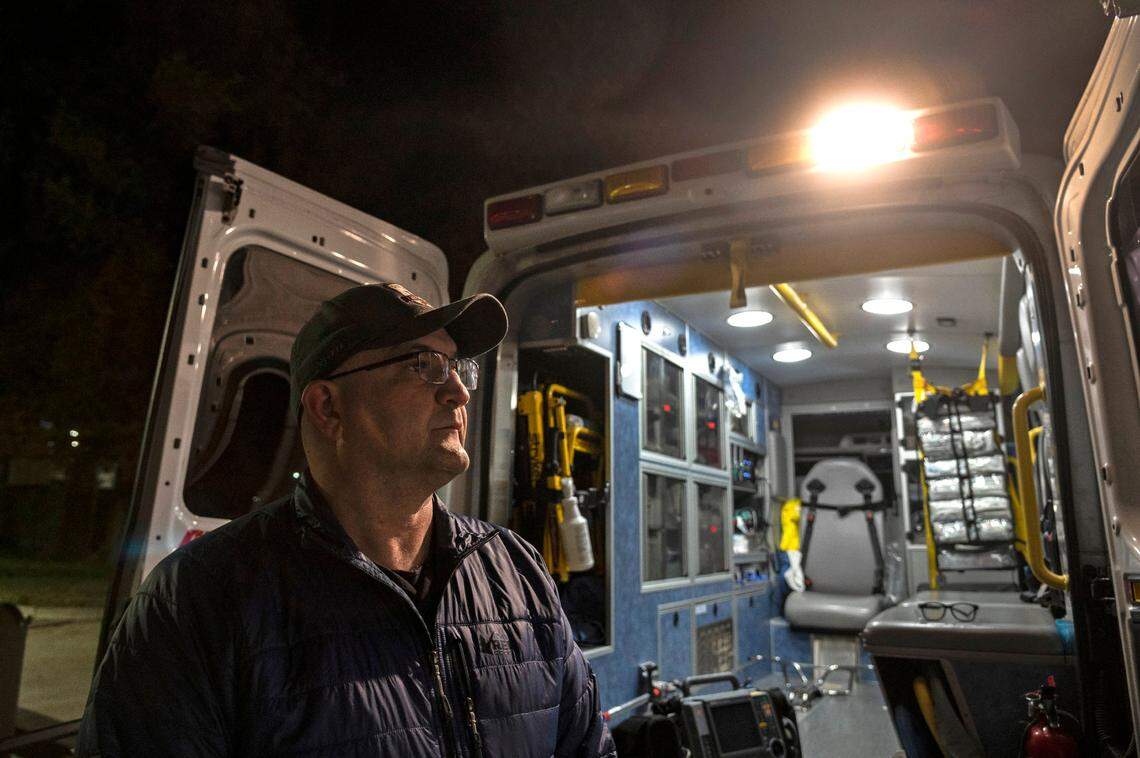
On the stand, Soghomonians explained what typical blood sugar ranges are. He wasn’t an expert on the endocrine system’s insulin production and repeatedly deferred questions about the chronic nature of diabetes to other medical specialists.
That level of depth, he said, was outside of his scope of practice.
In an interview with The Bee, Soghomonians remembered being stunned at the line of questions. Even the most highly skilled paramedic is not an expert in long-term treatment plans. Emergency medicine is about getting people to the hospital alive.
“That’s kind of interesting that no one from the emergency room would be called to come and testify about their findings and assessment and treatment,” Soghomonians said.
The Watts trial was one of the most memorable for Soghomonians, though he admitted he hadn’t followed the results after that day on the stand. One thing that has stuck with him all these years: “The judge, jury, defense and all that front line, he was the only African American. That I remember.”
Smith rested his case after just 30 minutes. It was 1:30 p.m. The jury went home early that day, too.
•••
Prosecutors Datig and Poyner didn’t hold back in their closing arguments the next morning. Poyner threw a gut punch, harkening back to Watts’ dazed state in the hospital bed when he went against Robinson’s advice and spoke with police.
“He could have remained silent, but he’s the one that told us about his lack of sleep. He’s the one that told us about his diabetes and his insulin dependency,” Poyner said. “He’s the one when asked, ‘What could you have done to avoid the accident?’ said ‘Stayed at home, but I needed the money.’ ”
“A measly $35. About $3 a head for those that died,” Poyner said.
Datig told the jurors to imagine their loved ones on an airplane with a pilot whose diabetes was uncontrolled and who hadn’t slept enough before stepping into the cockpit. Then he asked jurors to imagine loved ones getting onto a bus with a driver in a similar situation.
“Do you do that to a member of your family?”
The 3rd District Court of Appeal later said both prosecutors’ comments crossed the line. It was prosecutorial misconduct to speak in a way meant to arouse the jury’s sense of retribution and passions. It was strictly forbidden when determining someone’s objective guilt.
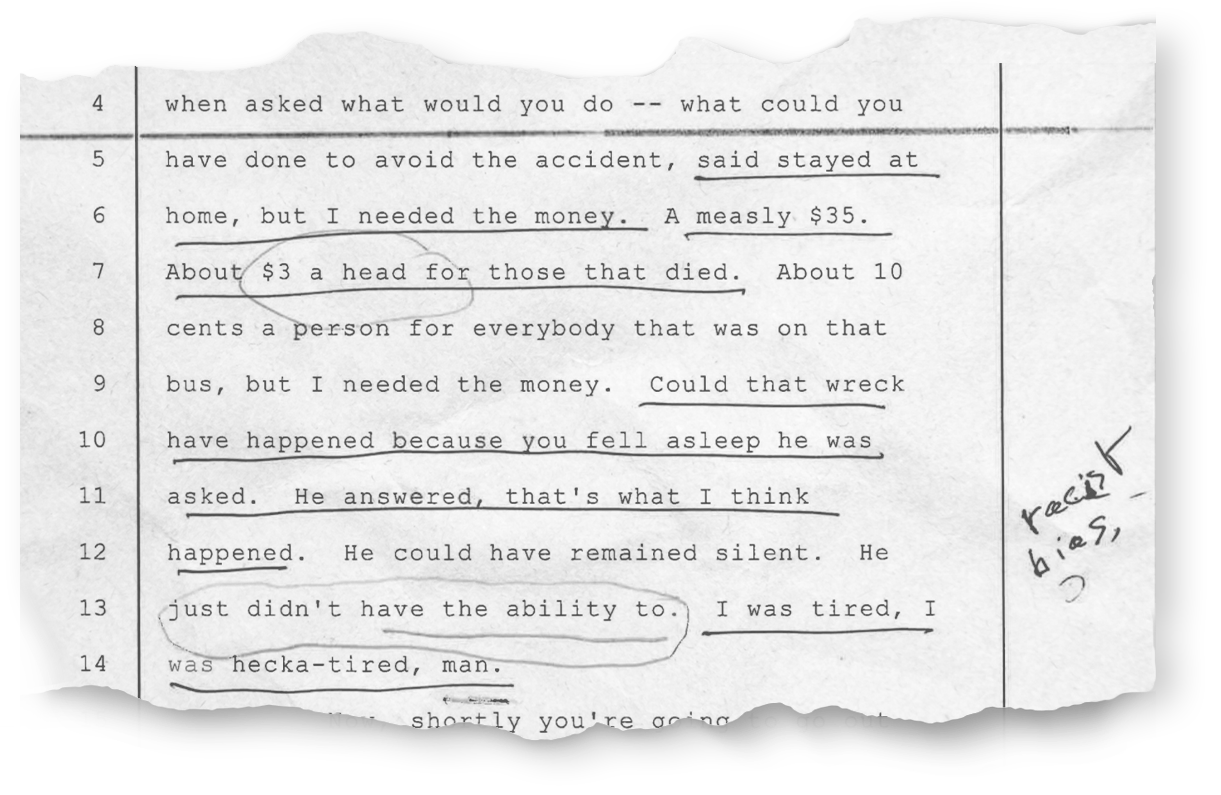
“There was no legitimate purpose to this argument,” the appeals court wrote in an unpublished opinion.
But Smith, Watts’ attorney, did not object to the comments during the trial. Smith in his closing argument made one thing clear: “Mr. Watts doesn’t know what happened.”
A diabetic emergency would not have been gross negligence but an “act of God,” Smith said. Driving while fatigued would have been ordinary negligence, which could have produced a much lighter sentence.
Prosecutors argued that such a finding would mean there was no accountability for the victims.
“There’s nothing ordinary, ladies and gentlemen, about the death of 11 people,” Datig said. “There is nothing ordinary about the terrible and lasting injuries that the other victims in this case suffered. Nothing ordinary about it at all.”
•••
In an interview for this story, Poyner said he tried to work out a deal with Watts.
“He was just not gonna cooperate with me, period,” Poyner said. “It just wasn’t gonna happen. I just felt bad for the guy, you know, I just wanted to sit down and bitch-slap him and say, ‘Listen, man, I’m actually trying to help you.’ But he didn’t care.”
Poyner said he was unaware of Watts’ seizure history. If he’d known, he would have brought it up, potentially to help bolster the case that Watts should not have been behind the wheel of the bus.
He acknowledged erring in his comments that the appeals court rebuked him for. “I don’t know why I did that,” he said. “That was bad mojo on my part.”
Datig, who now consults with the Riverside County District Attorney’s Office, declined to comment on the misconduct finding. He stood by the 26-year prison sentence, saying it was already lenient — Watts could have faced a prison term three times as long. He said he considers Poyner a friend and colleague but disagreed with him about an early release for Watts.
“The sentence that Mr. Watts received, and that he is currently serving, was very consistent with the interests of justice, because quite frankly, he could have been given a heck of a lot more,” Datig said in an interview.
Smith, the defense attorney, did not return multiple phone messages seeking comment.
CHP investigators noted Watts’ history of seizures in the conclusion of their exhaustive report. “However,” they wrote, “there was no evidence discovered during the course of this investigation to indicate that Watts suffered a seizure which led to his loss of consciousness immediately prior to the collision.”
Multiple experts on seizures contacted for this story disagreed.
Not all seizures look alike. Lack of sleep can contribute to seizure events. And head trauma — like from Watts’ beating in 2006 — could have caused or worsened a disorder, said Dr. James Grisolia, a neurologist with Scripps Health in San Diego County. Grisolia reviewed documents and details about Watts’ case for this story and said all signs suggested there was a “very significant chance” a seizure contributed to the crash.
At the least, it should have been brought up in trial, he said.
“The idea that he suffered a seizure causing the bus crash as opposed to just falling asleep is very likely,” Grisolia said.
•••
The case went to jurors at 11:31 a.m. Oct. 8, four days after it started.
They reached their verdict in four hours. Watts was guilty on 11 counts of gross vehicular manslaughter. And he was guilty of 21 counts of inflicting great bodily injury.
At the Nov. 4 sentencing, a victim advocate read a statement from the family of Eevang and Meuay Chio Saelee, a husband and wife who were killed in the crash.
“We, the Saelee family, do not know you and we still don’t want to know you. We only know that you are the one who killed our parents.”
In the days after the crash, local Asian community centers had become gathering spaces. Families planned funerals together. There was widespread mourning, and community advocates did their best to hold people together. That raw emotion turned into exhaustion by the sentencing date.
“May God forgive you,” said Tai Vang, whose parents were killed in the crash.
Robinson made the two-hour drive north from Stockton to speak at the hearing. She got there early and, as far as she knew, Smith would accommodate her request. She hated public speaking, her nerves often getting the best of her, but she wanted to be there for the father of her children.
The public defender never called her to speak. She said she never found out why.
“He had a health issue. And unfortunately, he drove that dang bus,” she said in an interview. “They needed someone to blame, someone to throw the hurt to. And they threw it at him.”
Tears welling in his eyes, Watts turned toward the gallery and made his statement: “Before you sentence me for what happened, I would like to address everybody out there. I want to let you know that I’m terribly sorry for what happened. I cannot take it back, what happened, but what happened was not intentional. It was a mistake, a bad mistake, and I’m very sorry for it.”
Thompson, the judge, was unmoved. He imposed a 26-year, 4-month prison sentence — beyond the 18-year term prosecutors offered in exchange for a guilty plea earlier in the year.
“Mr. Watts has a 33-year-old history of criminality which demonstrates indifference by him towards the effect of his actions on others,” the judge said. “Remorse that he demonstrates here in court today is late in arriving and of little moment in this case.”
Stanley Goldman, a law professor at Loyola Law School in Los Angeles, reviewed sentencing documents and the appeal court’s unpublished opinion for this case. In addition to problems with the omission of a jury instruction about unconsciousness as a defense, Goldman said the 26-year term for what was effectively a non-violent crime in the eyes of the law was “unusually harsh.”
“I think it’s an unusual amount of time for involuntary manslaughter,” Goldman said. “I mean, it really is a heavy sentence.”
Sacramento mathematician takes up the case
Watts’ seizures worsened in the years that followed, according to his prison medical records. In between bouts spent filing court papers, sending letters to his daughters and staring at photos from his bed, his health deteriorated.
About 7 p.m. on Jan. 10, 2012, Watts had a foggy brain. He “did not know what happened to him,” a nurse wrote on his medical papers before discharging him.
“Somehow I lost my memory for two or three hours,” Watts told another physician a year later.
“Possible seizure on the yard,” one doctor wrote in March 2013. “Implications for resentencing.”
That year, doctors prescribed Watts a seizure medication, Dilantin. They later put him on Keppra, another seizure medication that he takes to this day.
Years later, in 2017, Edric Cane wrote a letter to The Bee asking for an update on the Watts case. Cane, an 85-year-old mathematician originally from France, had moved to the Sacramento area around the time the trial was going on.
He read the headlines. For some reason, he said, the case stuck with him.
“If nothing else,” he wrote in his letter, “after 10 years, doesn’t the state have anything better to do with my tax dollars?”
Through that letter, he met Rhonda Glaser, a justice advocate who’d also become interested in Watts’ case. She had collected reams of records from Watts and advocated for his release. They spoke weekly and sifted through binders of case files and transcripts. They traveled to a Stockton police station to get documents about the 2006 beating.
Cane spent two months studying the files.
“I couldn’t forget about the guy,” said Cane, who ultimately visited Watts in prison to help set the record straight. “There were things that they knew would exonerate him and that were not brought up.”
“I very much hope that it will be noticed,” Cane said about his research. “I hope it is used as a case study for the kind of injustice that exists and that puts people in prison that would not be in prison if they were not Black.”
After learning some of the details from Cane, Assemblyman Ken Cooley, D-Rancho Cordova, petitioned then-Gov. Jerry Brown to commute Watts’ sentence in 2018. He never heard back on his request. In an interview with The Bee, Cooley said he would continue to work for Watts’ release.
“I think it’s a miscarriage of justice,” Cooley said.
When the coronavirus pandemic began, Watts continued his job as a custodian at the medical ward at California State Prison-Solano in Vacaville. He sweeps, empties trash and has earned credits for his custodial certificate. The prison reported its first death from COVID-19 on Dec. 14.
In August, the LNU Lightning Complex fire burned one hill over and the prison went on lockdown. Watts watched as embers fell to the ground outside his dorm window.
In Colusa County, tules still line the ditch along Lone Star Road. No markers commemorate the wreck. Flowers left in the ditch for the victims have long vanished. Without exact latitude and longitude from the crash reports, it’s impossible to know exactly where it happened.
Sixty-five miles away, Quinton Watts sits and waits.
BEHIND THE STORY
MOREWhy we did this story
The Sacramento Bee is committed to providing our readers with deeply reported accountability journalism about our community. Our mission includes thorough and detailed reporting of public institutions to illuminate inequality, waste and abuse. This story is an important part of the independent oversight of the justice system that is central to local journalism.
Click on the arrow in the upper right for more.
How we did it
On a Wednesday in February, Edric Cane emailed The Bee with a bold claim: The driver of a horrible bus crash had been unfairly sent to prison. Reporter Jason Pohl replied, interested in the proof that he claimed to have.
They met in person a few days later, and Cane turned over an envelope with crash reports and his notes. Pohl vowed to look into it. If anything, 12 years later, the reports could add some major context to a tragedy that shook the region.
In the next few months, The Bee reviewed thousands of pages of crash reports, trial transcripts and witness interviews. Many of the records came from Cane — Watts and Cane had become close, and Watts over the years mailed him reams of paper medical records and other reports.
Watts called the reporter in June. Calls from prison are limited to 15 minutes at a time, so Watts agreed to call back each Tuesday and Thursday while the reporter chipped away at the case and came up with new questions. At one point while covering wildfires in August, the reporter, who was in his car, spoke with Watts, who was in a smokey prison dormitory a few miles away.
The Bee traveled to Stockton to conduct interviews with Watts’ family and collect decades-old court documents and went to Colusa for additional records and to visit the crash scene. Pohl spent days trying to speak with victims and family members and interviewed attorneys, medical experts and scholars about the case, seizures, and the 26-year sentence.
This story was originally published December 17, 2020 at 5:00 AM with the headline "A California bus crash killed 11. Was the driver’s prison sentence a ‘miscarriage of justice’?."