Trying to choose the best LSAT prep course that’s right for you? Then, let’s examine the facts.
About 32% of people retake the LSAT, and a great prep course can make all the difference by offering realistic practice exams, video lessons, personalized study plans, and expert instruction that matches your learning style.
I reviewed the top LSAT prep courses, including Blueprint, Kaplan, LSATMax, and more. Whether you’re taking the LSAT for the first time or trying to improve a previous score, this guide will help you choose the course that gives you the best shot at reaching your goals.
| Best LSAT Prep Courses | ||
 |
| Start Now |
 |
| Start Now |
 |
| Start Now |
What Is the Best LSAT Prep Course for You?
Best Overall Course: Blueprint – outstanding balance of interactive learning, strong practice bank, analytics, and a solid score guarantee.
Top Support & Structure: Kaplan – perfect for those who want live classes, tutoring, printed resources, and a structured approach.
Great Value Self‑Pace: Magoosh – ideal if you’re budget-conscious, disciplined, and don’t need live instruction.
1. Blueprint LSAT Prep: Best for Visual Learners and Score Gains

Blueprint is the rare LSAT prep course that actually feels built for how students think. When I tested it, I immediately noticed how much more engaging the animated lessons were compared to the dry slide decks and static text I’ve seen elsewhere. Instead of dumping dense logic rules on me, the course walked me through arguments step by step, making concepts like conditional reasoning click faster.
The adaptive study plan was another highlight. I liked that it adjusted automatically when I missed a day, so I never had to stop and figure out what to do next. The analytics also stood out—I could drill into my performance by question type and timing, which made it easy to spot weak areas. Out of all the LSAT platforms I reviewed, Blueprint felt the most polished and intuitive to use.
If there’s a drawback, it’s that the course leans heavily on digital tools. The platform is sleek and modern, but anyone who prefers lots of printed materials might find themselves wanting more offline options.
Package Options
- Self-Paced Course: Best for motivated self-studiers who want to move at their own speed while still having access to live review sessions and a score increase guarantee.
- Live Course: Ideal for students who need a set schedule and real-time interaction, combining live classes with full access to self-paced materials.
- 170+ Course: Designed for high scorers aiming for elite results, offering double the live instruction plus personal coaching and a top-score guarantee.
- Tutoring Packages: Perfect for students who want fully personalized guidance, flexible scheduling, and targeted help on specific LSAT sections or skills.
In my review of Blueprint LSAT, the course built momentum efficiently. I never had to wonder, “What should I work on today?”, something I did find myself asking with more static options like Kaplan.
Key Features
- 7,000+ practice questions and 225 hours of video explanations
- 60+ total hours of instructor-led lectures available
- Adaptive, editable calendar that keeps you on track
- Access lessons and quizzes on the go
- In-class support, live office hours, and 24/7 chat
What are Students Saying about Blueprint?
Many reviewers highlight Blueprint’s flexibility and the advantage of choosing from multiple package options to fit different study needs.

One TrustPilot User. Said, “Blueprint is the best! I’m happy that I chose to do both the self-paced online course and tutoring with Dylan. The self-paced modules helped in learning the basics and provided hundreds of practice questions to apply the skills. Dylan really assisted in working through my weakest sections and question types and changed the way that I think about the LSAT.”

Save 15% on Blueprint LSAT Review Courses
Pros
- Live Sessions With Two Instructors: I appreciate having two instructors; this approach enhances engagement and provides diverse perspectives.
- Personalized Study Plan That Adapts Daily: It recalibrated whenever I fell behind, so I never felt “off track.” That flexibility matters when life throws curveballs.
- Truly Useful Score Analytics: I liked how I could sort performance by question type, time, and confidence rating, which helps target weak spots.
- High Instructor Responsiveness: In the live class version, questions weren’t ignored; they were discussed. Even Self-Paced students get real support
- Score Improvement Guarantee: This allows you to increase your score or get a refund if you don’t.
Cons
- More Expensive Than Self-Paced Platforms: You’re paying for top-tier instruction and design, so it’s a bit more expensive, but the quality is worth it.
- Print Materials Are Sparse: It’s very digitally focused. If you learn by writing things down, you’ll need to create your printouts or purchase their companion books.
Bottom Line: Why Choose Blueprint LSAT?
If you’re aiming for a top-tier LSAT score and want a course that adapts to you, Blueprint is the most complete option I have tested. The visuals are unmatched, the analytics are helpful, and the study plan adjusts in real time. It’s a bit pricier than others, but the support, structure, and score results justify it.
Blueprint LSAT
2. Kaplan LSAT Prep: Most Structured and Supportive

Kaplan felt like the most structured LSAT course I tested, and that structure is exactly where it shines. When I joined one of their live online sessions, I liked how easy it was to just show up and follow along without second-guessing what to study next. The instructors—who are all 99th-percentile scorers—took the time to break down tough logical reasoning questions, and I appreciated that there was always a support team in the chat to handle side questions in real time.
Another highlight was the sheer volume of practice material. With nearly 8,000 official LSAT questions and full integration with LSAC’s LawHub, I never felt short on realistic drills. The performance assessments were also helpful, giving me targeted recommendations instead of leaving me to guess where to focus.
The main tradeoff is that Kaplan feels more traditional and less “slick” than Blueprint. The interface and lessons aren’t as modern or visually creative, but if you thrive on routine and expert-led structure, it’s a reliable system that keeps you on track. Check out my review of Kaplan LSAT courses.
Package Options
- Live Online Course: Best for students who want the flexibility of remote learning with live instructor interaction and on-demand access.
- In-Person Course: Ideal for learners who benefit from face-to-face teaching in a structured classroom setting.
- On-Demand Course: Designed for self-motivated learners who prefer to work at their own pace with full access to lessons and practice tools.
- Tutoring Packages: Perfect for students who want a fully customized plan and individual instruction.
Key Features
- 7,500+ practice questions with explanations
- Live chat, phone help, and instructor office hours
- Score improvement guarantee
- Prep eBooks for mobile access

User Testimonial
“My experience with Kaplan was amazing and invaluable. Because of that review, I am achieving my goal. Thanks again.”
TrustPilot User

Get $150 Off Kaplan LSAT Prep Courses
Pros
- Accountability Built In: Weekly checkpoints made sure I showed up and studied.
- Instructor-Led Deep Dives: Instructors would explain wrong answers until the class understood, no rushing through.
- Multiple Formats Available: Offers flexibility if you know you’ll need live interaction or on-demand access.
- Solid Practice Test Library: Exposure to plenty of real LSAT-style questions builds confidence.
- Printed Resources: Comes with eBooks and print options for students who prefer studying offline.
Cons
- Less Personalized Feedback: In large classes, your question might go unanswered if time runs short.
- Format Feels Standard: more suitable if you enjoy traditional classrooms, especially if you prefer visual teaching.
Bottom Line: Why Choose Kaplan?
Kaplan LSAT is ideal for those who require structure and accountability in their preparation. Live classes provide reliable support, and the course materials thoroughly cover all the necessary topics. If you thrive in scheduled environments, Kaplan is a great choice, but it does not offer Blueprint’s visual flair.
Kaplan LSAT
3. Magoosh LSAT Prep: Best for Budget and Flexibility
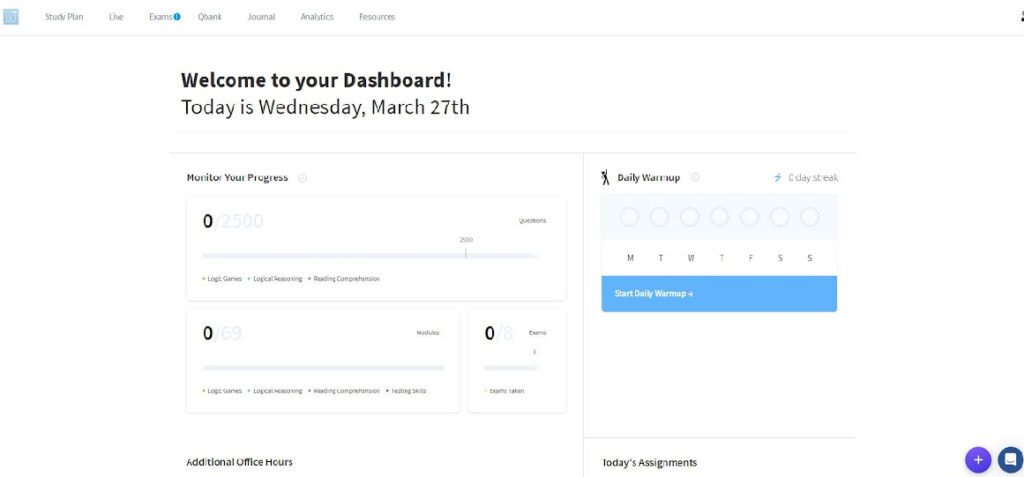
Magoosh stood out for being straightforward and affordable. When I tested Magoosh LSAT, I liked how clean and simple the dashboard was—it told me exactly what to watch or practice next without overwhelming me. The short video lessons were clear and easy to follow, and having 6,000+ official LSAT questions built in meant I could still get plenty of realistic practice at a fraction of the price of other platforms.
The year-long access was also a nice touch. I could see this being especially useful for students who need to spread prep out or want the flexibility to pause and come back without paying extra.
That said, Magoosh doesn’t offer live instruction, and I missed having an instructor I could check in with when a concept didn’t quite click. The smaller library of full-length timed tests also makes it less robust than Blueprint or Kaplan.
Package Options
- Self-Paced Premium: Best for independent learners who want flexibility, official LSAT practice, and a full year of study access.
- Guided Study Premium + On-Demand Classes: Ideal for students who want added structure, including recorded lessons from top instructors and personalized homework.

Key Features
- Self-paced
- 6,000+ official LSAT questions
- Email-based support with 24-hour turnaround
- Score guarantee or get your money back
- Customizable study schedules
User Testimonial
“Magoosh is worth it. I watched all of their videos and excluded the majority of the challenging practice quantitative sections (minus a few time-constrained ones in quant and verbal, due to a lack of time) over a month and a half. I was very pleased with my score.”
Reddit user.
Pros
- Affordable and Efficient: You won’t waste time, and you won’t overspend.
- Clear Video Lessons: Short, straightforward tutorials that explain strategies without unnecessary fluff.
- Extensive Practice Bank: 6,000+ official LSAT questions give you plenty of opportunities to drill with real material.
- Score Guarantee: Backed by a money-back guarantee if your LSAT score doesn’t improve.
Cons
- Fewer Full-Length Tests: While Magoosh includes access to LawHub Advantage, its platform features a smaller number of built-in timed practice tests.
- No Live Interaction: Pure self-study isn’t ideal if you struggle without immediate instructor feedback.
Bottom Line: Why Choose Magoosh?
Magoosh offers a streamlined self-paced prep experience. I found its clean interface straightforward, and its video explanations were refreshingly concise, no drama, just clear logic. It’s perfect for self-starters who want quality content on a shoestring.
Magoosh LSAT
4. LSATMax: Extensive Question Bank

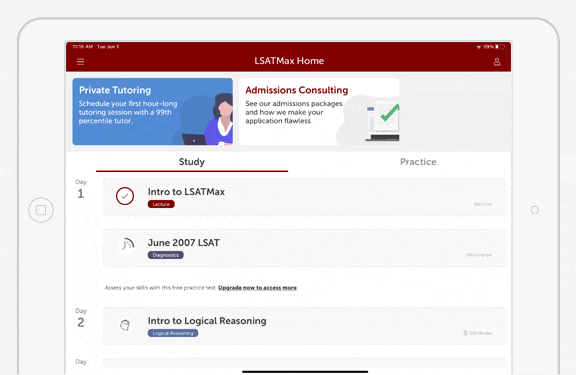
LSATMax impressed me at first with its sheer volume of material. Having access to all 95 official PrepTests plus a 9,000-question bank meant I never ran out of practice problems, and the detailed answer explanations were helpful for breaking down tricky logic games or reading comprehension passages. The instructors’ office hours also gave me a way to get questions answered without paying extra for tutoring, which I appreciated.
But compared to Blueprint or Kaplan, the platform felt less polished. The interface was clunky at times, and the study plan didn’t adapt as smoothly when I fell behind. LSATMax is still a solid choice if you mainly want a huge bank of real LSAT questions to work through, but it doesn’t guide you as intuitively as the top-tier courses.
Package Options
- 170+ Package: Best for high scorers aiming for elite results, with structured lessons, live office hours, and targeted drills.
- Tutoring Packages: Ideal for students who want fully personalized guidance and flexible scheduling with top instructors.
Key Features
- 90+ official LSAT PrepTests™
- 1,500+ hours of videos
- Score guarantee
- Mobile App for on-the-go studying
- Unlimited personalized support and guidance
User Testimonial
Many students consider LSATMax a solid choice, though some note it sends frequent marketing messages about additional features.
One Reddit user stated, “I personally use LSATMax and feel that it is a useful site. They do send a lot of messages attempting to get you to buy it, including tutoring hours and other services, but if you don’t need it, why buy it? The office hours are also handy to get extra help for free.”
Pros
- Extensive Question Bank: I like how LSATMax offers 9,000+ real LSAT questions, providing realistic study opportunities.
- Detailed Explanations: Each practice question is accompanied by thorough explanations, aiding in understanding the reasoning behind correct and incorrect answers.
- Instructor Access: Students can engage with instructors through live office hours and message boards, facilitating clarification of doubts and personalized guidance.
Cons
- Limited Customization in Study Plans: While LSATMax offers a structured study calendar, some users may find the lack of fully customizable study plans restrictive.
- User Interface: Although the platform’s user interface is functional, it may not be as polished or intuitive as that of some competitors.
Bottom Line: Why Choose LSATMax?
In my experience with testing out the program, LSATMax’s comprehensive question bank and detailed explanations significantly enhanced my understanding of the LSAT material. It’s a good option if you want to work through a lot of content and prefer self-guided study. But during testing, the interface felt less intuitive, and the study plan wasn’t as personalized as Blueprint. It’s best for students who want volume and don’t need as much structure or polish. For a more streamlined experience, consider Blueprint or Kaplan.
LSATMax
5. Princeton Review LSAT: Best for Classroom Fans

Princeton Review felt the most like a traditional classroom experience. When I joined a live session, I liked the way the instructor worked through questions on the spot and gave real-time feedback—it had the same back-and-forth dynamic you’d expect in person, which made it easier to stay engaged. The amount of live instruction was also a clear strength. With more hours than most competitors, I never felt like the material was being rushed.
I also appreciated that the lessons were paired with official LSAT practice materials, so every drill felt authentic. For students who learn best with a teacher guiding them step by step, the structured schedule is a real advantage.
The tradeoff is that Princeton Review leans heavily on a textbook-style approach, and the overall platform felt less flexible compared to Blueprint or Kaplan. It’s best suited for students who like consistency and thrive in a classroom setting, but it may feel rigid if you prefer a more adaptive or tech-driven experience.
Check out my comparisons of Princeton Review and Blueprint LSAT or Kaplan vs Princeton Review to see the differences.
Package Options
- LSAT 170+: Best for ambitious scorers, with 65 hours of live instruction and a 170+ score guarantee.
- Immersion 170+: Most comprehensive option, with 130 hours of live instruction plus 56 hours of content workshops.
- Self-Paced: Flexible 100+ hours of recorded video lessons for independent learners.
- Private Tutoring: 10- or 30-hour package for one-on-one targeted instruction.
- Fundamentals: 30 hours of live instruction focusing on core LSAT skills.
Key Features
- 65+ hours of live expert instruction
- LSAT course manual e-book access
- 90+ full official LSAT PrepTests™ for 1 year
- Instructor access via phone, chat, and email
- Score improvement or money-back guarantee
- Free full-length LSAT practice test

User Testimonial
I came across a Reddit post that shared a similar view to mine,
“I did Princeton Review. I found it helpful! I just would recommend something longer than the 6-week course (I think there is a 10-week option) because it was kinda fast for me.”
Pros
- Large Test Bank: In my opinion, the large test banks are great for heavy practice.
- Classroom Engagement: You will get Real-time feedback that keeps you invested.
- Comprehensive Study Materials: I like that Princeton Review’s LSAT prep course offers 65+ live instruction sessions and more than 1,800 pages of study materials.
Cons
- Pricey for Hybrid Experience: You pay more for the in-person option.
- Textbook-Heavy Approach: You’ll spend time flipping pages instead of engaging with interactive tools.
- No Mobile App: They don’t offer a full-featured mobile app, which may not suit those who prefer to study on the go.
Bottom Line: Why Choose Princeton Review?
If you prefer learning in a classroom setting, either virtually or in person, The Princeton Review may be a good fit for you. The live sessions were solid, and the group dynamic can be motivating. However, the course is textbook-heavy, lacks a mobile app, and the practice felt less refined compared to Blueprint and Kaplan. It’s worth considering if you want that in-person structure, but you may get better value and usability from Kaplan.
Princeton Review
6. LSAT Lab: Best for Ongoing Tutor Access

LSAT Lab stood out to me for the level of access to instructors. The 24/7 live tutor chat was something I didn’t see in other courses, and I liked being able to get quick answers when I hit a confusing logic game or reading comp passage. In the higher-tier plans, the built-in tutoring time also made it feel like you weren’t left on your own, which is rare without paying extra.
The video lessons and study materials were clear enough, and the platform included access to all 99 official LSAT PrepTests, which gave me plenty to work with. For students who value ongoing instructor support, that combination is a big plus.
On the flip side, I found the course less comprehensive than others—live classes only ran a couple of times a month, and the platform itself felt bare-bones compared to Blueprint or Kaplan. It’s a decent option if you care most about immediate tutor access, but it doesn’t have the same depth or polish as the higher-ranked courses.
Package Options
- Starter: Free plan with limited resources for basic LSAT prep.
- Premium: Full resource library plus live-online classes.
- Classroom: All Premium features with additional structured class time.
- Tutor: Premium access plus two hours of private tutoring each month.

Key Features
- Access to all 99 official LSAT PrepTests
- 24/7 live tutor chat with instructors
- In-depth performance analysis
- Private tutoring sessions
- Practice questions and quizzes
User Testimonial
“I’m using it for drilling and about to purchase a plan. I like that it prorates a plan up to the day of the test”
Reddit user
Pros
- Comprehensive Practice Materials: Access to all 99 official LSAT PrepTests.
- Personalized Study Plan: Tailored to individual goals and timelines.
- 24/7 Tutor Chat: Offers around-the-clock access to instructors,
Cons
- Limited Practice Volume: Smaller question bank compared to some competitors.
- Limited Live Class Cohorts: Live online classes are offered only once or twice a month, which may require students to wait before they can officially start their lessons.
- No Score-Boost Guarantee: LSAT Lab does not offer a score improvement guarantee, which may be a consideration for students seeking a promise of score enhancement.
Bottom Line: Why Choose LSAT Lab?
LSAT Lab’s live tutor chat and user-friendly dashboard are standout features, especially if you want immediate feedback. If 24/7 tutor access is your top priority, it’s a decent pick, but Blueprint or Kaplan offer a more complete and polished experience.
LSAT Lab
7. 7Sage: Best for Self-Paced Learners on a Budget

What I noticed right away with 7Sage is how much value you get without the high cost. The course leans heavily on video explanations and drilling, which works well if you like learning at your own pace. Their massive question bank comes straight from real LSAT questions, so you’re practicing with dependable material.
The video lessons break concepts down clearly, which 7Sage is known for. Their analytics dashboard also helps track progress, showing where you’re strong and where you need more review.
On the downside, 7Sage doesn’t have the live class structure or built-in tutoring you’ll see with Blueprint. It’s more bare-bones in terms of student support, and if you need real-time help from an instructor, you’ll have to look elsewhere. But if your priority is affordability and unlimited access to practice, it’s a solid pick.
Package Options
- Guided Self Study: 924 video lessons, explanations for every LSAT question, and adaptive drills.
- LiveCourse: Core features plus daily live classes, expert help, group sessions, and recorded lessons.
- Coach Course: LiveCourse plus two monthly tutoring sessions, accountability check-ins, and a custom study plan.
Note: all packages require an LSAC LawHub Advantage subscription.

Course Highlights
- Video explanations for every LSAT question type
- Access to 90+ official LSAT PrepTests™
- Customizable study schedules
- Detailed analytics and performance tracking
- Active discussion forums for peer support
What are Students Saying about 7Sage
“As someone with 7sage, I think it’s a good starter platform to learn the foundations. Some of the lessons are 5+ hours long. That being said, I did have to move on to other platforms/resources after 7sage.”
Reddit user
Pros
- Affordable Pricing: One of the lowest-cost LSAT prep options, with flexible plans that make it easy to start small and upgrade when you’re ready.
- Strong Video Library: Clear explanations that make tough sections easier to understand.
- Self-Paced Flexibility: Designed for independent learners who prefer to study on their own schedule.
Cons
- No Live Classes: Doesn’t include scheduled live-online instruction, which some students need for accountability.
- Limited Instructor Support: Beyond forums, there isn’t much direct help from teachers compared to bigger providers.
- Basic Platform Design: The layout is functional but not as modern or interactive as competitors.
- Low Accountability: Without live classes or tutoring, it’s easy to fall behind if you aren’t self-motivated.
Bottom Line: Why Choose 7Sage?
7Sage is an affordable LSAT prep option, giving students access to over 90 official PrepTests™, clear video lessons, and detailed analytics. It’s built for self-motivated learners who prefer flexibility and a no-frills study experience. The platform shines in explanations and customizable study schedules, but it lacks live classes, tutoring, and a score guarantee. If you need structure and real-time support, Blueprint or Princeton Review are stronger choices, but for budget prep, 7Sage delivers.
7Sage
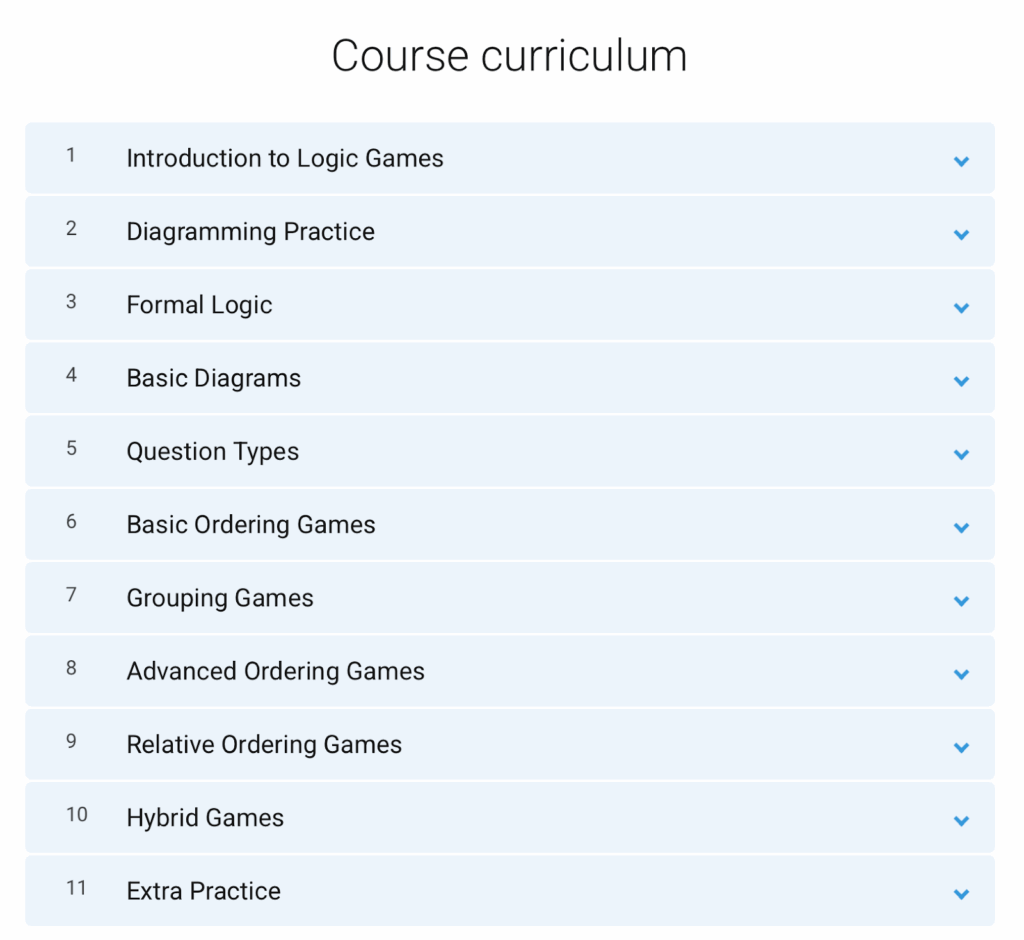
8. AlphaScore: Best for Straightforward, Flexible Prep

AlphaScore stood out to me for its simplicity and flexibility. The platform focuses on clear explanations, animated tutorials, and plenty of real LSAT practice questions. I liked that you can study entirely on your own schedule and still have the option to ask questions directly to an instructor.
The course covers every LSAT section with videos, detailed answer breakdowns, and access to LSAT practice exams. Instructors all have at least five years of LSAT teaching experience, so the support you get feels reliable. It’s also fully online and works across devices, which makes it easy to pick up where you left off.
Compared to Blueprint or Kaplan, AlphaScore feels more minimal. You won’t find daily live classes, interactive dashboards, or a score guarantee. But if you want a straightforward, no-frills prep option with access to experienced instructors, it’s a solid fit.
Package Options
- Complete LSAT Course: 50+ video lessons, 10 LSAT exams, 1,000+ practice questions, quizzes, assignments, and explanations.
- Premium LSAT Course: 50+ video lessons, 61 LSAT practice exams, 6,000+ practice questions, quizzes, assignments, and explanations.
Course Highlights
- Full coverage of every LSAT section
- Animated video tutorials and personal tutoring access
- Explanations for actual LSAT questions
- Works on desktop, tablet, or mobile devices
- Progress tracking and flexible scheduling
Pros
- Flexible Scheduling: You can log in and study anytime since everything’s online.
- Experienced Instructors: The lessons come from teachers who’ve been helping LSAT students for years.
- Device Friendly: It works smoothly whether you’re on a laptop, tablet, or even your phone.
Cons
- Minimal Live Instruction: Lacks structured, daily live classes.
- No Score Guarantee: Doesn’t promise improvement like some competitors.
- Simpler Platform: Less interactive than larger providers.
- Limited Extra Resources: Fewer add-ons compared to top-ranked courses.
- Outdated Content: Still mentions logic games, which are no longer part of the LSAT.
Bottom Line: Why Choose AlphaScore?
AlphaScore is a solid option for students who want flexible, no-frills LSAT prep. The course focuses on clear video lessons, animated tutorials, and access to real LSAT questions with detailed explanations. Instructors have years of teaching experience, and the platform works across all devices so that you can study on your own schedule. While it doesn’t have the same depth, polish, or score guarantees as bigger names like Blueprint or Kaplan, AlphaScore delivers reliable prep for independent learners.
AlphaScore
9. TestMasters: Best for Traditional Classroom Style

TestMasters is known for its emphasis on instructors, with all teachers scoring in the 98th percentile or higher. Classes are structured and heavy on live teaching, supported by a large question bank and advanced score analytics. The format works well if you want accountability, but it feels old-school compared to more adaptive platforms.
The biggest drawback is flexibility. With long class hours and no score guarantee, TestMasters feels rigid and overwhelming for students who want control over their prep. While resources are extensive, the platform lacks the polish and modern tools offered by Blueprint or Kaplan, and it costs more than a budget option like Magoosh.
Package Options
- Live Online: 45 hours of real-time LSAT prep with instructors, plus video access for missed classes.
- Online: 80 hours of on-demand videos taught by founder Robin Singh, with full prep resources.
- Classroom: In-person classes nationwide with 45 hours of live instruction and complete online access.

Course Highlights
- Instructors scored in the 98th percentile or higher
- Over 7,500 official LSAT questions with explanations
- 18 full-length practice tests with detailed score analytics
- 24/7 instructor support through the Online Resource Center
Pros
- Strong Instructor Credentials: Every teacher has an elite LSAT score, so you know you’re learning from someone who’s been there.
- Extensive Question Bank: You’ll get access to thousands of real LSAT questions to practice with.
- Multiple Course Formats: You can choose between live online, in-person classroom, or on-demand lessons, depending on what fits your style.
Cons
- Rigid Structure: Long class hours can feel overwhelming.
- No Score Guarantee: Unlike Kaplan or Blueprint, there’s no safety net.
- Less Modern Platform: Feels outdated next to adaptive tools from newer providers.
- High Cost: Much more expensive than other competitors.
- Limited Flexibility: Few options for students who prefer a lighter, self-paced approach.
What are Students Saying about TestMasters?
“You only get access to the course until the date you sign up for, so this is pretty bad value for your money…”
Trustpilot Reviewer
Bottom Line: Why Choose TestMasters?
TestMasters is a fit for students who want structure and a classroom-style prep experience. The instructors are highly qualified, and the question bank is large, but the format feels rigid and outdated compared to competitors. Kaplan offers a more polished platform with stronger guarantees, while Magoosh provides affordable flexibility for independent learners. TestMasters delivers on traditional instruction, but students looking for modern tools, adaptive study features, or better value may be better served elsewhere.
TestMasters
10. Mometrix: Best as a Supplemental Resource

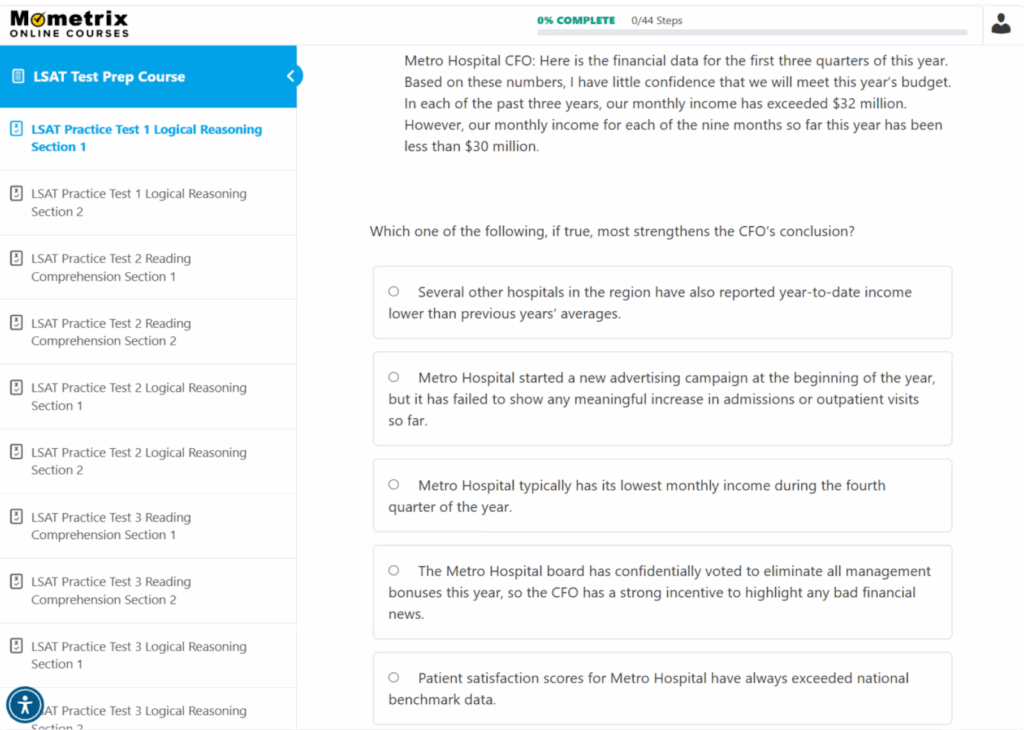
When testing out Mometrix, it felt more like a study guide than a full LSAT prep course. I liked the mix of lessons, flashcards, and practice tests, and the step-by-step explanations made it easier to learn from mistakes. The short lessons also keep things simple, which is helpful if you just want a refresher. That said, it falls short in depth—missing writing prompts, live classes, tutoring, and adaptive tools—so it works better as a supplement than a standalone course.
Course Highlights
- 600+ LSAT practice questions with in-depth explanations
- 30+ step-by-step LSAT study lessons
- 280 flashcards to reinforce key concepts
- 5 full-length LSAT practice tests
- Progress tracking with lesson completion and statistics
What are Students Saying about Mometrix?
“Good content review, but I was disappointed that the there weren’t any practice writing prompts. Just multiple choice questions.”
Trustpilot review
Pros
- Volume: You get 600+ practice questions plus five full-length LSAT tests, so there’s enough material to work through the basics.
- Structured Study Lessons: The 30+ lessons keep things simple and walk you through the core LSAT topics without overloading you.
Cons
- Single Course Option: Mometrix only offers one LSAT course, which limits flexibility for students with specific study needs.
- Limited Depth: Fewer practice questions and less comprehensive coverage than top providers.
- No Live Support: Lacks classes, tutoring, or real-time instructor help.
- Not Comprehensive: Works better as a supplement than a standalone prep course.
- Weak for Top Scores: Doesn’t provide enough challenge for students targeting 165+.
Bottom Line: Why Choose Mometrix?
Mometrix works best as a supplemental LSAT resource rather than a full course. I liked the flashcards, the straightforward lessons, and the clear answer explanations that make it easy to review mistakes. But the single-course option, smaller practice volume, and outdated references limit its effectiveness. Unlike Blueprint, it doesn’t include live classes, tutoring, or advanced tools, and even Magoosh provides more structure with a score guarantee. Mometrix is fine for extra practice, but not strong enough to stand alone.
Mometrix
Worth a Look
While these courses weren’t among the top-rated options, they may be worth exploring depending on your individual preferences.
- Varsity Tutors (LSAT Tutoring)
- Wyzant (LSAT Tutoring)
Head-to-Head: LSAT Course Comparison Breakdowns
Blueprint vs. Kaplan
I found Blueprint’s animated lessons far more intuitive, but Kaplan’s live classes were stronger for students who prefer scheduled environments. If you enjoy animation and progress tracking, Blueprint is the winner. For accountability via live instruction, go with Kaplan.
Bottom Line:
Pick Blueprint if you want a flexible structure, visuals, and adaptive tools.
Pick Kaplan if you need live instruction and a traditional classroom setup.
Blueprint vs. Magoosh
Blueprint offers deep analytics, live support, and a large question bank that adapts to your progress. I liked how I could see patterns in my timing and accuracy and get targeted practice based on it. Magoosh, on the other hand, is no fluff, just bite-sized videos and clean organization. It’s less advanced than Blueprint, but I appreciated how easy it was to get in, study, and move on.
Bottom Line:
Pick Blueprint if you want a significant score improvement and want analytics and instructor support.
Pick Magoosh if you’re self-motivated and want solid prep on a budget.
Kaplan vs. Magoosh
Magoosh stood out for its simplicity and affordability. The dashboard was easy to use, the short videos were clear, and the year-long access gave plenty of flexibility. Kaplan offers a traditional setup with live classes, adaptive practice, and a score guarantee for added confidence. Magoosh is straightforward and budget-friendly, while Kaplan provides structure and support for students who want more guidance.
Bottom Line:
Pick Magoosh if you want clean organization, flexibility, and prep that won’t break the bank.
Pick Kaplan if you want a more structured path with live classes and advanced tools.
Magoosh vs. AlphaScore
Magoosh felt smoother and more modern overall; the dashboard was simple, efficient, and I liked how it guided me on what to study next. AlphaScore had clear explanations and experienced instructors behind the material, but the platform design felt dated and less flexible. Both give you a solid question base, but Magoosh’s year-long access and score guarantee made it feel like the stronger value for independent learners.
Bottom Line:
Pick Magoosh if you want an affordable, flexible self-study program with strong value.
Pick AlphaScore if you prefer a straightforward course taught by experienced instructors but don’t mind a simpler platform.
Blueprint vs. LSATMax
Blueprint teaches efficiently; LSATMax offers a massive volume of practice material. Blueprint’s structured study plan helped keep my prep focused and disciplined, while LSATMax gave access to more raw questions and drills. The right pick depends on whether you prefer a guided structure; then, Blueprint is your best choice.
Bottom Line: Pick Blueprint if you need structure, interactive lessons, and helpful feedback.
Pick LSATMax if you want to drill thousands of questions.
Magoosh vs. LSAT Lab
Magoosh felt a lot more efficient; everything was clean, easy to follow, and I liked how the dashboard suggested what to do next. The LSAT Lab offered a helpful tutor chat, but the class schedule was limited, and the platform felt bare unless you upgraded to a premium plan. If you’re looking for simple, affordable, and flexible options, consider Magoosh. If you need more hands-on support and don’t mind waiting for live classes, LSAT Lab is decent.
Bottom Line:
Pick Magoosh if you want a simple, low-cost self-study tool that just works.
Pick LSAT Lab if you want a live tutor chat and don’t mind fewer class dates.
Blueprint vs. 7Sage
Blueprint felt more polished, with animated lessons, adaptive tools, and detailed analytics that made it easier to track progress. 7Sage was affordable and had clear video explanations, but it lacked live classes, advanced features, and a score guarantee.
Bottom Line:
Pick Blueprint if you want a modern platform with interactive lessons and adaptive study tools.
Pick 7Sage if cost is your main concern and you don’t mind giving up live support, advanced tools, and a score guarantee.
Also, check out the top LSAT tutoring services to add to your prep course.
| Best LSAT Prep Courses | ||
|
| Start Now |
|
| Start Now |
|
| Start Now |
My Final Verdict
Choosing the right LSAT prep course depends on your learning style, budget, and the level of accountability you require. Some students benefit from structured calendars and instructor access, while others prefer flexible, self-paced formats or platforms that adapt in real time. Understanding your learning style is crucial to selecting the right provider.
If you’re looking for engaging visuals and structured point-building, Blueprint LSAT is your best bet. For those who thrive in live classes and require accountability, Kaplan LSAT is a solid option. If you’re looking for solid preparation without spending a lot, Magoosh LSAT is a good option.
Check out your best match above to get started, and good luck on your LSAT journey!
FAQs
Do a few full ones to get used to timing.
Not always. Self-study works if you’re consistent.
Yes, with steady practice and review.
Anything above 160 is strong.
Retesting is fairly common. Many people do.