
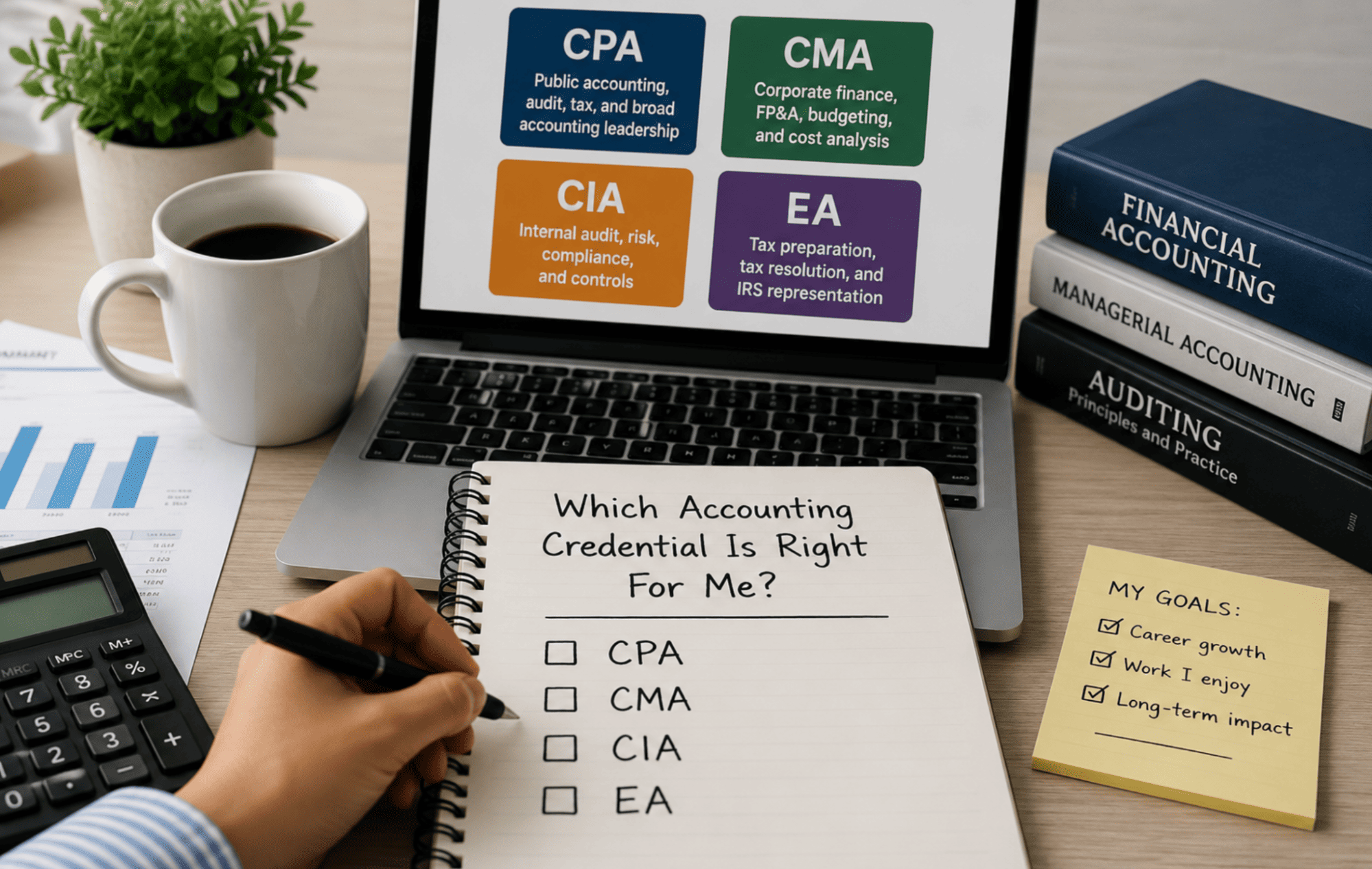
Accounting credentials can feel like alphabet soup.
CPA. CMA. CIA. EA.
They all sound useful, but they do not point to the same career.
That is where people mess up. They pick the credential that sounds the most impressive instead of the one that matches the work they actually want to do.
Today, I’ll walk through how to choose between the CPA, CMA, CIA, and EA based on your career goals, not just the letters after your name. If you are still deciding whether the degree itself is worth the cost, start with whether an accounting degree is still worth it.
Key Takeaways
- CPA fits the broadest accounting path.
- CMA fits corporate finance and FP&A.
- CIA fits audit, risk, and controls.
- EA fits tax-focused work.
- The right choice depends on the job you want next.
Start With The Job You Want, Not The Credential
The wrong way to choose an accounting credential is to ask, “Which one sounds best?”
Start with the work you actually want to do more often. CPA, CMA, CIA, and EA can all be useful, but they lead to different kinds of roles. The right choice depends on whether you want broad accounting options, corporate finance work, internal audit, or a tax-focused path.
For exam requirements and prep paths, see how to become a CPA, CMA requirements, CIA requirements, and how to become an enrolled agent.
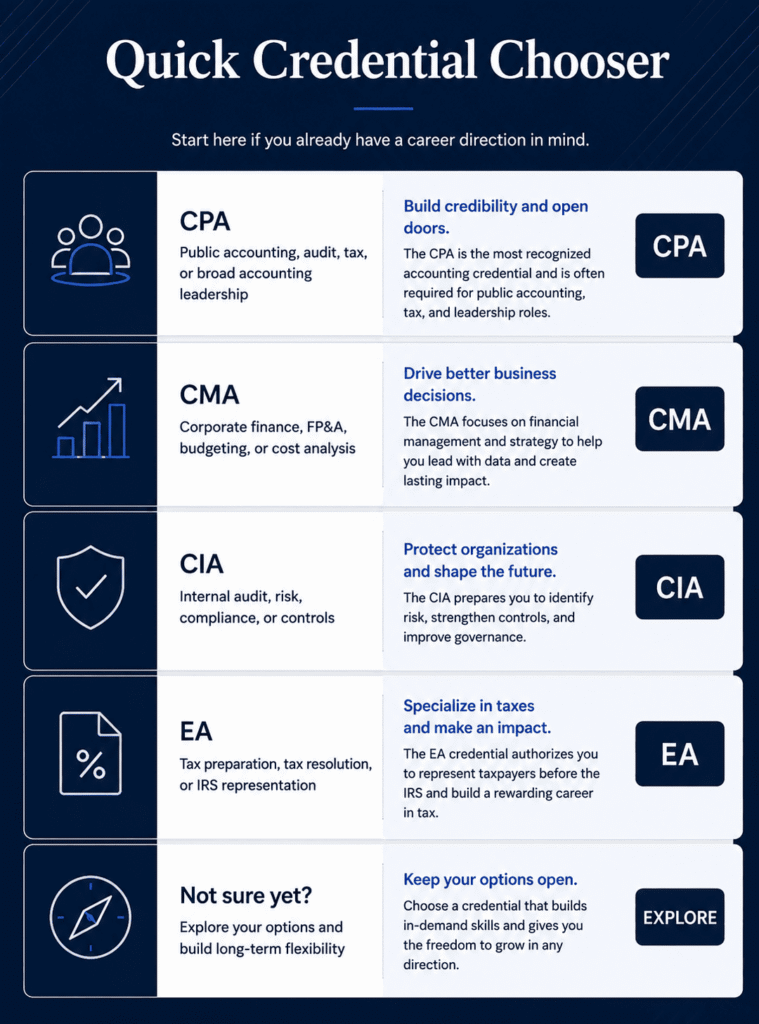
Quick Credential Chooser
Start here if you already have a career direction in mind:
- Public accounting, audit, tax, or broad accounting leadership: CPA
- Corporate finance, FP&A, budgeting, or cost analysis: CMA
- Internal audit, risk, compliance, or controls: CIA
- Tax preparation, tax resolution, or IRS representation: EA
- The widest long-term accounting flexibility: CPA
- A more focused credential with a clearer lane: CMA, CIA, or EA
This is not about which credential is “best.” It is about which one supports the career you are actually trying to build.
Choose CPA If You Want The Broadest Accounting Path
The CPA is usually the most flexible accounting credential because it applies across a lot of career paths.
It can help with public accounting, audit, tax, financial reporting, corporate accounting, controllership, and leadership roles. If you are not completely sure where you want to land yet, the CPA keeps more doors open.
That does not mean everyone needs it. The CPA can take a lot of time, and it may be more than you need if your goal is very specific. Compare paths in our CPA vs CMA and EA vs CPA guides if you are torn between credentials.
Choose CPA if you want:
- Broad accounting credibility
- Public accounting options
- Audit or tax flexibility
- Controller or leadership potential
- A credential that travels across industries
Choose CMA If You Want Corporate Finance or FP&A
The CMA is a better fit for people who want to work inside companies instead of focusing on public accounting.
This path makes more sense if you want a role focused on budgets, forecasts, performance, cost analysis, financial planning, and helping a business make better decisions — see what a CMA does for a closer look.
It is less about proving you can handle every accounting lane and more about showing you understand how numbers support business strategy.
Choose CMA if you want:
- Corporate finance
- FP&A
- Budgeting and forecasting
- Cost accounting
- Management reporting
Choose CIA If You Want Audit, Risk, or Controls
The CIA is the clearest fit for internal audit.
This credential makes sense if you are interested in how companies manage risk, follow rules, protect processes, and catch problems before they turn into bigger issues.
CIA work can be a good fit for people who like structure, systems, documentation, interviews, testing controls, and asking why something happened. For role context, see CIA salary and career paths and our overview of working in accounting.
Choose CIA if you want:
- Internal audit
- Risk management
- Controls testing
- Compliance work
- Process improvement
Choose EA If You Want A Tax-Focused Career
The EA is the most direct credential for someone who wants to focus on tax.
It can make sense for tax preparers, tax specialists, small business tax pros, and people who want to represent taxpayers before the IRS.
This path is more focused than the CPA. That can be a good thing if you already know tax is where you want to stay.
Choose EA if you want:
- Tax preparation
- Tax planning support
- IRS representation
- Small business tax work
- A focused tax credential
How To Avoid Choosing The Wrong Credential
A credential should support your next career move. It should not just look good on paper.
Before picking one, ask yourself:
- What job do I want next?
- What kind of work do I want less of?
- Do I want a broad path or a focused lane?
- Will this credential help in my industry?
- Am I choosing this because it fits me or because it sounds impressive?
The biggest mistake is choosing the hardest or most famous credential without thinking about fit.
CPA is powerful, but it may be more than you need for a tax-only path. CMA, CIA, and EA can be better choices when your career goal is more focused. The point is to choose the credential that supports the work you actually want to do.
My Final Thoughts
The CPA, CMA, CIA, and EA can all be worth it, but they are not interchangeable.
CPA gives the broadest accounting path. CMA leans toward corporate finance and FP&A. CIA fits internal audit, risk, and controls. EA is the clearest tax-focused option.
Pick the credential that matches the work you want more of, not the one that only looks best on a resume.
FAQs
Which accounting credential is best overall?
There is no single best credential for everyone. CPA is usually the broadest option, but CMA, CIA, and EA can be better fits depending on your career goal.
Should I choose CPA or CMA?
Choose CPA if you want broader accounting, audit, tax, or public accounting options. Choose CMA if you want corporate finance, FP&A, budgeting, forecasting, or management accounting work.
Should I choose CPA or EA for tax?
CPA may make more sense if you want broad accounting and tax flexibility. EA may be a better fit if your main focus is tax preparation, tax resolution, or IRS representation.
Is the CIA credential only for internal audit?
CIA is most closely tied to internal audit, but it can also support careers in risk, compliance, controls, and process improvement.
Can I earn more than one accounting credential?
Yes. Some professionals stack credentials over time, but it is usually better to start with the one that supports your next career move first.


![Surgent Discount Code: Save $600 [Verified 2026]](https://www.sacbee.com/careers-education/wp-content/uploads/sites/6/2024/07/Surgent-Discount-Codes-1024x569.png)


