
Lots of hiring opportunities. Steady pay. A degree that sounds useful before graduation day even hits.
Accounting is known as the safe major. But is it still worth the tuition?
That answer is not as simple as “accountants will always have jobs.” The payoff depends on school cost, debt, internships, CPA plans, and the type of work someone actually wants.
Public accounting, corporate roles, tax, bookkeeping, and average CPA salary data can lead in very different directions.
Here’s when an accounting degree still makes sense, when a lower-cost route may work better, and how students can get more value from the degree.
Key Takeaways
- The Cost Matters: A practical degree can still cost too much.
- The Degree Opens Doors: Some jobs are easier to reach with it.
- CPA Plans Change the Math: Licensure can make the degree more useful — see how CPA, CMA, CIA, and EA compare.
- Experience Helps: Internships can improve the payoff.
- Other Routes Exist: Not every accounting job needs the same path.
The Value of an Accounting Degree Depends on the Price
Accounting can still be a smart investment. But the same accounting degree can look very different depending on where someone gets it.
| School Type | Average Annual Tuition and Fees |
|---|---|
| Public two-year college | $4,150 |
| Public four-year college, in-state | $11,950 |
| Public four-year college, out-of-state | $31,880 |
| Private nonprofit college | $45,000 |
A student who starts at a community college or stays in-state may graduate with much less debt. Someone paying private-school prices could spend far more for a degree that leads to similar entry-level jobs.
Accounting can still pay off. The goal is to get the degree without overpaying for it.
Where the Degree Still Opens Doors
Accounting is one of the more direct business majors.
Students can graduate and apply for jobs that clearly connect to what they studied.
That can include:
- Public Accounting: Working with clients on tax, audit, or advisory work.
- Corporate Accounting: Managing records inside a business.
- Tax: Preparing returns and helping clients plan ahead.
- Audit: Checking whether financial records are accurate.
- Government Accounting: Working with public funds or reporting.
- Financial Reporting: Helping businesses organize their numbers.
Someone may start in public accounting, move into a corporate role, and switch lanes again later. That flexibility is part of the value.
When an Accounting Degree May Not Be Enough
The degree can help someone get through the door. It does not carry the whole resume.
Employers may still want experience, software skills, and someone who can explain numbers clearly.
Useful skills can include:
- Excel Skills: Organizing data and catching mistakes.
- Software Comfort: Learning how businesses track money.
- Clear Communication: Explaining issues in plain English.
- Attention to Detail: Spotting small problems early.
- AI Fluency: Reviewing output and knowing when something looks off.
Students do not need to know every tool before graduation. But they should be comfortable using Excel, working inside accounting software, and checking their own work.
The degree still matters. These extra skills can make the jump from classroom assignments to a real job much smoother.
Alternatives That Can Lead to Accounting Work
Not every accounting job requires a four-year degree. Some roles have a more direct path, especially for students who want to start working sooner or focus on one area.
That can include:
- Bookkeeping: Track transactions, organize records, and help businesses keep their accounts clean.
- Payroll: Handle employee pay, tax forms, and deadlines.
- Tax Preparation: Help clients file returns and build experience during tax season.
- Enrolled Agent: Earn a tax-focused credential and represent taxpayers before the IRS.
- Accounting Certificate: Build practical skills without committing to a full degree right away.
These options may not open the same doors as a bachelor’s degree. But they can make sense for someone who wants hands-on work, a lower-cost starting point, or a more focused path.
Reality Check: Someone aiming for public accounting or CPA licensure may still need the degree. Someone interested in bookkeeping, payroll, or tax work may have another route.
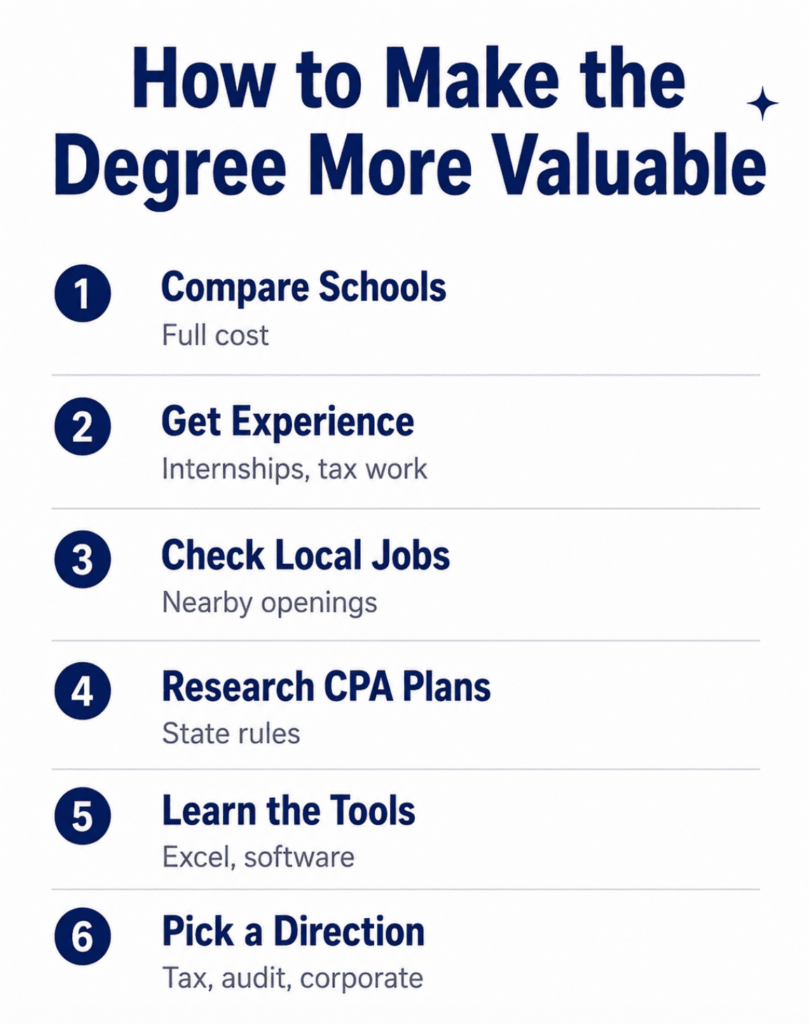
How to Make the Degree More Valuable
The degree does not need to become a giant financial gamble.
Students can make a few smart choices early. That can include:
- Compare Schools Carefully: Look at the full cost, not just the name.
- Get Experience Early: Apply for internships or tax-season work.
- Check Local Jobs: See which roles are hiring nearby.
- Research CPA Plans: Look at state rules before paying for extra classes.
- Learn the Tools: Build comfort with Excel and accounting software.
- Pick a Direction: Decide which type of work sounds most interesting.
For CPA eligibility and exam steps, see my guide to becoming a CPA. If you are still weighing the career itself, read what working in accounting is really like.
Who Should Choose Accounting & Who Should Not?
Accounting can be a smart major. But “safe” is not enough of a reason to spend four years on it.
Quick Quiz: Answer A or B in your head, or jot down your answers to find your result.
Q1. A spreadsheet has one number that looks off. What is your first thought?
A. I need to figure out why.
B. Someone else can deal with that.
Q2. How do you feel about checking work closely?
A. I do not mind going back to catch small mistakes.
B. I get bored or frustrated fast.
Q3. Why are you considering accounting?
A. I like the career options and have looked into the work.
B. People keep saying it is stable.
Q4. What does the money side look like?
A. I can choose a school without taking on overwhelming debt.
B. I would need to borrow heavily without a clear plan.
Your Quiz Results
Mostly A’s: Accounting could be a good fit.
A Mix of A’s and B’s: Research the day-to-day work in accounting before committing.
Mostly B’s: Another path may fit better.
How Much Can You Really Earn With an Accounting Degree?
The degree can lead to a wider range of jobs than some lower-cost paths. The salary gap helps show why that matters.
| Career Path | Median Annual Pay |
|---|---|
| Accountants and Auditors | $81,680 |
| Bookkeeping, Accounting, and Auditing Clerks | $49,210 |
Someone aiming for an accountant, auditor, or CPA-track role may get more value from the degree. Someone mainly interested in bookkeeping may not need the same path.
My Final Thoughts
Accounting is still one of the more practical majors. But “practical” does not mean students should stop asking questions.
The degree makes the most sense when the cost is realistic, and the career goal is clear. Someone planning for public accounting or CPA work may get a lot out of it. Someone interested in bookkeeping, payroll, or tax prep may have a shorter route.
The goal is not picking the safest-looking option. It is choosing the path that gets someone where they want to go without paying for steps they do not need. Once the degree decision is clear, use our credential chooser to pick the right exam path.
FAQs
Is an accounting degree worth it if I do not want to become a CPA?
It can be, but the payoff depends on the role. Corporate accounting, tax, audit support, government accounting, and financial reporting jobs may still value the degree. If the goal is bookkeeping or payroll, a shorter and cheaper path may be enough.
Can I work in accounting without a bachelor’s degree?
Yes. Bookkeeping, payroll, tax preparation, and accounting clerk roles may not require a four-year degree. A certificate, associate degree, tax credential, or hands-on experience may be enough for some entry-level roles.
Is community college a good way to start accounting?
Yes, especially if cost is a concern. Starting at a community college can lower tuition costs before transferring into a bachelor’s program. Students should check transfer rules early so they do not waste credits.
Do accounting internships matter?
Yes. Internships can make the degree more valuable because they give students real experience before graduation. They can also help students figure out whether they prefer tax, audit, corporate accounting, or another path.
Will AI make an accounting degree less useful?
AI may change some accounting tasks, especially basic data entry and routine review work. But accountants still need judgment, accuracy, ethics, communication, and the ability to catch problems technology misses.
What should I check before choosing an accounting program?
Look at total cost, transfer options, internship support, CPA eligibility, local job demand, online versus in-person format, and whether the program teaches practical tools like Excel and accounting software.


![Best CPA Study Materials in 2026 [+ Best Fit Quiz]](https://www.sacbee.com/careers-education/wp-content/uploads/sites/6/2024/07/Best-CPA-Review-Courses-1024x569.png)


