
Accounting has a reputation.
Stable. Practical. Safe. And honestly? That part is not fake.
Accountants and auditors held around 1.6 million jobs in 2024, according to the BLS, so the career has real staying power.
But stable does not always mean easy. The real job can still come with deadlines, client questions, review notes, software changes, and busy seasons that feel heavier than people expect.
Today, I’ll walk through what accounting actually feels like day to day and who this career is most likely to fit. If you are earlier in the decision, pair this with whether an accounting degree is still worth it and how to choose the right credential.
Key Takeaways
- Accounting is stable, not effortless.
- Deadlines shape a lot of the job.
- Communication matters more than people expect.
- Your experience depends heavily on the industry.
- Software is changing what new accountants do first.
Accounting Is More People-Focused Than Many Expect
Accounting is not only number work. It also includes emails, questions, meetings, follow-ups, and explanations of what the numbers mean.
A normal accounting day may include fixing entries, asking for missing documents, explaining a report change, or helping a client understand why records do not match. You do not need to be a salesperson, but you do need to communicate clearly and calmly.
For a fuller breakdown of duties and titles, see CPA vs accountant and what a CPA does.
Busy Season Can Shape the Whole Job
Busy season is one of the biggest accounting reality checks. Public accounting can get intense during tax or audit deadlines, while corporate accounting can get busy around month-end, quarter-end, year-end, budgets, and reporting.
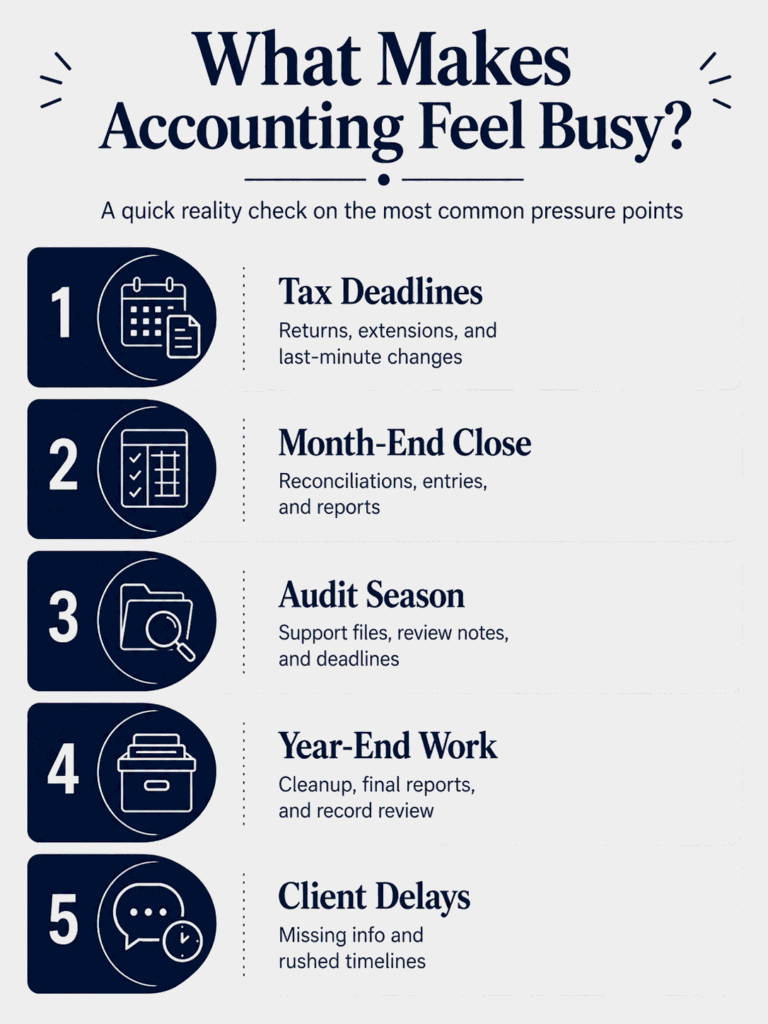
Common pressure points include:
- Tax Deadlines: Returns, extensions, client documents, and last-minute changes.
- Month-End Close: Reconciling accounts, posting entries, and finishing reports.
- Audit Season: Pulling support, answering review notes, and meeting deadlines.
- Year-End Work: Cleaning up records and preparing final reports.
- Client Delays: Waiting on people who still expect the work done fast.
The hard part is not always the accounting itself. Sometimes, it is the timing.
Myth vs. Truth: Accounting Career Edition
| Myth | Truth |
|---|---|
| Accounting is always calm. | Some roles are calm. Others are deadline-heavy. |
| Accountants only work with numbers. | They also explain, email, meet, and follow up. |
| Every accounting job feels the same. | Industry and company size change everything. |
| Stability means no stress. | Stability can still come with pressure. |
| Entry-level work is just data entry. | Review, software, and AI skills matter more now. |
| Public accounting is the only good path. | Corporate, government, nonprofit, and advisory roles can also be strong. |
The Work Changes A Lot By Industry
Accounting can feel completely different depending on where you work. Public accounting is usually faster and more client-heavy, while corporate accounting may feel steadier but still gets busy around reporting deadlines.
Government roles can offer more structure, and nonprofit accounting may involve budgets, grants, or funding rules. There are also niche paths like forensic accounting, internal audit, cost accounting, tax, advisory, and accounting systems.
| Path | What It Can Feel Like |
|---|---|
| Public Accounting | Fast-paced, client-heavy, strong learning curve |
| Corporate Accounting | More internal, routine cycles, close deadlines |
| Government Accounting | Structured, process-focused, often steadier |
| Nonprofit Accounting | Mission-based, grant- and budget-focused |
| Tax Accounting | Seasonal pressure, detail-heavy, client questions |
| Audit | Team-based, documentation-heavy, deadline-driven |
| Advisory | More problem-solving, analysis, and client guidance |
| Forensic Accounting | Investigative, detailed, less traditional |
This is why “Do you like accounting?” is not always the best question.
A better question is, “What kind of accounting environment fits you?”
Entry-Level Accounting Is Changing Fast
Entry-level accounting used to involve more manual setup, like entering transactions, preparing workpapers, and checking documents.
That work still exists, but software and AI are changing where new accountants start. Instead of building every task from scratch, they may spend more time reviewing software output, catching mistakes, cleaning up exceptions, and explaining what the numbers mean.
Old starter work: Enter it → organize it → send it up
New starter work: Review it → question it → fix it → explain it
That shift does not make accounting less valuable. It makes basic accounting knowledge more important because someone still has to know when the software misses something.
The Best Accounting Jobs Are Not Always Obvious
A lot of people hear “accounting” and picture public accounting first. That path can be strong, especially for building experience and working toward the CPA, but it is not the only good option.
Some accounting roles are better because of the work style, not just the title:
- Staff Accounting: Steadier company work and routine reporting.
- Government Accounting: More structure, process, and steadier hours.
- Cost Accounting: Better for students who like operations and business details.
- Internal Audit: Strong fit for systems, risk, and problem-solving.
- Tax or Advisory: Better for students who can handle client questions and deadlines.
That is why one bad internship, firm, or busy season does not mean accounting is wrong for you. Sometimes the issue is not the career. It is the environment.
Who Is Most Likely To Enjoy This Career?
Accounting can be a good fit for people who like structure, problem-solving, clean records, and practical career options. But you do not need to be obsessed with math. That is another myth.
You need to be comfortable with numbers, but the job is more about logic, accuracy, patterns, rules, and judgment than doing wild math all day.
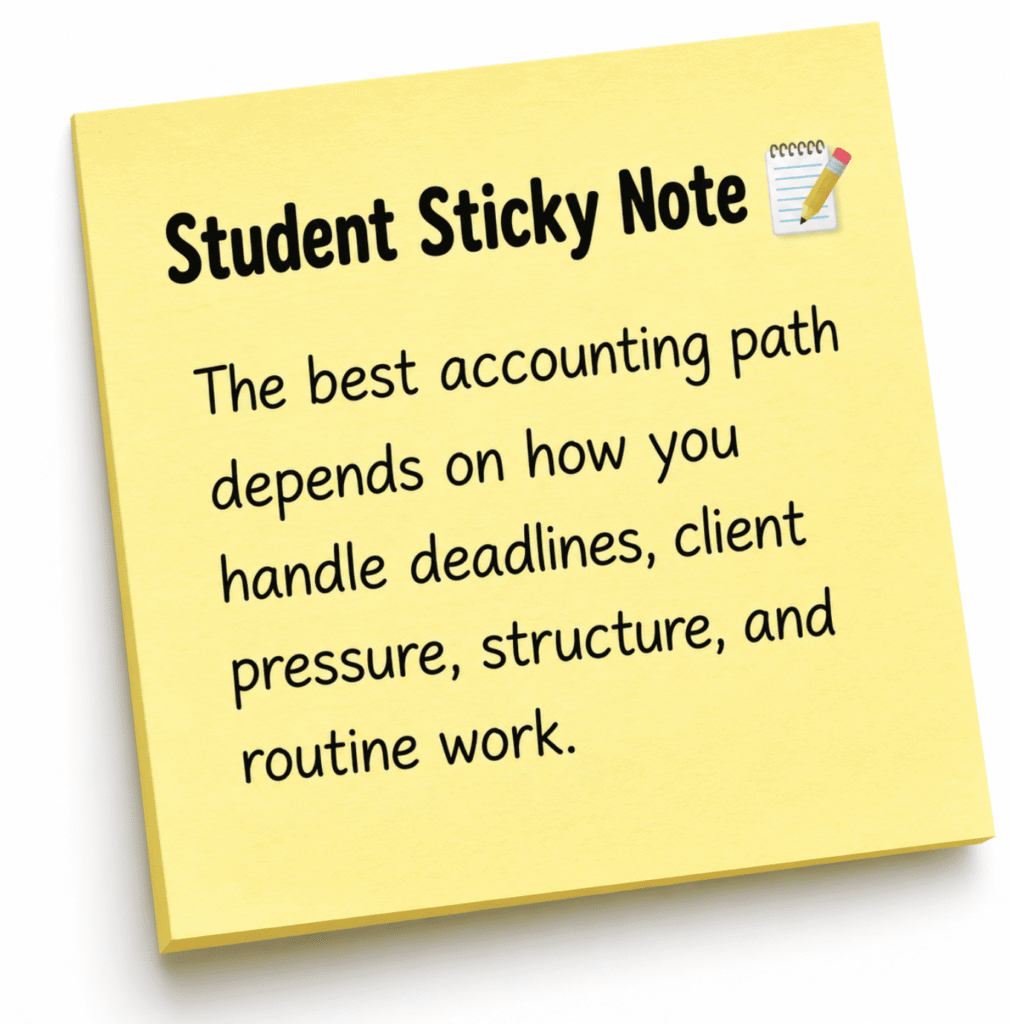
You may enjoy accounting if you like:
- Clear Rules: You like when work has standards and structure.
- Problem Solving: You want to figure out why something does not match.
- Practical Careers: You care about stability, pay, and job options.
- Details: You can slow down and catch small errors.
- Explaining Things: You can turn confusing numbers into plain English.
- Learning Software: You are willing to keep up with changing tools.
You may not enjoy it as much if you hate deadlines, avoid detail work, dislike communication, or want every day to feel creative and different. Accounting can be stable, but it is still a real job with pressure, repetition, and timing issues.
That is the tradeoff.
My Final Thoughts on Accounting
Accounting can still be a stable and practical career, but it is not the easy “sit with numbers all day” job people picture. Salary context can help too — see average CPA salary data without treating pay as the whole story.
It can be a strong path if you are okay with deadlines, details, software changes, and regular communication. The main thing is knowing that the career can feel very different depending on the role, industry, team, and work environment.
If you already meet the CPA requirements, check out these recommended CPA prep courses to help you study efficiently and pass the exam.
FAQs
Is accounting actually a stable career?
Yes. Accounting is still considered a stable career because businesses, governments, nonprofits, and individuals need financial records, tax support, reporting, audits, and compliance work.
Do accountants talk to people a lot?
Yes, many accountants talk to clients, managers, coworkers, auditors, or other departments. Some roles are more independent, but accounting still involves explaining numbers, asking questions, and helping people understand financial information.
Is accounting boring day to day?
It depends on the role. Some accounting jobs are repetitive and routine. Others involve research, client problems, audits, investigations, reporting, software changes, or business decisions. The industry and company matter a lot.
Is public accounting the best accounting career path?
Public accounting can be a strong path, especially for building experience quickly. But it is not the only good option. Corporate accounting, government accounting, nonprofit accounting, internal audit, tax, advisory, and forensic accounting can also be strong fits.
Is accounting still worth it with AI and automation?
Yes, but the work is changing. AI and automation can handle more routine tasks, but accountants are still needed to review results, apply judgment, explain issues, and take responsibility for final work.


![Surgent Discount Code: Save $600 [Verified 2026]](https://www.sacbee.com/careers-education/wp-content/uploads/sites/6/2024/07/Surgent-Discount-Codes-1024x569.png)


