Over half of CPA candidates fall short of a 75 — and the reason often isn’t what they expect.
The CPA exam is not just hard because the material is hard. A lot of capable candidates struggle for reasons that are easier to miss before test day, especially when the study plan looks good on paper but does not hold up in real life.
So if you’re one of the many people asking, “Why is this exam so hard, and what are people getting wrong?” I’ll break down why so many people fail the CPA exam, what those numbers really reveal, and what candidates tend to get wrong before test day.
Key Takeaways
- Pass Rates Do Not Tell the Whole Story: The bigger issue is why people fail.
- Passive Studying Can Backfire: Reading alone does not prove exam readiness.
- Time Management Matters: Weak pacing can hurt even prepared candidates.
- Work Makes Prep Harder: Real schedules can break unrealistic study plans.
- Retakers Usually Need A New Strategy: More hours only help if the plan changes.
The CPA Exam Is Not Hard For The Reason Many Expect
The CPA exam is not hard just because the material is hard. The bigger issue is that the exam tests whether candidates can use the material under pressure.
A topic can feel easy in a lecture, then feel totally different in a timed question or simulation.
- Recognition ≠ Readiness
- Each Section Tests Differently
- Small Gaps Show Up Fast
- Simulations Add Pressure
- Stamina Matters
That is why “I understand this” is not always enough. The real test is whether the concept holds up when the clock is running.
Pro Tip: Judge readiness by practice performance, not by whether a topic feels familiar.
Memorization Is Not Enough To Pass
Memorization helps with formulas, rules, and definitions, but it cannot carry the whole CPA exam. The test asks candidates to apply concepts, sort through details, and make decisions under time pressure.
That is where passive review starts to fall short. A study session can feel productive because the material looks familiar, but that does not always mean it will hold up on exam day.
| Passive Study | Active Study |
|---|---|
| Reading notes | Working questions |
| Highlighting | Reviewing misses |
| Watching lectures | Practicing sims |
| Feeling familiar | Proving it under time |
This is where some test takers get blindsided. They studied the material, but they did not practice using it enough to catch the gaps before test day.
Work Schedules Make Passing Harder
Most CPA candidates are not studying in perfect conditions. They are studying after work, during busy seasons, between deadlines, or when their brains are already fried.
That does not make passing impossible, but it is one of the biggest reasons solid study plans fall apart.
That does not make passing impossible. It just means the study plan has to be realistic.
- Busy Weeks Interrupt Momentum
- Short Blocks Still Count
- Perfect Plans Break Fast
- Review Needs Breathing Room
- Bad Weeks Need Backup Time
Pro Tip: Build the study schedule around a realistic week, not the fake perfect one.
Burnout Makes Study Time Worse, Not Shorter
Burnout is one of the quieter reasons people struggle with the CPA exam. Someone may still be showing up every week, but the quality of that study starts dropping fast.
That can look like rereading the same page, guessing through questions, avoiding harder topics, or pushing through lessons without actually absorbing much.
- Studying Feels Fake Productive
- Hard Topics Get Avoided
- Review Starts Feeling Random
- Motivation Drops After One Bad Score
- Breaks Feel Guilty, But Help Long-term
Fast Fact: Research shows that burnout can affect working memory and focus.
Burnout does not always look like quitting. Sometimes it looks like studying for two hours and remembering almost none of it.
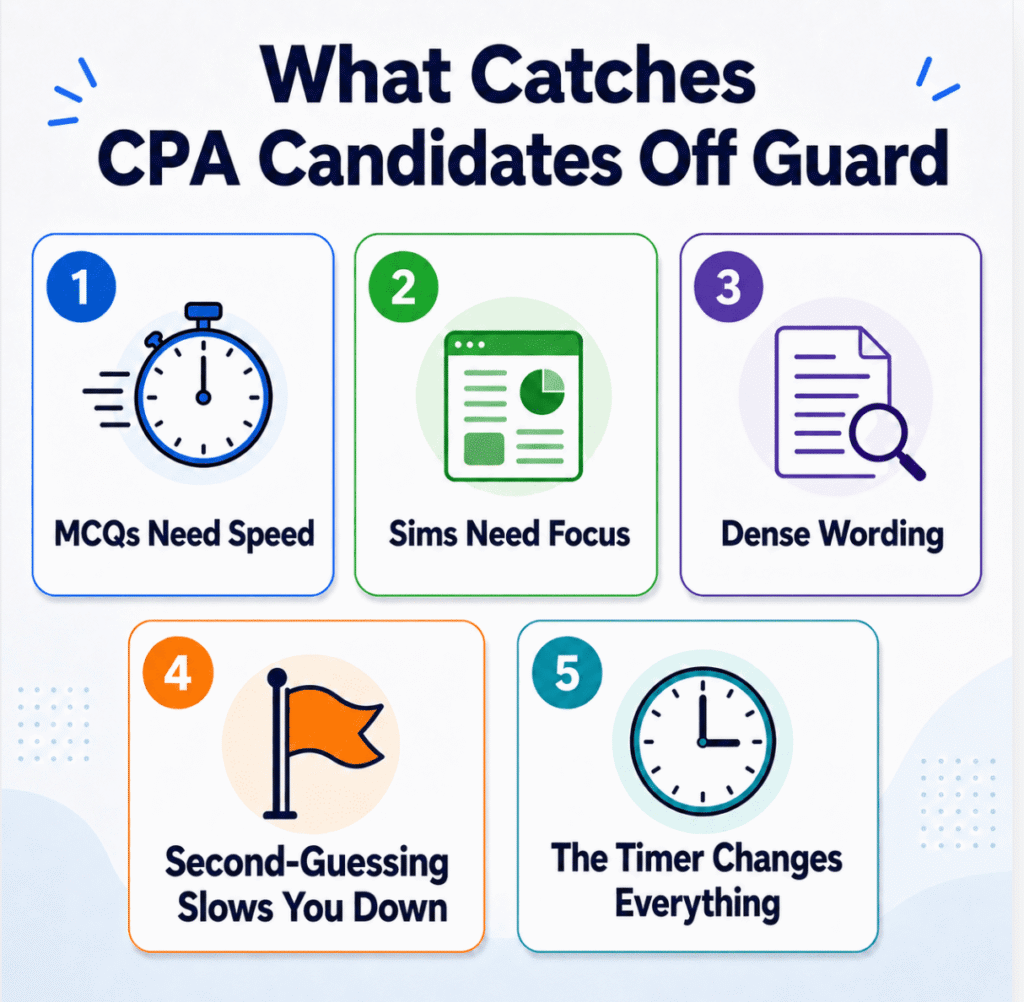
The CPA Exam Format Catches People Off Guard
Some candidates know more than their score shows. The problem is that the CPA exam format adds pressure on top of the content.
The timer, dense wording, simulations, and test flow can make familiar material feel harder faster.
- MCQs Need Speed
- Sims Need Focus
- Wording Can Be Dense
- Second-Guessing Adds Up
- The Timer Changes Everything
That is why content review alone is risky. Candidates also need to practice the actual rhythm of the exam.
Many Underestimate The Time Commitment
CPA prep takes longer than people expect because one pass through the material usually is not enough. Candidates need time to learn the content, practice it, review mistakes, and come back to the same topics until they actually stick.
That is where a lot of study plans get too tight. People often plan for the lessons, but not the full prep cycle:
Lesson → Practice → Missed Questions → Review → Timed Sets → Final Review
- Plans Start Too Optimistic: Most schedules assume smooth weeks.
- Review Takes Longer Than Expected: Fixing mistakes can take more time than learning the topic.
- Hard Topics Need Repetition: Some areas need more than one pass.
- Weak Areas Need Space: Trouble spots need time before test day.
- The Final Stretch Gets Rushed: Review often gets squeezed in too late.
The issue is not always a lack of effort. Sometimes people studied, but did not leave enough time for the work that actually improves scores.
What Successful Retakers Often Change
Successful retakers usually do not just study more. They study differently because they have a clearer picture of what went wrong the first time.
For some, it is pacing. For others, it is simulations, weak-topic review, or spending too much time reading and not enough time practicing. The second attempt gets stronger when the study plan changes with the problem.
- Review Misses More Closely
- Practice More Simulations
- Use Timed Sets Earlier
- Track Weak Areas
- Make Final Review Intentional
The takeaway is not that the CPA exam is impossible. It is that the exam exposes a weak strategy fast, and the next attempt needs to fix the real problem, not just add more study hours. A strong prep course can shortcut that step — see how the top options compare in our best CPA review courses breakdown.
For the latest section-by-section numbers, see our CPA exam pass rates guide.
Final Thoughts: Why The CPA Exam Is So Hard To Pass
The CPA exam is hard, but not in a mysterious way. It gets people when they underestimate the time, rely too much on reading, skip enough practice, or build a study plan that falls apart the second life gets busy.
That does not mean passing is out of reach. It just means the strategy has to match the exam. The candidates with the best shot are usually the ones who practice early, review honestly, and stop waiting until the final stretch to fix what is not working.
FAQs
What Score Do You Need To Pass The CPA Exam?
75 on a 100-point scale. That is not 75% correct — the CPA uses scaled scoring, so your score reflects question difficulty and how you perform relative to other candidates. Each section is scored independently, and you need a 75 on every section.
Which CPA Exam Section Has The Lowest Pass Rate?
FAR (Financial Accounting and Reporting) typically has the lowest pass rate among the four CPA sections. Pass rates shift each testing window — check the AICPA’s quarterly releases for the most current section-by-section numbers.
Can You Fail The CPA Exam And Retake It?
Yes. You can retake any failed section after your score is released — there is no limit on attempts. Most candidates wait a few weeks to refocus their study plan before re-sitting. Fees apply to each retake, so plan to invest in targeted prep before paying again.
Does Failing One CPA Exam Section Hurt Your Other Scores?
No. Passed sections stay passed. The real risk is the credit window — you must pass all required sections within the AICPA’s 30-month window, or earlier passes expire, and you have to retake them. Plan retakes carefully to protect your timeline.
What Should You Do After Failing A CPA Exam Section?
Diagnose what went wrong — pacing, simulations, weak topics, or passive review — using your score report’s section breakdown. Then change the study plan to attack that specific weakness. More hours alone rarely fix a failed attempt; a targeted strategy does.