
A historic hotel’s rebirth as a dining destination could signal Sacramento is on the rise
The morning after Harry Styles’ Nov. 10 concert at Golden 1 Center, nearly every occupied breakfast table at The 7th Street Standard had a teenage girl in a T-shirt bearing the pop star’s name.
That the Golden 1 Center now hosts concerts — and Kings games — represents part of downtown’s slow climb out of the pandemic shutdown. The spillover of that audience, the once-promised synergy between events and restaurants finally resuming, shows the next stage.
So does where those Styles fans chose to eat. The pandemic curbed downtown’s progress from forgotten spaces to urban destination, but this glittering new project could signal Sacramento’s transformation has restarted in earnest.
The 7th Street Standard opened Nov. 4 inside the Hyatt Centric, the 172-room hotel replacing the Hotel Marshall at Seventh and L streets next door to Golden 1 Center. The restaurant boasts an all-star roster of chefs, a gorgeous interior and creative takes on familiar dishes that showcase the diversity and local sourcing for which Sacramento is known.
It’s the best new restaurant to open downtown in some time. To Downtown Sacramento Partnership executive director Michael Ault, though, The 7th Street Standard and the Hyatt Centric are part of a larger trend.
A block and a half away at 609 Capitol Mall, The Frederic, an eight-story apartment building with 7,000 square feet of retail space, is under construction. A 14-story luxury Hilton hotel with 55 apartments and another rooftop lounge has been proposed at Ninth and L streets.
Both spots will likely revitalize blocks of downtown space that have been underused in recent years.
Sacramento has seen this kind of evolution before, as the pre-coronavirus renaissance was marked by the transformation of dilapidated buildings into attractive new spaces housing cutting-edge restaurants.
The Hardin transformed Seventh and K streets as restaurants and bars gradually opened beneath 137 apartments throughout the last couple of years.
“You’re creating little urban neighborhoods, and that’s what we want to see. It brings activity, brings eyes and ears and, more importantly, brings life (to downtown),” Ault said. “The hope that development with DoCo and Golden 1 Center would spur additional investment is coming true, and it’s exciting.”
It might be exciting, but downtown restaurants still face stiff headwinds.
High rent, a service industry staffing shortage, little parking, a rising homeless population and the sudden dearth of a downtown workforce continues to force restaurants to close. La Bonne Soupe — once heralded by Zagat as the best restaurant in Sacramento — shut its doors earlier this month. Downtown employers had plans to require in-person work in early 2022, but that was before the omicron variant of COVID-19 emerged.
Still, hundreds of new central city residential units will hit the market next year. Those aforementioned hotels will provide lodging for more and more visitors as the new SAFE Credit Union Convention Center hosts multinational conferences such as the Unified Wine & Grape Symposium, scheduled for Jan. 25-27. A long-delayed development boom, the kind that propelled Portland and Austin into destination cities, seems to be coming to Sacramento’s urban core.
The 7th Street Standard isn’t just a hot new restaurant. It’s a beacon for a brighter future and a reminder of the past, evidence Sacramento can turn boomtown into blight and back again.
Fine dining, Sacramento-style
Ravin Patel leads The 7th Street Standard. Many Sacramento diners got to know Patel’s work when he was the chief culinary officer for Selland Family Restaurants (owners of The Kitchen, Ella Dining Room & Bar, OBO’ Italian Table & Bar and three Selland’s Market-Cafes). Patel left the Sellands to join a cousin at Presidio Companies hotel group in 2018, for whom he’s managed Seasons in Davis until now.
He’s joined by executive sous chef Pedro DePina, Selland Family Restaurants’ former corporate chef who once led Esquire Grill and Ettore Bakery & Cafe’s kitchens.
Patel’s biggest recruiting coup might have been getting Puur Chocolat owner Ramon Perez to come out of restaurant retirement as The 7th Street Standard’s executive pastry chef.
Born to chef/restaurateur parents, Perez began working at Napa’s Auberge de Soleil at 12. He staged at a trio of restaurants that had three Michelin stars and was a finalist at the 2002 National Dessert Competition. He became the executive pastry chef for the Los Angeles-based David Myers Group, overseeing all things bread for pizzerias, patisseries and Michelin-starred modern French restaurants from Arizona to Singapore.
It was a great gig until Perez burned out. He and his wife, Nicole, returned to the Sacramento region (his parents once owned Citronée in Nevada City) and started Puur Chocolat in a Del Paso Heights business park in 2012.
Puur earned a sparkling reputation among high-end dessert lovers, winning a 2019 Good Food Award for its eucalyptus lemon bonbons, and Perez was named one of the Top 10 North American chocolatiers by Dessert Professional Magazine in 2016.
The Perezes still own Puur, but Ramon will also craft desserts for The 7th Street Standard, such as a silky Japanese custard with eggplant marmalade and crunchy sesame seeds ($13), or an airy cream puff with housemade hazelnut-praline ice cream, salted caramel chantilly and a crémeux made from 66% dark single-origin Mexican chocolate ($13).
“I missed restaurants ... (but) I wasn’t going to just jump into any restaurant. You have to get along with the people you work with, too, and that was very important for me to find the right location, find the right people,” Perez said. “I thought it was a unique opportunity, a unique position and sort of a fun playground where we can just play and have fun and create something unique and different.”
The chefs’ travels and roots will show up on The 7th Street Standard’s seasonal menu — DePina’s family is from West Africa, for example, so a moules-frites appetizer ($21) includes yuca fries instead of those made with potatoes and comes with a side of mojo aioli. A native Sacramentan whose parents immigrated from the vegetarian-friendly Indian state Gujarat, Patel riffed on sambar to make curried pigeon pea soup ($13) with carrot tartar, fried black mustard seeds and grilled naan.
Cross-cultural entrees include the braised lamb shank from Superior Farms in Dixon ($38), served with biryani, gin-soaked raisins, carrots, cashews and za’atar-spiced gremolata. Ora King salmon ($45) leans into the fall harvest with a squash puree, pepita-mushroom crust and side of delicata squash.
Perez will also play a major role in the Hyatt Centric’s grab-and-go cafe called The Interlude. Look for kouign-amann, croissants, hand pies and boozy milkshakes when it opens on the lobby’s other side in the second quarter of 2022.
“I think guests want to have an elevated dining experience but still (have it) be very approachable,” Patel said. “So our decor is very nice in here ... but once you sit down, you’re getting a French toast, you’re getting avocado toast, you’re getting a classic breakfast plate. It’s not unapproachable, it’s just simple food done right in a great atmosphere.”
A new Standard
Opened in 1911 as The Clayton and then rebranded as the Hotel Marshall in the late 1930s, the hotel at the corner of Seventh and L streets was once a jazz hot spot that hosted the likes of Billie Holliday and Louis Armstrong, when downtown was known as the West End. That legacy is preserved at the Hyatt Centric’s sixth-floor rooftop bar, the Clayton Club, which opened Dec. 10.
Vinyl records featuring Billie Holiday and Gerry Mulligan hang on the walls around Clayton Club customers sipping $15 cocktails such as The Honey Badger (bourbon, yellow chartreuse, rosemary, ginger, lemon and honey) or MXOF (anejo tequila, spiced agave and chocolate mole). The Clayton Club might also feature live jazz, depending on acoustics and whether neighboring guests might be bothered. It’s now open just on Friday and Saturday nights, with plans to gradually expand its hours.
Those jazz glory days are long gone. As the Capitol Mall development project displaced downtown residents and Sacramentans fled to the suburbs, the Hotel Marshall fell into decay. It became a vermin-infested haven for registered sex offenders, the destitute and the mentally ill until the end of 2014, when it closed ahead of a 2019 gutting that spared just the historically-protected brick facade.
A Greyhound bus station that opened in 1949 on an adjacent corner of Seventh and L didn’t help matters, and the site stayed undeveloped for six years after the bus line moved to Richards Boulevard in 2011, ultimately becoming a parking garage. The city of Sacramento was so eager for the Hyatt Centric to come in that it loaned developers $4 million in 2017 after they came up short.
The Hyatt Centric, opened in mid-October, now gleams for 11 stories directly east of Golden 1 Center. Guests are greeted by a guitar-shaped desk and a backdrop of Marshall amplifiers at check-in. The 7th Street Standard is all soft greens, gingham chairs and brass fixtures, a sort of Beast + Bounty/Camden Spit & Larder hybrid around a horseshoe-shaped bar.
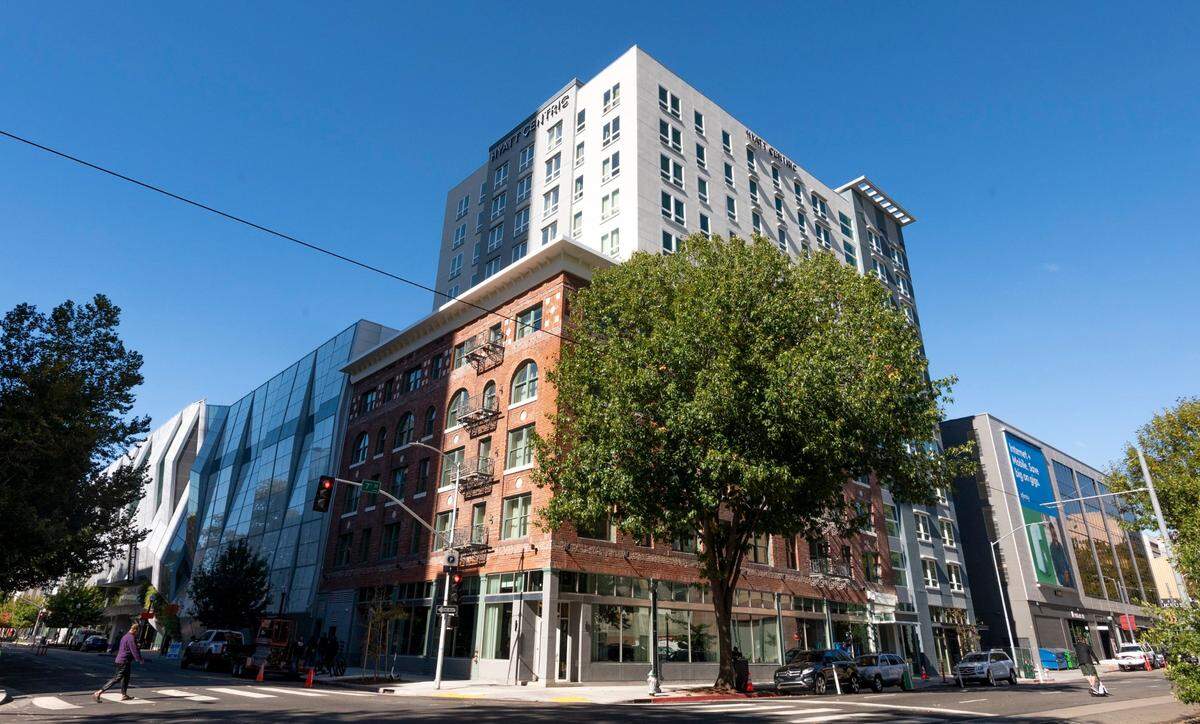
The pandemic hurt downtown Sacramento businesses in large part because there weren’t enough residents around to make up for state employees suddenly working remotely. Now, more apartment buildings are slowly going up.
Downtown hotel occupancy rates have stayed above 65% since March, according to data from hospitality research firm STR. As Kings games, shows and conventions resume, some attendees are staying above one of Sacramento’s best new restaurants.
“These guys were clearly looking at making a statement with (The 7th Street Standard),” said Ault, who recently stopped in for a drink. “The amenities, the feel of it, this is the exact type of investment we had hoped to come in and complement some of these other projects.”
This story was originally published December 17, 2021 at 5:00 AM.