
For reasons ‘lost to history’ this Sacramento County bridge can’t swing. Did it ever?
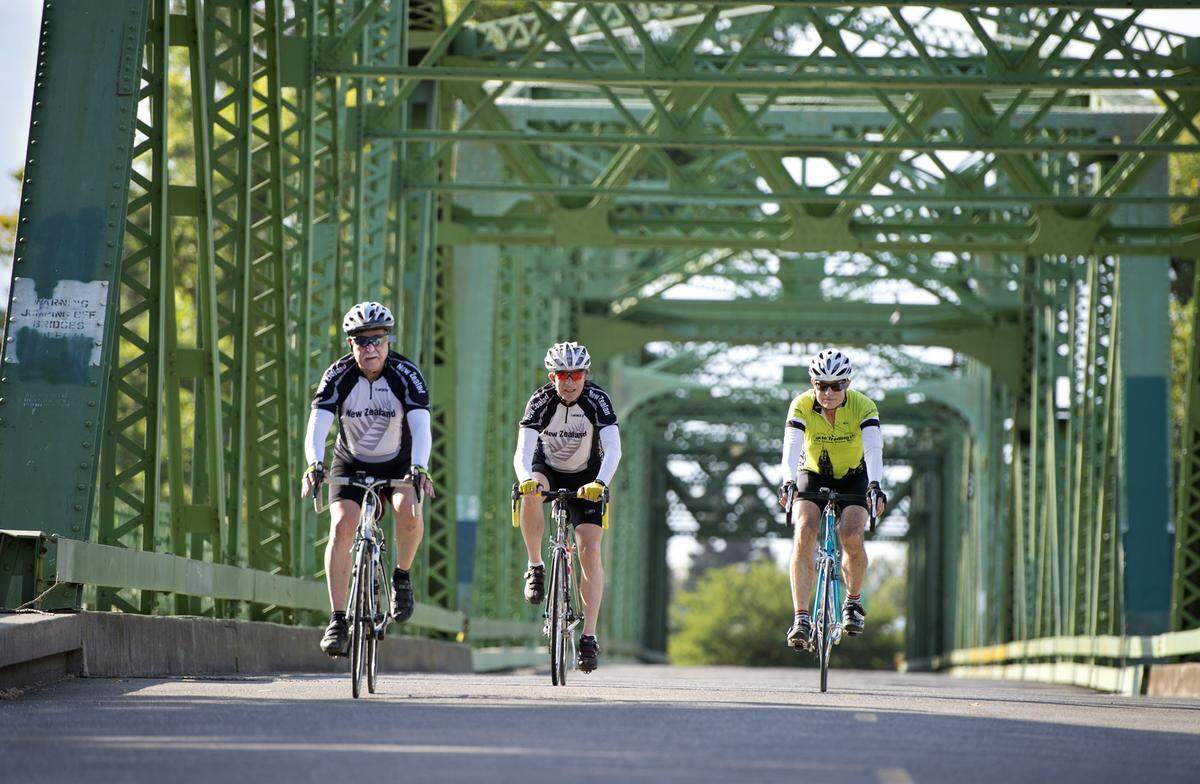
With two rivers hugging the Sacramento region, bridges are the city’s veins — including the Jibboom Street Bridge that suspends over the American River north of downtown.
About three times a week, Harry Starkey, a Sacramento resident, rides from West Sacramento to the bike path at Discovery Park, crossing the Jibboom Street Bridge.
One day, Starkey, who is also a mechanical engineer, studied the green metal truss bridge after finishing his bike route. He said he noticed the center portion of the bridge had a seam that would allow it to rotate. But there were trees from the park that would be in the bridge’s way, if it did move.
As a part of the launch of Bee Curious’ new mini-series, “What is that thing?” Starkey asked: “Is the bridge into Discovery Park a rotating bridge like the I Street Bridge? Is it ever rotated and if so, why?”
Here’s what we found.
Is the Jibboom Bridge a rotating bridge?
It used to be.
The Jibboom Bridge was a swing bridge, but it does not operate anymore. A swing bridge is a bridge that rotates horizontally, parallel to the water, so that boats and ships can pass.
Built in 1931, the 959-foot bridge was partially renovated in 1969. But its rehabilitation did not include restoring the bridge’s ability to swing for boats, said Matt Robinson, Sacramento County’s public information officer.
“Why? No idea,” Robinson said in an email reply to The Bee. “We know it was done, but the reason (and documentation) seems to be lost to history.”
“It may be the cost prohibited full restoration. 50-plus years down the road nobody has brought forth the need (or funding) to let it swing again.”
Even if ships needed to pass the Jibboom Street Bridge — and it did swing for them — they would find another obstacle: the Interstate 5 American River Bridge just east, where shallow waters and narrow clearance would certainly stop a large boat from continuing on.
What is the I Street Bridge?
The I Street Bridge is a truss swing bridge over the Sacramento River, connecting the city’s core to West Sacramento.
Spanning 900 feet long, the bridge was built in 1911 and offers highway access on its top deck and railway access on the bottom. More than a century old, the I Street Bridge is undergoing major renovations.
“[T]he lanes are too narrow to serve buses, there are no bicycle lanes, and the sidewalks are too narrow to meet current accessibility standards,” according to the city of Sacramento’s website.
As a part of the replacement project, there will be construction of a new bridge upstream the Sacramento River, connecting Railyards Boulevard and C Street. The new bridge will serve cars, bikes, buses and pedestrians, while the former bridge will continue to be a railroad crossing, according to the city. The top deck of the old bridge is being studied and planned for pedestrian and bike use.
Construction is slated for 2023 to 2026.
What other bridges move in Sacramento?
There are four moveable bridges over the Sacramento River and Georgiana Slough that are operated by the Sacramento County Department of Transportation, Robinson said.
This includes the Freeport Bridge, Walnut Grove Bridge — which are Bascule draw bridges — Georgiana Slough Bridge and Tyler Island Bridge near Isleton — which are swing bridges.
The city’s golden Tower Bridge is also vertical lift bridge, the first to be built on the California highway system, and was constructed to be raised for passing large ships.
Ever wondered about an obscure building, plaque or other quirky sights in Sacramento? Ask us about it in the form below and we’ll find the answer. Or email beecurious@sacbee.com.
This story was originally published September 3, 2022 at 5:00 AM.