
$250K later, investigation into California cop text messages drags on behind closed doors
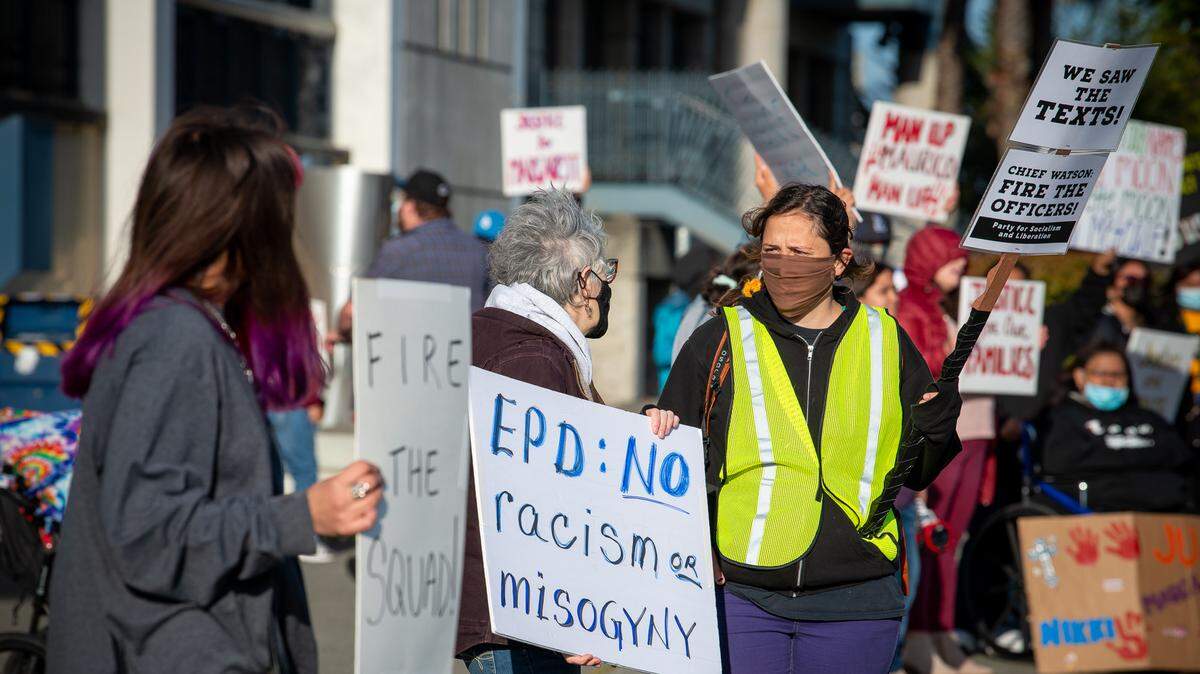
Northern California leaders didn’t mince words when they learned that Eureka police officers had sent vile and degrading jokes in text messages about decapitating homeless people, shooting a man in the face and sexually abusing women.
“Transparency and accountability are required in the positions we fill,” wrote Steve Watson, the then-chief of police in Eureka.
“Our community wants answers quickly. I expect that, and you deserve that,” Mayor Susan Seaman told the community.
Assemblyman Jim Wood, D-Santa Rosa said he’d closely follow the newly announced outside review and “ensure that this investigation begins immediately and is transparent.”
But nearly 11 months and some $250,000 since The Sacramento Bee’s damning report that sparked those pledges for transparency, city officials have not released any of the 200-page report they commissioned. It’s been months since leaders have updated the public about the costly and sprawling investigation. Miles Slattery, Eureka’s city manager, said five officers are facing discipline but declined to elaborate, citing due process rights and a “potential appeal process.”
Though it’s unclear how much longer the public will have to wait, Slattery said the city still planned to release some version of the wide-ranging report or its findings. “We will provide what we are able to based on current legislation and policy,” he said.
Experts say the dragged-out case in Eureka is the latest example of California’s special legal protections for law enforcement officers running up against the public’s right to know about those who abuse their power while wearing a badge. While changes to California law in recent years have opened up troves of police records, California law still exempts many types of misconduct files from public view.
“When you have a price tag that high, the public has a reasonable expectation that they’re going to see the product, they’re going to see what they paid for,” said David Snyder, executive director of the First Amendment Coalition, a nonprofit that advocates for open and transparent government.
It’s unclear when a thorough accounting of the misconduct will be released — if it ever is.
“I’m not sure that California law is going to allow that, at least not in full,” Snyder said. “And that’s too bad.”
Slattery agreed and has said it would have been better if the investigation could have been resolved long ago and made publicly available.
“Laws about what can be made available to the public are changing all the time,” he said. “It’s just a matter of staying on top of those changes.”
Chief resigns as investigation costs climb
The city in March ordered an outside investigation into vile banter in private text messages sent among a supervisor and his squad. Sgt. Rodrigo Reyna-Sanchez and other officers, primarily Mark Meftah, likened homeless people to troglodytes and joked about putting mentally ill women in demeaning sexual situations.
One message from Reyna-Sanchez to his squad encouraged them to “face shoot” a suspect. (Reyna-Sanchez shot a man in the head at close range in 2010. That shooting was deemed justified.)
The messages, first reported by The Bee, were widely seen as more than just shop-talk among cops. Experts in policing said comments like that — especially involving a supervisor — was indicative of broader problems with the department’s culture.
Experts said it could affect how officers interact with the public and derail efforts in departments, like Eureka, that have long struggled to earn the community’s trust.
Chief Steve Watson put Reyna-Sanchez and Meftah on paid administrative leave hours after The Bee’s initial story was published.
Much has gone on inside the Eureka Police Department in the months since.
Records show the city paid $155,000 to a Bay Area consultant firm to look into the text message scandal and investigate any other cultural failures inside the department. The firm, Sacks, Ricketts & Case LLP, submitted its report in mid-September. It’s been under review since.
The city has also paid Sacramento-based law firm Liebert Cassidy Whitmore more than $92,000 to review the wide-ranging document and any other legal options, the city said.
That amount of money for what amounted to an internal affairs investigation into text messages “seems unreasonably high,” said David E. Mastagni, a Sacramento employment lawyer who specializes in law enforcement litigation. It makes sense to withhold records until an investigation is complete, he said, but the timeline and costs raise questions.
“It’s usually not even attorney work,” he said.
In a November meeting, Watson acknowledged the case had dragged on far longer than anticipated. But, he said, the report was “extremely thorough and comprehensive.”
“I believe it sheds a very clear picture of what we’re dealing with,” Watson said, adding that it was mostly focused on two officers in particular. He acknowledged California law might limit how much of that picture the public becomes privy to. “Our desire has been all along to be as transparent as possible, so we’ll see what we’re allowed to do going forward.”
Watson, 50, retired Dec. 1.
In an email to The Bee, Watson said his departure had “absolutely nothing” to do with the investigation that swirled for his final eight months on the job.
“The last bastion of an old way and culture shared by a relative few is falling,” wrote Watson, who took over as chief four years earlier after a turbulent period for the North Coast department.
“We are a fundamentally different department than we were a few years ago when looked at as a whole organization, which makes my deep disappointment in the actions of a very few that do not reflect the character of the great majority even more acute.”
Meftah blasts Eureka, moves to Ohio
Watson wasn’t the only officer in town to leave last year.
Meftah, the officer who sent the lion’s share of the demeaning messages and who apparently accessed a mugshot database to compare a woman’s face to a toad, moved to Ohio last summer. He ridiculed the city and its leadership along the way.
In a 1,550-word letter to a local blogger, Meftah belittled the investigation and criticized his department’s handling of the review. He said the city strung him along for six-months in an effort to force him to resign. Eureka was a “dismal place,” he said, and he’d been looking at leaving since before the pandemic and the texting scandal.
For two months, he said, he cashed a paycheck after moving to Ohio.
“We bought 8 acres, a barn, a pond, woods, a two story house with 5 bedrooms...when I couldn’t even afford to buy a house in Humboldt County,” he wrote. “Punish me some more, Eureka!”
Watson ordered him to work July 12 for desk duty and threatened to fire him if he didn’t show up, Meftah wrote. He didn’t show.
The city tried to entice Meftah to resign, even offering him money and a “sanitized personnel file with no mention of this investigation in it,” he wrote. The only condition? That he wouldn’t sue. He refused, he said.
The city paid him until another set of desk duty orders for Sept. 17. He didn’t go, and the city terminated him for failure to report to work, he said.
He wasn’t downtrodden. Meftah said he started a new job Sept. 27.
He did not return a request for comment for this story. But in his letter posted by the blogger, Meftah didn’t pull punches on his thoughts about the “TEXT MESSAGE CAPER OF ‘21.”
“If they were willing to throw Rigo and I to the wolves for some private, constitutionally protected workplace banter,” Meftah wrote, “but were unwilling to discipline officers engaged in egregious uses of force, sick leave abuse, perjury, and the like — then this wasn’t a place I wanted to work.
Slattery, the city manager, declined to address the specifics of Meftah’s claims. But in a previous email to The Bee, he wrote: “While I appreciate Mr. Meftah’s perception of reality, this is a confidential personnel matter.”
Other supervisors still on leave
Reyna-Sanchez, the sergeant, has been on paid administrative leave for the entire 11 months, Slattery said. Additionally, Capt. Patrick O’Neill has been on leave since May, though city officials have not provided details about his potential involvement in this case.
In a statement for this story, Assemblyman Wood again called the officers’ actions “reprehensible” and urged the city to take “appropriate and significant action.”
“That action should be made public,” Wood said, “to assure the community that their police officers will act with integrity and that everything will be done to assure that every officer and the culture of the force will reflect that.”
Seaman, the mayor, did not return a request for comment for this story.
Snyder, with the First Amendment Coalition, has led the recent efforts to improve the public’s access to police records. In recent years, advocates have made some progress, most notably with the passage of SB 1421 which has helped the public learn about police shootings, sexual abusers and dishonest officers.
Another bill, SB 16, expands the universe of releasable records to sustained findings “involving prejudice or discrimination.” That might apply to the Eureka texting investigation, experts said.
Just not anytime soon. That law doesn’t take effect until January 2023.
This story was originally published February 8, 2022 at 5:00 AM.