Coronavirus updates: World over 2.5 million cases; Placerville to address California governor
The global coronavirus pandemic continues to reach harrowing milestones nearly every day, with confirmed worldwide infection total reaching more than 2.5 million Tuesday evening.
More than 176,000 people have died from the virus, according to data maintained by Johns Hopkins University, including more than 44,000 fatalities in the United States, more than any other nation.
California on Monday officially surpassed 1,200 reported deaths from COVID-19, the disease caused by the highly contagious virus, Gov. Gavin Newsom said during his daily news conference. At least 1,269 have died in the state and more than 33,000 positive cases have been confirmed as of midday Tuesday, according to a Sacramento Bee survey of individual counties’ public health departments.
The state faced a surge of deaths late last week — a single-day record of 95 COVID-19 fatalities reported between Thursday and Friday’s updates by the California Department of Public Health, followed by 94 more deaths disclosed between Friday and Saturday. But California’s death total remains relatively low considering its population of about 40 million people.
California’s capital region also faced a bit of unrest from citizens earlier this week, as Newsom’s mandatory stay-at-home order, now in its second month after the governor issued the restrictions March 19, has ground life and the economy to a screeching stop in an effort to curb the spread of the pandemic, “flattening” the coronavirus growth curve to keep hospitalization and ICU rates manageable.
Scores of demonstrators gathered midday Monday outside Sacramento’s Capitol building to protest the stay-home order, carrying signs with messages like “Let us work” and “Stop the tyranny.” Why or how such an event was granted a permit, allowing up to 500 people to gather in close proximity amid a statewide order preventing gatherings of any size, remains a point of contention.
During Newsom’s daily briefing, which happened at the same time as the protest, he urged those demonstrating to practice safe, physical distancing to avoid spreading the coronavirus while they protested.
He also said he sympathized with their anxieties. The statewide stay-at-home mandate has effectively shut down entire industries that are not considered essential. The result has been mass layoffs or furloughs, leading to record-shattering unemployment figures at the state and national levels. Newsom said last week that more than 3 million Californians have filed for unemployment benefits since late March.
Many Californians, protesting or not, have clamored for answers as to when California’s restrictions will be lifted or eased. Newsom on April 14 outlined a framework of six criteria the state needs to meet before it can start to gradually reopen the economy, but did not offer any specific calendar dates or estimation of when that might happen.
But Newsom on Monday said that during this Wednesday’s daily news conference, he and other state leaders will offer a “peek behind the curtain” and shed some additional light on where California is in that reopening process given those six key points, which include hospitalization and testing rates, among other metrics, which may or may not give a better sense of when some small sense of normalcy may return.
Newsom speaks on testing, promises ‘deep dive’ Wednesday
More widespread testing, along with contact tracing measures to track the spread if confirmed cases, is among Newsom’s six factors being considered before reopening the state and arguably the list’s most important item.
Diagnostic testing, which health experts say is critical in battling spread of the pandemic, has been a priority well before the governor unveiled his framework. The U.S. as a whole continues to experience issues and setbacks related to availability of testing and the tests themselves.
Newsom during Tuesday’s news conference promised a “deep dive” into California’s testing numbers and projections Wednesday, but said his testing task force is expected to reach its initial goal of performing 25,000 tests per day before the end of April.
The 25,000 daily test mark will still be too low, he said, adding that the state doesn’t yet have a set number of tests its needs to conduct per day before reopening; he called that figure “very dynamic.”
By some estimates being suggested, Newsom continued, the state may need to test a minimum of 1 percent of the population per week or per day. Those are obviously two very different numbers: To get to 1 percent daily, that would be about 400,000 tests, or 16 times more testing than the original goal of 25,000; for 1 percent of the state’s population per week, the state would need to test roughly 57,000 people per day.
How low could California gas prices drop?
The pandemic-induced economic shutdown continues to wreak havoc on the global crude oil industry. Oil futures fell to minus-$37.63 a barrel on the NYMEX exchange, the lowest price on record.
That means oil traders were paying people to take the product off their hands, due to supply far outpacing demand.
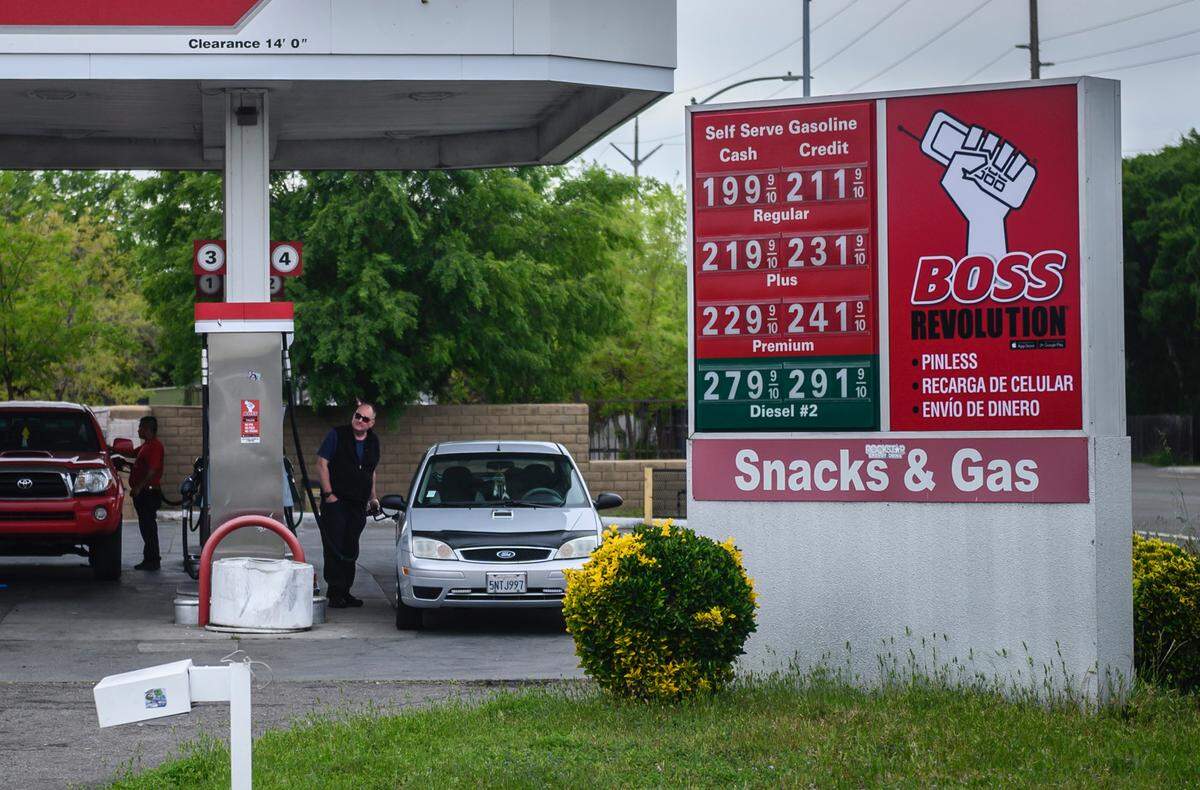
A negative futures price doesn’t mean drivers will get paid at the pump as they fill up, but it does reflect a decline in real-world pricing for consumers. Refineries still need to do their jobs and gas must be hauled to the pumps. AAA said the average price in California has dropped to $2.81 a gallon, down from $3.25 a month ago. In Sacramento, the average price is $2.67, down from $3.12 last month.
“Retail prices in California can get under $2 a gallon,” said Dave Hackett of Stillwater Associates, a petroleum consulting firm in Irvine.
Average gas prices in California haven’t dipped below $2 since the Great Recession.
Placerville letter to Newsom
Placerville city officials on Tuesday released a statement explaining a letter that will be sent to Gov. Gavin Newsom and state lawmakers regarding the effect the stay-at-home order is having on local businesses and residents.
In a 5-0 vote last week, the City Council authorized the city manager to draft a letter urging Newsom to strongly consider lifting the stay-at-home order earlier in Placerville sooner rather than later. The vice mayor in El Dorado County’s seat, who is recovering from a COVID-19 infection, says the coronavirus infection rate there is low and businesses need to reopen so the community can return to some normalcy.
“The purpose of such a letter would be to demonstrate the unique set of circumstances of our geography and point out the very low numbers of COVID-19 cases,” according to the written statement from the City Manager’s Office. “Ultimately, the letter could serve to provide a path to reopening our City in accordance with the order issued by the Governor of California and the Directive issued by El Dorado County Public Health Officer.”
As of Tuesday afternoon, there were 39 confirmed COVID-19 cases reported in El Dorado County with no deaths reported. Placerville has reported five COVID-19 cases; 15 cases in the El Dorado Hills area and 13 in the Lake Tahoe area. The county’s data indicated 34 people have recovered from COVID-19.
City officials also said in Tuesday’s statement that Placerville leaders have prioritized the community needs and will look to find “a balance of safety and economic recovery.” They added that Placerville desires a transitional opening as it looks to develop a phased plan within the state’s orders.
Placerville Vice Mayor Dennis Thomas said at last week’s City Council meeting that it’s “mind numbing” for business owners to not know when exactly the statewide order will be lifted, and that the town “can open with a measured approach.”
The City Manager’s Office said Placerville is different from densely populated areas, such as Sacramento, San Francisco and Los Angeles. So, standards for a transition to reopen should offer “flexibility that recognizes the inherent differences among California counties and cities,” officials said in the written statement.
Sacramento Valley farms struggle as restaurants close
Farms and wineries in the Sacramento Valley are suffering big losses during the coronavirus crisis. Sacramento’s once booming farm-to-fork scene is, at least through the COVID-19 crisis and possibly much longer, a fraction of what it once was. Restaurants California-wide have been forced for more than a month now to either transition to takeout or delivery service only, or to close entirely.
Small-scale farmers often can’t sell directly to supermarkets because their outputs fall short of what stores need and prices can’t compete with larger, streamlined agricultural producers, according to Certified Farmers’ Markets of Sacramento County coordinator Dan Best.
With restaurants needing less and distributors adjusting accordingly, many rely more on local farmers markets, which Best said have seen declining sales as well.
“What (farmers) actually need is to be able to have an outlet and a home for their goods. They can’t eat 25 acres of goods with their families,” Best said. “We’re dealing with perishables. A week later, you’re going to have nothing to sell. You can’t put it back on a shelf and wait for things to reopen.”
Workers compensation fund greatly expanded amid COVID-19
The State Compensation Insurance Fund, one of California’s largest workers’ compensation insurers, announced Monday it will greatly expand its benefits to employees at essential businesses, estimating it will spend more than quadruple what it announced last week that it would.
The agency says it will pay COVID-19 medical costs and income losses for workers regardless of whether they contracted the illness at work, which can be difficult if not impossible to prove in many cases.
State Fund officials said that with the added benefits, the agency will pay out a total of $115 million to assist essential workers. In addition to covering medical costs, they will also extend temporary disability benefits to any covered essential worker who must self-quarantine, according to a news release.
To get the benefits, workers must provide a confirmed positive test for COVID-19 for the period of time between the start of Newsom’s stay-at-home order and before the order is lifted, the agency says.
No fireworks in Davis this July 4, city says
The city of Davis on Monday announced, more than two months ahead of the holiday, that it has canceled this year’s Fourth of July celebration, including fireworks, due to the coronavirus pandemic.
City government and law enforcement leaders in a news release said the decision was made because while some elements of the statewide stay-at-home and Yolo County-wide “shelter in place” orders may be eased by July, it appears unlikely that large group gatherings will be able to resume.
“Unfortunately, Davis just doesn’t have a large enough space that allows the event to go on and still provide adequate protection for everyone to see the fireworks,” Davis Police Chief Darren Pytel said in a statement.
Pytel also suggested the city “may very well want to have a City-wide celebration” to mark the end of the COVID-19 crisis, whenever that may be.
Newsom has suggested that large group gatherings such as sporting events and music concerts are unlikely to come back any time this summer. Yolo County’s shelter-in-place is currently set to expire May 1, already an extension from its original April 7 end date.
Davis appears to be the first city in the greater Sacramento area to formally cancel its Fourth of July celebrations, though the current trajectory of the pandemic has cast considerable doubt for annual holiday festivities that frequently bring hundreds to central locations across Sacramento, El Dorado, Placer and Yolo counties to watch fireworks.
Latest Sacramento-area numbers: 53 dead, more than 1,270 cases
Sacramento County in a Tuesday morning update reported 16 new COVID-19 infections and one new death, with the fatality coming in Citrus Heights.
As of Tuesday morning, there have been a total of 1,272 lab-confirmed coronavirus cases and 53 COVID-19 deaths across Sacramento, El Dorado, Placer and Yolo counties.
Sacramento County now reports 35 deaths among 954 confirmed cases, last updated 10:45 a.m. Tuesday. Of the fatalities, 19 have come in the capital city, three in Elk Grove, three in Citrus Heights, one in Rancho Cordova and nine in unincorporated parts of the county, according to the county public health department website.
El Dorado County has reported 39 cases of COVID-19 so far with no deaths, last updated Tuesday afternoon, according to its public health department. There was one additional case reported since Monday in the El Dorado Hills area, bringing the total there to 15. There are 13 cases reported in the Lake Tahoe area, five in the greater Placerville area and the rest are scattered throughout the foothills.
Placer County reports 133 confirmed coronavirus cases and eight total COVID-19 deaths, last updated 10 a.m. Tuesday. No new cases or fatalities were reported between Sunday and Monday mornings, and just one case and no deaths were reported between Monday and Tuesday. More than 110 of the cases have come in South Placer, which includes Roseville, Rocklin and Lincoln, according to the county’s public health website.
Yolo County reported 146 cases and 10 fatalities as of Tuesday afternoon, including four new cases since Monday. Woodland accounts for about half of all confirmed cases at 74, followed by West Sacramento at 46, 16 in Davis and 10 in Winters and unincorporated Yolo County.
World numbers: More than 176,000 dead among 2.5 million cases
The worldwide COVID-19 infection total reached 2.56 million as of 5 p.m. Pacific time, according to the Johns Hopkins data map.
More than 823,000 reported cases have come in the United States, where over 44,000 of the 176,000 global deaths have come. New York state accounts for more than 258,000 lab-confirmed cases and over 19,000 deaths as of Tuesday evening.
New Jersey has exceeded 4,700 fatalities, Michigan is past 2,500 and several other states — California, Pennsylvania, Massachusetts, Illinois, Louisiana and Connecticut — have reported more than 1,000 deaths.
Worldwide, the U.S. is followed by Italy at 24,000 deaths, Spain at just over 21,000, France at more than 20,000, the United Kingdom at more than 17,000, Belgium at nearly 6,000 and Iran at nearly 5,300.
What is COVID-19? How is the coronavirus spread?
Coronavirus is spread through contact between people within 6 feet of each other, especially through coughing and sneezing that expels respiratory droplets that land in the mouths or noses of people nearby. The CDC says it’s possible to catch the disease COVID-19 by touching something that has the virus on it, and then touching your own face, “but this is not thought to be the main way the virus spreads.”
Symptoms of the virus that causes COVID-19 include fever, cough and shortness of breath, which may occur two days to two weeks after exposure. Most develop only mild symptoms, but some people develop more severe symptoms, including pneumonia, which can be fatal. The disease is especially dangerous to the elderly and others with weaker immune systems.
This story was originally published April 21, 2020 at 8:53 AM.