
Facing discipline after text message review, Northern California sergeant, captain retire

Facing discipline stemming from a yearlong investigation into a text message scandal, a Northern California police captain and sergeant have both retired from the Eureka Police Department.
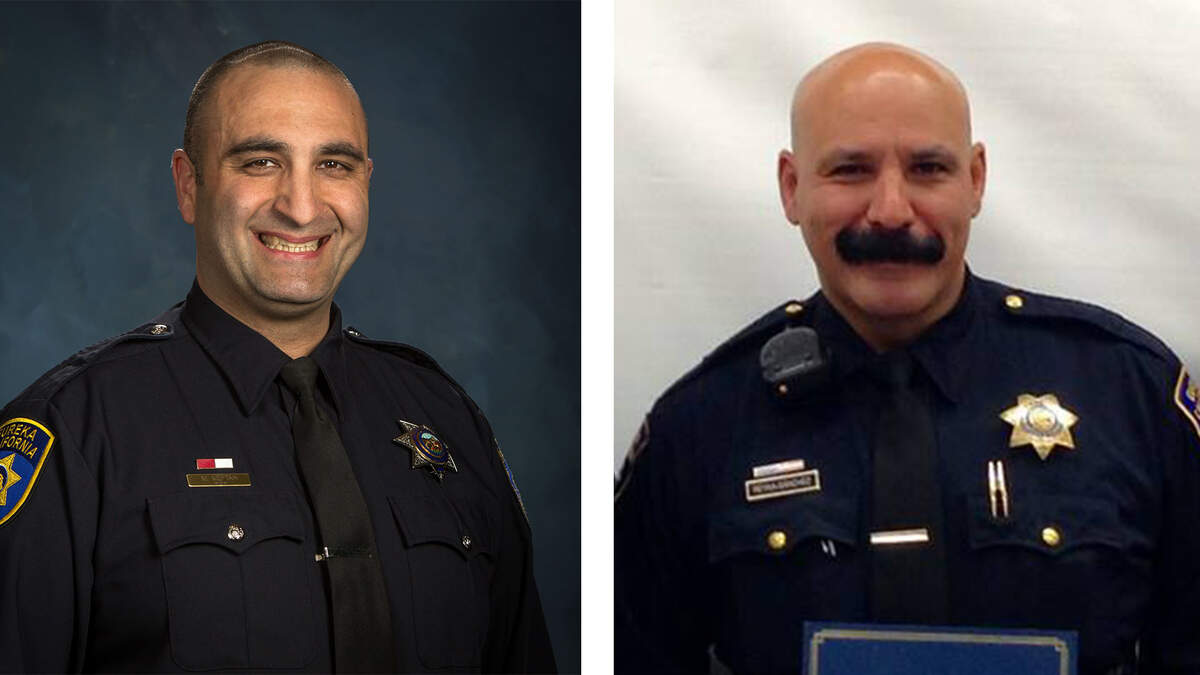
City officials on Monday announced Sgt. Rodrigo Reyna-Sanchez and Captain Patrick O’Neill left the department as of Friday. The retirements, combined with the departure of a third officer last year, largely brings to close a sprawling review of the vile text message banter and the lingering “old guard” culture that some have described as toxic and in need of overhaul.
“This investigation is over,” Miles Slattery, Eureka’s city manager, said in an interview Monday.
Though city officials have vowed transparency for more than a year since commissioning the third-party review, Slattery said California law and protections for municipal employees — especially police officers — significantly restrict what records and details from the report can be released.
That means the public will not immediately, and may never, learn the particulars of the costly investigation.
“I think that we clearly demonstrated through this process that we did the right thing,” Slattery said, stressing that he wished more could be made public. “While it was frustrating and not always in the best interest of the community, it was in the best interest of the city and the department to do it right.”
In the text messages, first reported in March 2021 by The Bee, Reyna-Sanchez and other officers, primarily Mark Meftah, likened homeless people to troglodytes and toads.
One message joked about corralling homeless people into a burning building. Other messages, which were sent while on-duty, included jokes about female colleagues and about putting mentally ill women in demeaning sexual situations.
There were also messages that bantered about roughing up protesters. One message from Reyna-Sanchez to his squad encouraged them to “face shoot” a suspect. (Reyna-Sanchez shot a man in the head at close range in 2010. That shooting was deemed justified.)
The messages were widely seen as more than just shop-talk among cops. Experts in policing said comments such as those — especially involving a supervisor — were indicative of broader problems with the department’s culture. Experts said it could affect how officers interact with the public and derail efforts in departments, such as Eureka, that have long struggled to earn the community’s trust.
“The text messages brought to light by the article and confirmed during the independent investigation were abhorrent and are not representative of the respect that members of EPD have for our citizenry,” Interim Police Chief Todd Jarvis said in a written statement Monday.
“These actions fly in the face of the extensive efforts that our team has taken to ensure we address every challenge with a clear focus on human dignity, professionalism, and respect for the individual.”
Former Chief Steve Watson put Reyna-Sanchez and Meftah on paid administrative leave hours after The Bee’s initial story was published.
O’Neill, who oversaw some level of day-to-day operations and was Renya-Sanchez’s superior, was put on leave in May. City officials were silent about his involvement, though Slattery on Monday said his leave stemmed from information gleaned during interviews with employees.
Reyna-Sanchez and O’Neill continued to get paid during their leaves, Slattery said. Online records show Reyna-Sanchez’s annual salary of $82,000 in 2020; O’Neill earned $108,000.
Records show the city paid $155,000 to a Bay Area consultant firm to look into the text message scandal and investigate any other cultural failures inside the department.
The firm, Sacks, Ricketts & Case LLP, submitted its report in mid-September. It’s been under review since. The city has also paid Sacramento-based law firm Liebert Cassidy Whitmore more than $92,000 to review the wide-ranging document and any other legal options, the city said.
Some of the investigation went on absent a key player.
Meftah parted ways with the department last summer and moved to Ohio. In a 1,550-word letter to a local blogger, Meftah belittled the investigation and criticized his department’s handling of the review. He said the city strung him along for six-months in an effort to force him to resign. Eureka, he said, was a “dismal place.”
Though city officials initially called for a quick and transparent investigation to hold people accountable, leaders, including Chief Watson, said they’d grown frustrated by how long the process was taking.
Watson recommended discipline against Reyna-Sanchez and O’Neill in the fall.
Watson, 50, retired Dec. 1. In an email to The Bee, he said his departure had “absolutely nothing” to do with the investigation that swirled for his final eight months on the job. “The last bastion of an old way and culture shared by a relative few is falling,” wrote Watson, who took over as chief four years earlier after a turbulent period for the North Coast department.
“We are a fundamentally different department than we were a few years ago when looked at as a whole organization,” Watson said, “which makes my deep disappointment in the actions of a very few that do not reflect the character of the great majority even more acute.”
The city plans to ask a newly established independent police auditor to do a top-to-bottom review of the investigation.
Experts say the dragged-out case in Eureka is the latest example of California’s special legal protections for law enforcement officers running up against the public’s right to know about those who abuse their power while wearing a badge. While changes to California law in recent years have opened up troves of police records, California law still exempts many types of misconduct files from public view.
“When you have a price tag that high, the public has a reasonable expectation that they’re going to see the product, they’re going to see what they paid for,” David Snyder, executive director of the First Amendment Coalition, a nonprofit that advocates for transparent government, said last month.
“I’m not sure that California law is going to allow that, at least not in full,” Snyder said. “And that’s too bad.”
This story was originally published March 29, 2022 at 5:00 AM.