
A Sacramento supervisor has a challenge from the left. Is he at risk this election?
From west to east, Sacramento County’s second supervisorial district paints a picture of stark contrasts and disparities.
On its western edge, manicured lawns and white-picket fences line the leafy Pocket/Greenhaven neighborhood. Heading eastward, toward blue-collar and historically Black and brown communities, strip malls and dangerous intersections dot the landscape.
In the race for District 2, Supervisor Patrick Kennedy is looking to fend off challenger Duke Cooney to earn a third-term on the Board of Supervisors representing the diverse district. The race will be decided in the June 7 election.
Kennedy, 54, handily beat previous competitors, garnering more than five times the votes of his opponent when he was first elected in 2014 and cruising to reelection in 2018.
This cycle, too, Kennedy, well-funded and some key endorsements in hand, appears poised to emerge victorious.
He says he has unfinished business, like a 911 alternative for people experiencing mental health issues that’s supposed to go live this summer and a community review commission providing Sheriff’s Office oversight that has recently been seated.
“I’m proud of a lot of the things that I’ve accomplished, but a lot of them – you know, everything happens so slowly in government – a lot of them still need to be taken over the finish line,” Kennedy said in an interview.
But some in the district are looking for change. And Cooney – a 29-year-old political newcomer and public policy associate with a Sacramento-based consulting firm – is determined to put up a fight.
He knew he wasn’t going to be able to raise as much money as Kennedy, but he put up about $7,400 of his own money “just to be competitive.” For the most part, he’s relied on knocking on doors, calling people and going to every community event he can find.
“Just figuring out what the issues are and what people want to see, what’s been missing all these years,” Cooney said in an interview.
How they’d address homelessness
Both Kennedy and Cooney consider homelessness one of the biggest issues facing their district and the rest of the county.
Kennedy’s efforts to tackle the growing crisis were recently dealt a setback when the board decided to put off a vote on a proposed tiny home community for unhoused residents in his district.
The county needs more drug, alcohol and mental health programs, specifically residential programs, Kennedy said. He plans to find more money for those in the county budget but also wants to go after state funding.
A city of Sacramento ballot measure, going before voters in November, would – if passed – require the city to provide shelter beds for 60% of its homeless population or face lawsuits.
Kennedy said he plans to bring forward a similar measure for the county. The goal is to closely match the city’s proposal.
To Kennedy, addressing homelessness is a “balancing act.” The county, he said, has to “look harder at protecting” its open spaces, pointing to homeless camps along the American River Parkway and fires that some say are connected to them.
“I don’t think that homelessness should be criminalized, but at the same time, there have to be consequences,” he said.
To Cooney, the county – instead of getting stuck with “stopgap solutions” – needs to develop a regional plan to tackle its homelessness crisis.
“We sort of have this hodgepodge effort of initiatives,” he said. “Like the county is saying, ‘Oh, we’re gonna build 100 tiny homes.’ Well, that’s great, but when we have tens of thousands of people on the street, that’s just a showpony.”
In south Sacramento, the farther you get down Florin Road, the more homeless people you see sleeping on the cement or at bus stops, Cooney said. The area isn’t equipped with services to help them.
“We really need a support network where the county pays their fair share,” he said.
Cooney wants the county to approach homelessness from a public health crisis perspective, much in the same way the coronavirus pandemic was addressed – with “sweeping policy change” and “meaningful budget allocations to deal with the problem as if it’s an emergency.”
He wants to bring homelessness advocates to the table right away. He said he has heard from them that a lot of their requests for help have fallen on “deaf ears” so far.
Homeless residents should also be involved in those conversations, Cooney said. They deserve public health resources, including mobile shower systems, hand washing stations and access to food and clothes.
Cooney wants to leave legacy for his daughter
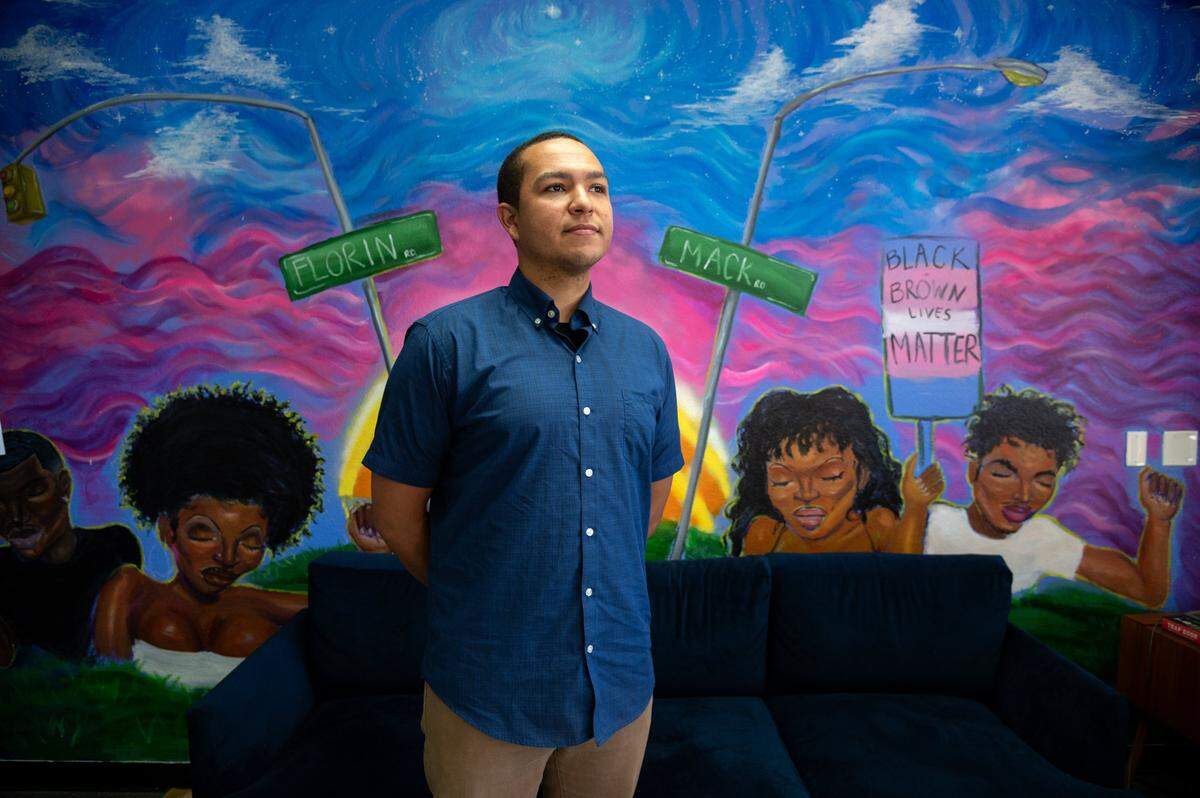
Cooney lives in south Sacramento with his partner, Nathan, and their 3-year-old daughter, Isadora. As a person of color, he said his lived experiences allow him to tap into solutions that others can’t.
His generation has “inherited a lot of messes,” Cooney said, from a homelessness crisis to unstable housing markets and jobs that don’t pay a livable wage.
“But I don’t want to leave that sort of legacy for her,” he said, referring to his daughter.
Among his top issues: environmental protection. District 2, he said, is a transit district, where major thoroughfares and highways bombard the community with trucks, cars and pollution. The residents are left to deal with the long-term impacts, including health issues, Cooney said.
He wants not only more environmental impact studies but also air monitors, new parks, trails, accessible walkways and sidewalks.
With his campaigning style, Cooney has quickly made his presence felt in the district.
“I’ve literally seen Duke at big events, small events, events in the community I had no idea he even knew about,” community activist Berry Accius said. “And that speaks volumes.”
Kennedy wants to boost housing production
Before he was elected to the Board of Supervisors in 2014, Kennedy, a fourth generation Sacramentan who grew up in District 2, served on the Sacramento City Unified School District Board of Education. He and his wife Judy raised their four daughters in Hollywood Park and now live in the Pocket/Greenhaven neighborhood.
If reelected, he wants to continue to work on affordable housing projects. With a shortage of multi-family homes in the county, Kennedy wants to identify and remove barriers that may impede housing production.
“Are our fees too high?” he said. “Is it too cumbersome of a process to go through the planning and building process? If so, then we need to really look at that and be introspective.”
Kennedy garnered a number of endorsements from elected officials, unions and other organizations, including the Democratic Party of Sacramento County. The supervisor race is non-partisan but both Kennedy and Cooney are Democrats.
Though it was a “tough decision,” considering the organization sees Cooney “as basically the future of politics,” Kennedy’s record on homelessness efforts put him over the top, said county Democratic Party Chairwoman Tracie Stafford,
“Patrick Kennedy is the only supervisor who has a plan for unhoused communities,” she said.
This story was originally published May 9, 2022 at 5:25 AM.