
Jim Cooper says he’ll work as Sacramento sheriff to toughen up laws, forge partnerships
Jim Cooper knows something about gangs.
“Thirty years in the sheriff’s department, 10 years narcotics and gangs, I worked undercover for five years buying drugs, illicit drugs from a lot of gang members,” the Sacramento sheriff’s candidate said in an interview days after the April 3 gang shootout downtown left six people dead and 12 others wounded.
“They should have been in jail, grown men and gang members,” Cooper said of the men arrested so far in connection with the 2 a.m. shootout, all of whom have criminal records and are prohibited from having firearms because of their convictions. “And part of the problem is Prop. 57.
“When Prop. 57 was proposed to the voters, it was for violent offenses. The problem is, non-violent offenses in California are drugging and raping a woman, domestic violence, human trafficking of a child, raping someone who’s developmentally disabled, hate crimes.”
Prop. 57, passed overwhelmingly by voters in 2016, allowed inmates classified as having been convicted of nonviolent crimes to receive more credits for good behavior and win parole faster, part of California’s years-long effort to reduce its prison population.
But critics say the measure classified crimes such as domestic violence and others as “non-violent” and have led to the release of thousands of inmates who should have spent more time in prison.
Cooper, who is making his second bid to be elected sheriff, says he’s been trying for years to toughen up such measures that have reduced penalties for some non-violent crimes and led to short jail and prison stays after an arrest.
He is banking on that experience, his record in the sheriff’s office and eight years in the state Assembly to get him to the job he first sought in 2010, when he lost a close race to outgoing Sheriff Scott Jones.
Cooper, who would be Sacramento’s first Black sheriff if he wins his race against Undersheriff Jim Barnes, has a decided advantage in name recognition and fundraising, with a cash balance at the end of 2021 of nearly $600,000, compared to $224,000 for Barnes.
And he is fashioning himself as a candidate who wants to toughen up crime laws that have been the subject of voter-approved reforms in recent years.
“Some of the laws that have passed recently in the past four or five or six years have given an aura of no accountability,” Cooper said. “These folks know they won’t get in trouble. If you get arrested, you’re going to be out right away.
“And that’s been the big issue they have. They have no fear basically. So everybody carries guns these days, and they’re buying them everywhere.”
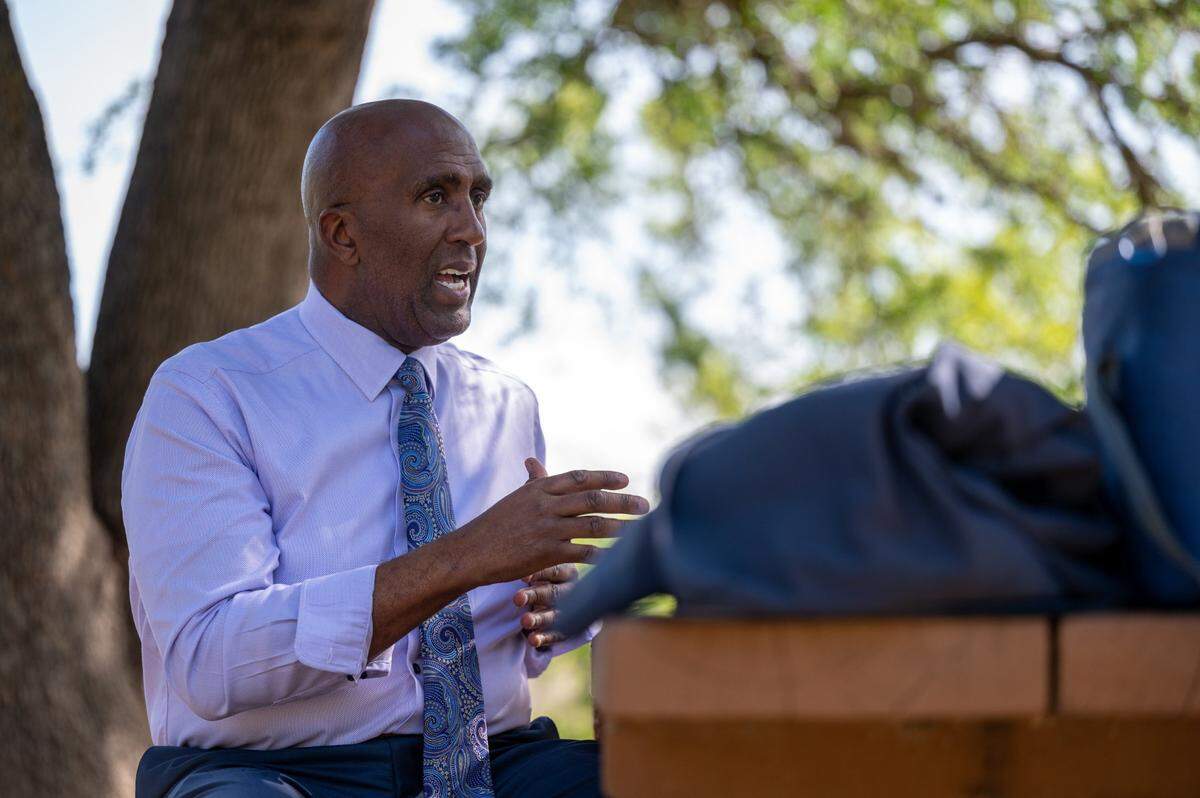
Democrat pushed for sentencing changes
Cooper noted that he pushed hard in 2020 for Proposition 20, which would have made firearm theft and some other crimes felonies rather than misdemeanors, and would have classified convictions for crimes such as domestic violence as violent crimes that would have excluded them from Proposition 57’s non-violent offender parole program.
One of the suspects in the April 3 shootout, Smiley Martin, was released in February after serving about half of his 10-year sentence for domestic violence and assault on a girlfriend he beat with his fist and a belt, but Cooper says Martin would still be in prison if his Proposition 20 had passed.
“Think about that,” Cooper said. “He’d have been in jail for that if it was a violent crime in California.”
Cooper argues that in the current climate, voters would jump to pass Proposition 20.
“I’d argue that if it was on the ballot this year it would pass overwhelmingly,” he said in an interview along the American River, where he had just come from a news conference announcing a bill to remove homeless camps from the parkway.
Record on sanctuary law
Cooper’s opponent scoffed at the notion that Cooper could reform laws as sheriff, saying he had ample opportunity in the Assembly and blaming him for California’s so-called sanctuary law, which was signed into law in 2017. Cooper voted for the law, which prevents local law enforcement from helping immigration agents detain immigrants.
Barnes’ campaign connected the sanctuary law to the Feb. 28 church shooting in Sacramento in which a gunman named David Mora killed his three young daughters and a man inside an Arden-area church before killing himself.
Mora was in the United States illegally and was being held earlier in a Merced County Jail after he allegedly assaulted a California Highway Patrol officer. He was released despite a request by federal immigration officials that they be notified before he was let out.
Cooper “co-authored that,” Barnes said, referring to the sanctuary law. “When you have a homicide suspect or violent criminal who has the same protection as a low-level offender, that’s a problem.”
Cooper said Barnes is wrong, that he pushed to reform a flawed bill that most law enforcement initially opposed and that he has been active in forging compromise, while Jones and Barnes have not bothered to weigh in on legislation.
“When that bill first came out, everyone opposed it, all the D.A.’s in California, the state sheriffs, the police chiefs, every law enforcement union,” Cooper said. “I forced amendments on that bill and changed that bill.
“When the final bill came out, only two organizations that were opposed to it. So that’s what made the difference, being involved, being engaged. The problem is in my eight years there, they’ve never testified down and they’ve never come to one hearing on some of the most important legislation California’s had.”
Barnes also has criticized Cooper as someone whose law enforcement experience is out of date, while Cooper responds that Barnes is simply an extension of Jones’ three terms as sheriff.
Contesting Scott Jones’ record
Cooper noted that Jones forced the ouster of Inspector General Rick Braziel after Braziel, a former Sacramento police chief, in 2018 authored a report critical of an officer-involved shooting, something Cooper said was an avoidable confrontation.
“I’ve lived in Sacramento my whole life,” Cooper said. “We need change. You’ve seen the rhetoric, the inspector general being kicked out. You don’t do that...
“You can disagree with Rick Braziel, but still have a conversation, sit down and talk to him. Don’t lock him out, because that just doesn’t do anybody any good. And people want transparency. They want body cameras here. The (Sheriff’s Office) is the last big agency in Sacramento to get body cameras.”
Cooper pointed to the support he has garnered from law enforcement groups and area leaders, including Sacramento County District Attorney Anne Marie Schubert and Sacramento Mayor Darrell Steinberg, and proudly touts his reputation as “the cop in the Capitol.”
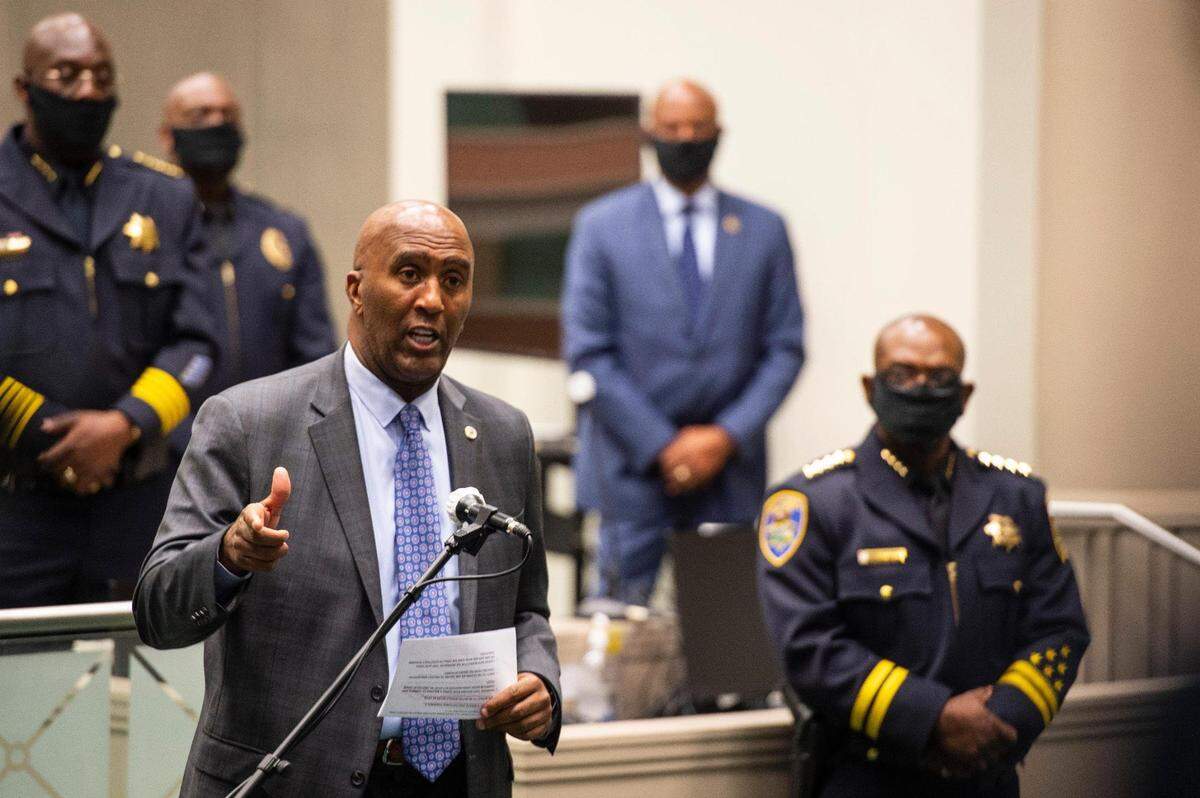
And he said he’s willing to make tough decisions to deal with the region’s growing homeless population, advocating for a return to conservatorships for some mentally ill people.
“We’ve got to have a conservatorship for some of these folks,” Cooper said. “They’re downtown walking around with no clothes on, it’s freezing outside, they’re eating out of a trash can.
“It has to change, and these advocates, the ACLU specifically, would rather have them have their freedom than for someone to be the adult in the room. The law has to be changed for conservatorships. You have more people that are worried about their credentials, their progressive credentials, than being the adult and making the hard decisions.
“It’s a hard decision to take someone’s freedom, but I would argue they’d be better off if they are someplace being taken care of or getting food medicine, because the jails can’t be your mental health wards.”
With all of his experience in local politics, Cooper is better known than Barnes, who is making his first run for countywide elected office, and Cooper is expected to be able to outspend Barnes in the race that will be decided in June.
But Cooper was the better known and better-funded candidate in 2010, as well, and still lost. Now, he said, he’s taking no chances.
“I don’t take anything for granted,” Cooper said.
This story was originally published May 8, 2022 at 5:00 AM.